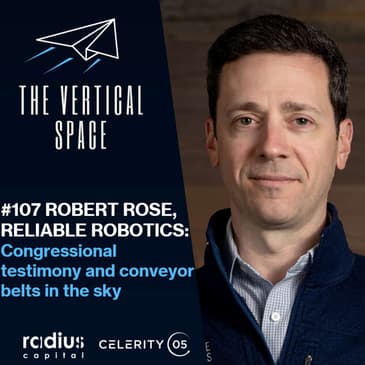
In this episode we reconnect with Robert Rose, CEO of Reliable Robotics, fresh off his testimony before Congress on the state of advanced air mobility. Robert shares what most people misunderstand about FAA certification, i.e. that the regulator isn't there to coach you through it, they're just calling balls and strikes. We explore why Reliable has spent eight years building autonomous systems within existing regulations rather than waiting for new rules, how they've convinced the FAA that zero-visibility automated landing standards can scale from wide-body jets down to Cessna Caravans, and why the "cargo first" narrative that dominates autonomy discussions is largely a regulatory myth.
We also dig into Reliable's new Pentagon contract to deploy autonomous cargo aircraft for contested logistics in the Indo-Pacific, what the military calls building "conveyor belts in the sky." Robert explains why military logistics actually demands commercial-grade safety in ways most people don't appreciate, how their solid-state radar technology became an unexpected multibillion-dollar opportunity for existing airlines, and what changed at the FAA after years of low morale and congressional scrutiny. It's a grounded, technically rigorous conversation about what it actually takes to certify autonomy, why operational risk assessments don't work for aircraft above a certain weight class, and how Reliable is grinding through hundreds of compliance submissions to prove that autonomy isn't some distant dream but it's ready now.
04:01 What Actually Makes Certification Hard: Legal Basis, Compliance Plan, Execution
06:33 Testifying Before Congress: FAA Reauthorization, Morale, and What’s Improving
18:40 Why Reliable is a different kind of company
26:41 Reliable's regulatory strategy
34:08 Update on the autonomous Caravan project and contested logistics
37:22 Conveyor Belt in the Sky
39:10 Military Logistics Still Needs Civil-Level Safety
46:44 SkyGrid sponsor segment
49:35 Update on Reliable Robotics and the industry
54:15 Cargo-First Mythbusting
01:01:22 Scaling Autonomy: Certification Tooling, Digital Flight Rules & Closing Thoughts
Robert: 0:00
The Air Force really likes using commercial technology because then they don't have to dig into things at any level of depth. They can rely on civilian certification. This was part of the promise of the 767 and the KC-46, for example. And there's other examples of commercial aircraft where they're relying on much of the safety analysis from the civilian world and taking credit for that in the military domain.
Jim: 0:34
Hey everyone. Welcome back to The Vertical Space. Today we're joined by Robert Rose, co-founder and CEO of Reliable Robotics. Robert recently testified before the House Committee on Transportation and Infrastructure Subcommittee on Aviation at a hearing titled America Builds the state of the advanced air mobility industry, we happen to see that testimony and we thought he was terrific. So we thought we'd have him join us to, talk about and expand on that testimony, share his perspective on where Advanced Air Mobility industry stands today, and give us an update on what's happening at Reliable Robotics. I'm sure you will enjoy our talk with Robert. Robert Rose, how great to have you back in The Vertical Space. Welcome again.
Robert: 1:16
It's an absolute honor to be back. Thank you very much for the opportunity.
Jim: 1:19
so we've asked you this before. Is there anything that very few in the industry agree with you on?
Robert: 1:25
I was just talking with someone this morning about certification processes and how these systems are constructed and there's a misconception that I've encountered repeatedly that, about how certification works and there's this sense that for advanced automation, safety enhancing technologies, autonomy to be certified, we need to wait for the regulator to figure this out. We need to wait for the FAA and that's just not the way in my view, the system works and I was telling them that the FAA is like an umpire at a baseball game. I used to coach Little League a few years ago. We were just talking about kids earlier. And the umpire doesn't give you any coaching advice that all they do is call balls and strikes. So you can do your best out there, but they're not gonna help you actually play the game. And so if you develop a new technology, you can't just show it to the FAA and say, Hey, what is it you need to see? They're just gonna say, is it safe or is it not safe? And when the game changes, when you're talking about new technology, that's never been put into the airspace before. And I think the example here is, if you wanna, if you want the umpire to call safe or out at first base, they might say, that's the line umpire's responsibility. we don't, that's not my job then it's still your job as the applicant to explain to them why they can do this legally. Why can they make that call? And this is something I've encountered repeatedly, all across the industry. There's, there seems to be this lack of understanding as to how this process actually works.
Luka: 3:01
and Robert, this holds as long as the rules are constant. Right, but are the rules changing?
Robert: 3:08
The regulations don't change very often. It takes a very long time to modify them. How long did Mosaic take? being a recent example. And they don't change really the fundamentals of the process. I mean, even Mosaic is as extensive as it is. I think you could say that this, it's a lot of relatively small changes that sum up to a set of large changes or a large change. but the fundamentals of safety and how we assure systems actually work in the airspace is not changing that much.
Luka: 3:39
yeah, it's interesting and what I'm also reading between the lines is that certification as a formal quote process is not necessarily the bottleneck that people think it is, but rather the substantial work that's required to make certification possible. and I do agree, many in the industry often say that certification is the long pole. In your experience, what's the hardest work that has to happen before certification can even really begin?
Robert: 4:08
Hey, you break down what certification actually is. It's, I guess it's two or maybe three, three phases. the first is establishing the legal basis for the certification activity. what, what gives the regulator the authority to engage in this process in the first place? And for technology that's been certified before, that's. Relatively straightforward. you can pull guidance off the shelf, you can take publish guidance from the FAA, but if it's a new technology, then you have to go through that process. And then once you have the legal basis established, then you have to decide, well, what are the processes or how do you demonstrate that you're complying, with a certification to the regulator? And that's an extensive activity. And then the third phase is you just actually do it. So you run through and you show compliance. And I think where people get tripped up in way where we say like, oh, certification is this big, big ordeal. It's because in most other industries, you're only doing the third step. you're just, you're building a thing and then you're testing it, and then you're calling it good. You're essentially self certifying. So you're not first thinking critically about the legal basis for the equipment. Or thinking in advance, like, well, how are we gonna demonstrate compliance? Because you're developing a technology at the same time you're developing your test cases. trying to think of an analogy for software engineering, but I think that might send me down a long rabbit hole.
Luka: 5:31
Okay. So back to the sports analogy. in other industries where you're saying people only need to do step three, that's analogous to just the referee calling, balls or strikes. But in this world that we're talking about, you also have to convince the referee that. Your interpretation of the rules is also valid. So,
Robert: 5:54
And you also have to explain, to the regulator how they're supposed to do their job. In the umpire example, then you would say, all right, let's agree upfront on what the strike box is. I.
Luka: 6:03
which makes it a little bit more complex
Jim: 6:05
what's the strike zone
Luka: 6:07
yeah.
Jim: 6:08
and the most controversial part of what you're saying, how would some people take exception? Are you just providing a interesting perspective on the regulatory process with advanced air mobility, or are you presenting something that's controversial?
Robert: 6:23
maybe it's not that controversial. I guess this is something that's top of mind, because I encounter it quite often. it's a message that I want to get out there more.
Jim: 6:31
Very good. Yeah. Yeah. Very good. you recently, Robert, spoke before Congress and it was a, it was a terrific, articulation of your perspective.
Robert: 6:43
thank you. I was incredibly nervous. I was totally unprepared for how nerve wracking that would be.
Jim: 6:49
you were common, cool. why were you there and give us a couple of the highlights of your.
Robert: 6:55
Yeah. I guess the background here, so we went through this process over the last several years with the FAA 2024 Reauthorization Act, and this was one of the most significant, reauthorizations of the FAA. a generation, maybe multiple generations. very extensive piece of legislation. and this was spearheaded by the House Transportation and Infrastructure Aviation Subcommittee, which was the subcommittee that I was presenting to. So I was working with members of this committee, for several years on the FAA reauthorization. and, but when I say working with them, let me elaborate. our team has been working with the FAA on this certification project going back to 2017, and we have learned some things and we have formed some opinions about what works really well with the FAA and what could be improved. And some of the things to improve the fas, how they function, requires support and, monetary support and direction from Congress. because a lot of what the FAA does goes back to law, that Congress has passed and, Congress over the years has had tremendous input directly through law, but then also through public inquiry and private inquiry as to how the FAA functions. So that all has built up to have the FAA that we have today. And we've learned some things about how we viewed that should be adjusted. Tweaked or tuned around the edges. And so we influence the creation of that law. I was asked to testify basically to provide a status update on how that law is being implemented and are we seeing positive changes as a result of this law, and does Congress need to take additional action in the form of legislation or in the form of congressional inquiry? the gist of my, testimony, I hope this came across was things are going pretty dang well. Like, the legislation has moved the fa very positively and what I think is a good direction. I think you'd say the FAA went through a bit of a dark time, over the last several years, especially given, some of the aviation accidents that we've had and that has resulted, the reason it's been a dark time partly is that's resulted in members of Congress, pushing on the FAA in certain ways that, some have been positive, some have been disruptive, not an opinion. I'm just stating a fact. And I've heard from folks that work in the FAA that, they've gone through a difficult time over the years. morale was quite low several years ago. but they're on the uptrend now. And, the attention from Congress, especially through the FAA reauthorization Act. And then more recently, the passing of the legislation around a TC modernization and funding. Many of these activities that the FAA has, been seeking funding for many years has done wonders, I think, to improve morale within the agency, but also to like in a very, how do I say this, tactical near term way, make folks in the FAA more productive and increase their ability to, make decisions and expedite decision making processes. So what we've noticed here over the last year and a half, eh, I call it two years, has been an acceleration in a lot of challenging work in the form of. Issue papers moving forward, standards moving forward through the process. It's all been very good. That's, I don't mean to, I'm not saying it's all perfect. It's not a panacea. There's still a lot of work that needs to be done. It can always be faster. but what I was trying to highlight in the testimony is like the House, TNI Committee, aviation subcommittee, I think has been a very positive force, in recent years and encouraging them to continue on that trajectory.
Jim: 10:42
Why do you think you Beta and wisk were, speaking?
Robert: 10:47
I think the reason we're called, well, I know Kyle and his team at Beta, and the WISC team too have also been involved in FAA reauthorization. we see them at many of the same events and. Crossed paths, in Congress and have coordinated on. I wouldn't say we've directly coordinated on legislation, we exchange notes. so I think that was part of it. I think the other reason the committee has these sorts of meetings is to highlight American innovation and to give a platform to projects that are important to us, national interests, whether they be economic or national security, which was another point I was trying to make in my testimony.
Luka: 11:31
Other than providing feedback to the legislation. Would you say, what was some other motivation behind your testimony? Was it more aimed at unlocking funding or regulatory clarity, or just overall institutional confidence?
Robert: 11:47
My approach to a meeting like that, I guess I'll say it publicly, is you don't go into a meeting like that with an ask. That's, I think that's in poor form. The ask is made outside the meeting. so in, in that meeting, I was trying to highlight what's working really well, behind closed doors. I'm a little more direct, with members about what I think we should be focused on next and behind closed doors with the FAAI am a little more direct on what I think they should be doing in terms of next steps. we usually always have some kind of ask when we're talking with those folks. I will say like the size of the ask has really decreased over the years because things are moving in the right direction and it's really more around subtle adjustments around the edges. one thing I tried to highlight in the follow-up, conversation in that, in the testimony, it wasn't in my initial thing, but, the FAA has been a great partner in moving forward, the detect and avoid standards that we've been working on. the background here is RTCA, through special committee 2, 2, 8, many years ago, published standards for Detect and Avoid and that utilize Radar and the fas, acas X algorithms. and the initial draft of these standards were really intended for operations in Class Alpha over 18,000 feet and at very high speed in. Encounter closure rates, for an aircraft like what we're working on, certifying first on the Cessna Caravan, those standards were kinda overkill. It was a bit too much for an aircraft the size of the caravan where you're not, you're never gonna go over 250 knots in class echo, and you've got encounter speeds and maximum velocities of 500 knots. So you don't need quite the energy and you don't need quite the, well, the reaction times are the same, but the velocities are a lot lower. And so this could drive a different technological solution. And so we worked with RTCA on, incrementing or enhancing that standard to accommodate smaller vehicles below 18,000 feet. And getting back to the FAA where things have been trending very positive for us recently, as the FAA has engaged with us on the adoption of. This new iteration of DO 365 and DO 360 6. and they, it was around the same time, actually, I think it was during the testimony. they released the changes to these, TSOs technical standard orders to the public. released it for public comment. And I'm told the back channel is, it's about to be released here any moment. Of course, any moment. Air quotes for the FAA means one to end months,
Luka: 14:27
Yes. And being usually greater than 18.
Robert: 14:30
I think this one's gonna be done really soon. And so I was trying to highlight that this is an area where the fas really, they're working on the right things and they're getting it done pretty fast.
Luka: 14:39
If nothing changes as a result of this hearing, what do you think breaks first? Is it the timelines? Is it capital, public trust, something else?
Robert: 14:48
Can you be more specific?
Luka: 14:50
specifically given the objectives of the testimony. And the recommendations. there, there's a, there's an implied assumption that Congress embraces some of this feedback, and then, does with it what everybody on the panel thinks they should do with it. If nothing happens, then, what's the trajectory that we're on and what does that lead to in terms of, the scale out of the industry and therefore, what then becomes the bottleneck? What breaks first, do we run out of capital? Does, the public trust kind of evaporate? what do you think is the bear case for, if nothing changes as a result of this testimony?
Robert: 15:31
So what I was trying to do there was, emphasize again what was working well. the changes that we're asking for at this stage are actually much longer term and don't really impact anything reliable is doing in the near term. So we've actually, Brandon Suarez was on your podcast recently and discussed digital flight and other future enhancements to the nas. And so what we've been also working with members of Congress and the FAA on behind the scenes are pushing these standards forward so that the reliable robotics and others of 2035 and 2040 can achieve much. Higher degrees of success. because as we've pushed more of these safety enhancing technologies and more advanced automation into the cockpit, we're gonna drive traffic densities up and we're gonna start to ask questions about, controller workload and other limitations, related to airspace congestion and surface congestion as well. and so we're trying to get the industry, the FA, a Congress to start thinking in that domain. Going back to the near term, we've got what we need from the FAA. So, we have the certification plans means of compliance done. We've got the issue papers closed, we have the project plans approved. Reliable robotics For the caravan project is in an execution mode. Right now we are racing to deliver the hard evidence that we comply with the standards that we've agreed to with the FAA. And so the potential negative outcome here would be reliable robotics fails to execute and why would we fail to execute? Probably'cause we didn't hire enough people to get this thing over the finish line. it sounds trivial here, but one example might be, I don't know if there's hardware, environmental qualifications that need to occur for certain components. And as much as you would like, you can't just, you can't throw bodies at some of these tests. It just takes time. but there's a lot of them. And, a lot of my focus internally, within the company has been tracking our execution on these projects. But we've done this before. We know how to do it. I've done this previously in my career at other companies. We have a lot of other people here that have done it before. and so it's really just about grinding out all of this test evidence at this point. So I don't see, at least for Reliable Robotics, a scenario where the FAA moves too slow. I'm not worried about that because at this stage, everything we're submitting, all the FAA is doing is just cross checking to make sure that the evidence we're submitting lines up with the plan that was agreed to previously. And as long as they line up, then they accept it. And so we've already submitted a bunch of these like final design data submissions to the FAA. They've accepted them. Okay. Problem is there's hundreds of them and we need to grind through them.
Luka: 18:40
Right. when Congress is asking how is a a m doing, do you get a sense that they are lumping EV tolls and autonomous aircraft and drones into a single a EM bucket? and. I wonder what the implications are because clearly those categories differ radically in their certification basis and their capital intensity and, operational risk profiles. And so on the one hand, using the a a umbrella might help the industry gain momentum for all of those participants, but at the same time, it potentially can hurt by collapsing very different, risk profiles into a single narrative. How did you read that dynamic?
Jim: 19:22
It's a great question.
Robert: 19:23
Yeah. Where do I start with this? I'll try not to get too emotional,'cause this does get close to striking a nerve with me.
Luka: 19:29
Just open up, Robert. Just let it go.
Robert: 19:32
I was just like, let go. All right. So Reliable Robotics is a bit of a different business and we're a bit of a different technology project from everybody else. There's not really anyone else that's tackling this problem.
Jim: 19:50
What's the closest comp to you?
Robert: 19:52
I don't know. I am not aware of anyone else that is focused on how to certify safety enhancing components that ultimately lead to a pilot not needing to be in the cockpit anymore.
Jim: 20:05
All right. Let's get back to the anger then.
Robert: 20:07
And then so the frustration, it's not quite angry yet, but the frustration is, we don't. There, there's not a collection of companies really to lump us with other than other people that are doing new things in the sky. And they're building vehicles, so let's call lab robotics, advanced air mobility, when really, I don't know if I had to lump us, I would say we're more, we're a lot closer to a traditional avionics company, that is just continuing on this trajectory of improving safety. It's just we have a different ultimate end goal. And so the technology projects that we've chosen to take on along the way are a little bit different.
Jim: 20:51
But do you
Robert: 20:51
a startup too, we also get lumped into a m
Jim: 20:55
to, to Lucas's question, do you sense that Congress lumps it all together?
Robert: 20:59
no. well. Congress has a single unit. Sure. But, I would say there are a number of very enlightened members that understand the difference. it does take time. It's taken time to educate them because yeah, when you walk in fresh, they see a a m and they immediately think, oh, you're that company that's working on that electric airplane. no. sir, it's a Cessna Caravan. It burns Jeff Fuel, but it doesn't have a pilot on board. They go, what? And then you have to explain to them what the Cessna Caravan is and the cargo mission and how it's more about serving, regional communities than urban communities. and usually after you spend four or five minutes explaining the difference, people go, oh, this makes a lot of sense. Yeah, this makes a lot of sense. Why haven't I heard of this before?
Jim: 21:44
So to that end, you're more closely associated with Whisk than you would be a Beta in some way. And you made a comment where autonomy is ready now. Talk about what's ready now.
Robert: 21:56
well, let me break down some differences. So, whisk, let me first say mad respect for everyone else in the industry. I'm not trying to knock on anybody here, but they're tackling a very different problem, not just from the vehicle. I mean, there's kind of the outsider perspective. it's electric, it's Vertical takeoff and landing. It's a different mission set. It's in an urban environment, whereas. We burning jet fuel. It's a fixed wing platform. We're flying out in regional areas, we're flying cargo and not people, but it's actually more complex when you dig in operationally. whisk has more in common with a helicopter, than an airplane, obviously. And a lot of what we're pursuing in our regulatory strategy at Reliable is around precedents. doing things that are small adaptations of stuff that the FAA has already done previously. Simple example with Whisk. you take helicopters, there is very little precedence. IFR operation of a helicopter is a thing. Like that's a really big deal. it's not that common. IFR operation of a helicopter all the way to the surface in zero visibility, total whiteout conditions is. Exceptionally rare outside of the military. And there's a lot that needs to be developed with the FAA. Like, forget about electrification, forget about distributed electric propulsion. Forget about urban environment. Just doing zero visibility, white out landing with a helicopter. that's a big deal. And then doing that in a fully automated sense is another big deal. there's not really precedence for that. So with reliable, we're a fixed wing airplane landing on a runway, and there is precedence for doing zero visibility landing. It's cat three B, CAT three C, or now just cat three B in the us. So we can take those standards. there's already minimum operational performance standards published for how to do that. Or excuse me, there's an advisory circular that the FAA published that goes into excruciating details to how you build airborne components. That can comply with cat threes, cat three B, and there's a lot of precedence for how you certify an operator to perform a CAT three B auto landing. So we come along with a caravan. Yeah, it's a part 23 aircraft, but we can pull from the part 25 standards and yeah, it's a part 1 35 operation, but we can pull from the part 1 21 standards. And so it's not really that big of a stretch. It's really, it's just, eh, it's an inch above what you've already done previously. And so it doesn't require this like massive, we're not boiling the ocean. There's not like a million problems that all need to be solved. We can bring this down into a very tangible set. So to get back to your point, like autonomy is solved, like from. The technology side, like we know how to do this, the military knows how to do. I mean, with auto landing, we're already doing commercial auto lands, so that's a quote solve problem. And then from a regulatory standpoint, I would say reliable has solved it. Like we have worked with the FAA for the last eight years. On defining specifically how you take those large aircraft standards and pull them down to small vehicles and then extend it into other domains. So our approval with the FAA to do automated takeoff, it sounds a little flippant, but it's kind of just the reverse of the auto takeoff. Like we're pulling a lot from those standards. Instead of flying an approach, we fly a standard instrument departure procedure and all the same performance requirements, kind of, sort of mostly work in reverse. There's a few adjustments around the edges. And then we took that a step further and pushed it into automated taxi standards and used a lot of the same, performance navigation, system performance and navigation integrity requirements for landing. We're just using those on the surface as well. And there's a few things we made up like. Fa didn't have a standard for how closely you need to track the taxiway yellow line. But, we came up with one and then came up with an integrity, metric for that based on auto land and part 25 precedent. So it's not, it doesn't require this big radical leap of faith,
Jim: 25:57
How about on the autonomous side?
Robert: 25:59
Well, it's, it that's all related. I mean, all those technologies that I just described work, if you have a pilot in the cockpit or you don't have the pilot in the cockpit,'cause we're assuming zero visibility whiteout, this is RVR zero decision height zero. like that's the standard that we got the fa to agree to. So now to say there's no pilot in the cockpit, cross-checking, well, even if the pilot is in the cockpit, it's, you're in the soup. you can't visually confirm the runway. You can't visually confirm the taxiway or. Or terrain. That's another set of standards that we got, agreed to with the FAA. How do you put the Terrain database into the system to ensure separation from terrain?
Luka: 26:41
Robert, how do you think that progress happens more commonly in building autonomy? Is it by adding capability or intelligence, or is it from constraining the problem to a point where you know you earn trust as opposed to failing because of expanding capability too early?
Robert: 27:00
There's a broader philosophical question there, but I'll, let me first say What Reliable robotics has chosen to pursue is what is possible within the existing regulations. And that's been our focus, like almost the exclusive focus of the company. I don't know. our attitude, my attitude from the beginning has been we can do whatever we want. Like the technology is not the hard part. we can science this all we want. the hard part is what's the legal authority for the regulatory body to certify it? And then how do you demonstrate that you comply with whatever that regulatory authority happens to be? And that like vastly, grossly constraints the solution space. it's kinda like first principles, except the first principle is what is certifiable, what is compliant? What could you do that's compliant with the regulations? This is another thing that makes us very different. So when you look at it from, when you start from the regulations. And you flow things down. after a couple steps, you start to exclude solutions that utilize non-deterministic algorithms or very large neural networks. Remember collecting data, solutions where you need to collect data and demonstrate that your data collection processes comply with the regulation because they, there currently is no precedence for that. There's no standards. Academia doesn't even have, consensus on how to do that. So you eliminate camera, camera based computer vision that has neural networks processing image data or using neural networks to process lidar data, things of that nature.
Luka: 28:42
Did you at some point have that architecture?
Robert: 28:44
In the very early days. Um. Mean, I would say like the first six months of the company, we had, we had a document actually, we called it, MVA Minimum Viable Autonomy. And it outlined this multi-step progression to realize an autonomous aircraft. And we just kept adding to this document. every time there was a new problem, we would add a row and then we would describe in that what were the possible technical solutions. as our state of conversations with the regulator matured, and as our state of understanding of the current regulations and standards matured, we started going back through and just crossing stuff off. Like, well, this is obviously never going to work. because a software algorithm, there's no way to prove. Through analysis that a software algorithm meets a level of integrity. You can't prove that it's 99.999% accurate or whatever the requirement happens to be, or there's a hardware component that relies on some non highly non-deterministic or environmental characteristic that is very hard to certify. So with detect and avoid, for example, I'm not gonna say like this was immediately obvious to us, but it took time. But eventually we came to conclude that the only way to do this would be to have a active airborne surveillance component on the aircraft that emits radar in the nine gigahertz spectrum. and needs to put out a certain amount of energy. and so, and you need, and then once you have this requirement set, then it's basically just physics out from that.
Luka: 30:20
other than this system architecture, where does this, constraining the problem to meet the regulatory framework? Where does that also show up the most in practice? Is it in the routes that you decide to fly on? Is it the weather envelopes that
Robert: 30:37
Oh, so, so one thing that we, we held fixed in our requirements was we wanted approvals to fly anywhere, everywhere, all the time, in any condition with maybe like a few very extreme limitations relating to icing and turbulence, et cetera, like normal pilot limitations. But we didn't think the business we didn't think that it was viable from a business perspective. If we only had approval for one or a finite set of routes, and every time we needed to expand that, we would have to go through a whole other approval process. in the United States, the FAA has largely moved away from, risk assessment based approvals, with the exception of the small drones. So, Zipline and others, I mean, small drones under a certain weight class, have seen some success with the FAA on specific operationally constrained approvals. If we fly under this altitude, if we fly under this air speed, if we, X, Y, Z, whatever, then you'll get approval. But this constrains you to an airspace volume or a corridor, and then if you want to go somewhere else, okay, well that's a whole other approval. I think that's fine. and Europe has shown that this is fine and it can scale to a certain point. I think you reach a limit where the aircraft hits a certain mass and now the risk calculus changes for view the operator and the FAA where you go, well, may maybe we can't just solely rely on operational constraints and specific operational risk analysis methods. We, we need to look deeper into the assurance process. And so fortunately, because the FA has taken this approach of not accepting operational, risk assessments for large vehicles, at least large autonomous vehicles, like our approach, I think has been very complimentary. So. We've been seeking approvals, and this is what we have written in our STCs, that there's no special conditions, limitations on operations, and it's approved for use in all 48 states. Plus Alaska took years to get there. I mean, we're now eight years into this. maybe we could have fought the FAA and maybe we could have lobbied Congress, Hey, we need to create a new part, whatever, to make exceptions for these sorts of systems. But, our belief in the early days is that wasn't like likely to be a successful approach. I,
Now let's get back to our show. I.
Luka: 34:08
So what is the status of the Caravan project? How has it evolved since the last time we spoke?
Robert: 34:14
so we're at a point now. as I mentioned earlier, the approvals for this first caravan, STC are in place, the, or at least the FAA, project approvals. Or signed. And so now we're executing on that. And so we're really in a heads down engineering focus mode right now, trying to deliver all of the evidence to the FAA that we comply with these plans. big thing that's changed since we last spoke, however, was the Department of War has now become extremely interested in autonomy and they recently consolidated their. DOW priorities down to six items. And they listed contested logistics as one of them. And Admiral Papapa, who runs Endo Paycom also testified before Congress recently and talked about how he needs unmanned commercial airlift capability in the Indo-Pacific. Now. He needed it yesterday. and so that's been a very positive tailwind for us. shortly after these announcements came out, we won a contract with the Department of War to deploy our system to the Indo-Pacific region. And the plan, if all goes according to plan, knock on wood, will be to deliver this capability by the end of this year. What I think is especially exciting too about it is it's the same technology that's going through the fa a certification process. So I mean, we've already built this system. We showed many years ago, we can fly a window pilot on board. and so now this gives us an opportunity, to highlight this for the Department of War in advance of the full certification.
Jim: 35:50
Robert, tell the audience a little bit about what Contested logistics is and what options did the department have beyond reliable robotics to address this requirement.
Robert: 36:01
I am probably gonna butcher this definition, but my, how I explain it internally and to, friends and family is the Endo Indo-Pacific region. The Pacific Ocean is vast and there are, the military talks about the tyranny of distance and they talk about the need to control, certain key points in the supply chain so that they can resupply forward operating bases and forward operating, groups. And because of these vast distances, it makes it very difficult to protect, Hubs and other elements that perform the supply and resupply operations. And they believe that this logistics infrastructure will be contested. That we should not assume that the United States will have complete air superiority all the way to Taiwan, for example, that there may be encroachments on that. And so the United States needs a much more flexible backhaul logistics capability, that doesn't rely on very large single points of failure. And there's a whole concept called Agile combat employment within the Air Force that, articulates this doctrine. For your listeners that are interested in it, I'll the, basically the summary of that is. It's part operational strategy in terms of how they run their network, their resupply network, but then it's also the technology that's utilized in that network. So we have a finite number of C one thirties and C seventeens, to haul gear around the Pacific, whatever it happens to be. So that's one problem. they're also very large and complex machines to operate, and they're not as reliable as we would like them to be. It's a sad reality. And if a aircraft is lost or if a runway is taken out, you need to immediately be flexible, to that change and where a solution like ours, Could be beneficial. It's a smaller aircraft that's unmanned. you could fly these aircraft at much higher frequencies and you could potentially take much greater risk, because it's unmanned. Another interesting benefit is there's a very finite number of C one thirties, and if you have a finite number of missiles, it's a relatively straightforward problem. But if you have a much greater number of small things and a finite number of missiles, you might be a little more judicious in how you choose to deploy those missiles. And with something like the caravan, we could fly this thing constantly. Like for the price of a single C one 30. You could have five caravans, five or 10 possibly caravans, bouncing back and forth between airports continuously. And the Air Force calls this a conveyor belt in the sky and you can dynamically reposition because you don't have crew. crew limitations. I think it's a very essential capability. And, well, we're here now, we're doing the right thing, deploying this technology. I wish we'd gotten started on this a lot earlier. but here's where we are today.
Luka: 39:10
you mentioned earlier, which is something I'd love to maybe expand on a bit more, that you're using the same architecture for both the DO W customer and the FAA and clearly those are two very different customers and different risk postures. and my understanding of how autonomy is progressing usually in the defense world is that it is
Robert: 39:32
Well, let me interrupt you.'cause actually maybe this would be something I believe that nobody else believes. this will be more interesting. yeah, there, there's a misconception that the DOW is a very different risk posture that is. True for portions of the DOW mission. So when it comes to weapons engagement systems, if you're dog fighting or you're gonna do a bombing run out somewhere. Yes. the risk posture is very different. Like you, you need to complete the mission Hell or high water logistics is a little bit different, because logistics starts in a civilian operation domain or close to civilian operations, and then it extends out into, the battlefield and the Air Force, I forgot their terminology, but they talk about three or four different phases of engagement and levels of risk associated with that. And the lowest level being like flights over Washington, DC or San Francisco, for example, like the acceptable level of risk there is extremely low. And so you need high reliability systems, when you're operating in that environment. But now, if you're dog fighting out over the middle of nowhere Pacific, okay, yeah, we can turn on crazy mode and do crazy things.
Luka: 40:47
Yeah, that's a good point. but also I could also see that in the context of, contested logistics you could assume a certain level of attrition that in a commercial world would be totally unacceptable. And so, there are some tolerated bounded failures in the military context that is different in how the FAA might demand extreme conservatism, extreme explainability. And, the autonomy needs to be so good that it never fails.
Robert: 41:17
Yeah, I mostly agree with what you're saying, just with the caveat that it would not be acceptable for our aircraft to crash on a runway. For example, e even though you might be in the heat of war, the enemy might be miles away. taking out a runway or taking out a barracks next to a runway is unacceptable level of risk. definitely cannot do that. and one of the, one of my beliefs here that, I've been talking about, with members of Congress and with folks in the Pentagon is with autonomous systems that, perform these weapons engagement tasks, you have to consider the case where they were successful and they need to come home. So, is it acceptable for you to have a very low or relatively low reliability flight control system? Bring that autonomous aircraft back and land on a runway when it's fully loaded with arms? if that thing, you might take the risk for launching it, say, all right, low probability it's gonna come back and hit the barracks. But when the thing comes back to land, are you willing to accept it to be. how many meters precise does its navigation system need to be? how many nines reliable do the actuators need to be? Would it be okay if it hard over, right above the runway and flips over and blows up the runway? Probably not. that, that's one side of it. There's also the patrol side, so a lot of this is where, okay, Robert naive. I'm not, I'm not a war fighter. I'm tremendous respect for war fighters, but I do read a lot of news and media and I, what I've seen over my lifetime is the United States largely has been fighting wars in peacetime and peacetime areas. And when you look at what's happening in and around Taiwan, there's a problem there of patrolling near densely populated areas and we're not, We're not gonna quote, declare war and then go do crazy things in the airspace. So we need to have autonomous systems that we are comfortable operating in and around. Densely populated civilian areas. another example here would be, today if somebody bus A TFR over San Francisco, what do we do? Like we, we scramble a manned fighter jet. and usually we scramble a 40-year-old manned to fighter gen. I don't think that's very intimidating. And so I, I ask people in the Pentagon, would we scramble a collaborative combat aircraft over San Francisco or over the skies of Washington DC usually get this horrified look like, well, of course not. No. Like, those things are designed for a 300 hour, 400 hour useful life. No, we wouldn't take that risk. And I go like, oh, that's not scary to me. I think what's scary is a nation that is comfortable flying in extremely reliable autonomous aircraft over our most densely populated areas and national assets.
Luka: 44:18
so if the expectations and the bar for safety, and risk is comparable, how come we haven't seen autonomous technology spillover from DOD into the commercial world?
Robert: 44:32
the processes are unfortunately, very different. and the level of scrutiny that the Department of War needs to see things or the Air Force through the Air Force certification, standards, it just, it doesn't get to the same level of depth that, that the FAA needs to go.
Luka: 44:50
Yeah.
Robert: 44:50
The other side of this too, I'd point out that, the Air Force really likes using commercial technology because then they don't have to dig into things at any level of depth. They can rely on civilian certification. this was part of the promise of the 767 and the KC-46 for example. And there's other examples of commercial aircraft where they're relying on much of the safety analysis from the civilian world and taking credit for that in, in the military domain. Don't ask me any follow up questions by the KC 46,'cause that's a whole other thing.
Luka: 45:21
No, I won't. but what comes to mind is, the fire scout, which, if you talk to anybody who has been involved in the program, and we've had guests on the show previously who had firsthand experience, you could see that the, the military wasn't looking for an FA, a level of safety to field the systems. it was okay. To have failures that were bounded, that were understood, that were acceptable. And they've lost, I don't know how many, of these he autonomous helicopters on approach to the ship, because the system just didn't work. And so I still do feel like there is a much greater appetite to take risk in the military domain than commercial. perhaps, nuances as to what mission sets, but, how does that all then trace back to,
Robert: 46:10
and sorry, I do agree with you and I just think that the nuances are in the mission sets and that what people often discount are, there's a lot of mission sets where you actually want high reliability.
Luka: 46:22
okay. but for the use case that you're targeting, you're saying there's pretty much no difference. in designing a system that meets the requirements of the FAA and the DOD or DOW.
Robert: 46:33
Yeah, like we're gonna be taking our airplane to Guam. not acceptable to crash on Guam. Sorry. Can't do it. very low risk tolerance there. So we need to follow many of the same standards.
Jim: 46:44
Hey, before we hear from Robert about what's new at Reliable Robotics, let's take a moment to listen to one of our sponsors, SkyGrid. I asked them a couple of questions and I think you really liked the responses. What are the immediate operational technical infrastructure and or regulatory challenges as advanced air mobility operations grow?
Brenden: 47:04
Well in the near future or that kind of immediate. challenges that we need to overcome is we need to make v FFR style airspace more machine readable and keep a TC workload consistent to where it is today, and not increase it at an operational level. We need to integrate high tempo a a m without increasing control, workload shifting routine separation to automated services. You know, at a technical level, we require resilient communications, low altitude surveillance, micro weather, and robust detect and avoid logic that works and is complimentary to ground services. So for infrastructure, we need more ground sensor networks, reliable connectivity and data distribution with service level agreements. And finally, regulatory guidance is really required to define clear roles and responsibilities for operators and third party service providers. With pathways for one to many vehicle supervision, the success will be measured through higher throughput with no extra strain on the existing infrastructure and air traffic control while maintaining the level of safety. The community rightfully expects in aviation.
Jim: 48:12
What does the future of advanced mobility look like? What will it deliver to people and what technologies will enable it?
Brenden: 48:19
I'd say the future of Advanced Air Mobility is really about increasing the accessibility of the world around us. So, you know, those shorter, commutes across the city or within a regional area that's more affordable, that is, accessible as well as opening to other necessary means to the community that improves in medical services. First responders and, critical deliveries without adding additional traffic to the ground. So I think, for most people, a m will feel like getting time back with quicker commutes, more reliable logistics. And new connections between places that were previously, inconvenient when asking ourselves, what makes it possible. I think there's three big technology pillars that come to it. There's the electrification of the aircraft with more efficient and lighter batteries. the introduction of more autonomy and ai that in providing increasingly automated flight decks to detect and avoid systems. ground-based traffic management that allows these vehicles to operate more safely at scale. And then of course, that digital infrastructure that comes through the next generation of air traffic management systems, high bandwidth networks and realtime data sharing that keeps all of these, aircraft coordinated over, a bus environment and integrated with the existing aircraft that we have today.
Jim: 49:33
Now let's get back to our conversation with Robert. I. Robert, from when you are on last, what's changed with Advanced air Mobility Autonomy. And reliable robotics.
Robert: 49:42
Well, I would go back and emphasize the FA Reauthorization Act and the work there and the restructuring that's occurring in the FAA. I would also say now, this is not commentary on one administration or the other, but having, leadership in the FAA that's not in an acting capacity, very much benefits the industry. it means there's a much greater chance of moving things through the processes quickly and making decisions and, empowering people to make decisions. And so that's very good and that's good for the industry overall, not just reliable robotics. I think in summary too, the big thing that's changed for Reliable Robotics, well, getting our final sets of approvals for this project through are good. Being on the home stretch now, is good. And that's new. department of War contracts is also new and that's changed for us. Say another thing that's new for reliable. since we last spoke this radar technology, we've seen tremendous inbound interest in utilizing this on existing part 25 platforms. And so, we have been spinning up, a lot of new work now, supporting the interest that we're seeing there in the Part 25 world. And we're now working on a par 25 version of this radar. What's interesting about the radar for listeners that might not be familiar, reliable, is developing an ESA electronic scan array antenna radar. This is a solid state technology, so radars that go into commercial aircraft today are gimbal. They have moving parts and they're relatively slow and relatively low accuracy. The advantage of an ISA is there's no moving parts. We can electronically steer the beam and we can scan the sky in front of the aircraft, tend to a hundred times faster than, existing systems at much higher resolutions and accuracies. and so it has uses. We came at it first from collision avoidance because we need to solve the 9 1 1 13 detect and avoid beyond visual line of sight problem. But the same technology also has utility for weather. we can scan the cloud environment in front of the aircraft much faster than today's systems. We can also do high altitude ice crystal detection, wind shear detection, turbulence detection, and we can also put a low power mode into the radar that enables us to, mitigate collisions on the surface so we can scan the airport environment in front of the aircraft and, provide pilots like your, your ultrasound sensors you got in your vehicle, like beep, beep, beep, beep, beep when you're getting close to something. We can do the same with the radar. what's interesting for this, I think it's a, It's a neat story about, this, well classic entrepreneurship example of where you start down one path with an intention of building one technology, and along the way you find that there's other technology advancements you can create that have business opportunities by themselves. And this is, I think, best example for us of that, this radar technology, the operators and OEMs that we're talking to, they're not ready for autonomy. it's scary. They see it as this thing that will happen, we're not gonna worry about that for right now. But the problem right in front of them is they want to replace their existing radars with more reliable technology. That was not a pun. but the resolvers and other moving parts in those systems create maintenance nightmares. and they want to give pilots, better situational awareness so they can make decisions much sooner. if you have a weather radar that can scan, the environment in front of you in three or four seconds instead of a minute or more, then that means you can request a diversion or request a different heading altitude from air traffic control much sooner. And that means fuel savings
Luka: 53:39
Robert, a, a nerdy follow up. Is that a, are you developing a passive or an active ESA
Robert: 53:43
to active? Yeah.
Luka: 53:45
Active visa. Okay, great. And does that cross into ITAR territory?
Robert: 53:49
Ah, IR that is an ongoing discussion with the Department of Commerce. I. Ask me that question again in about a year. we're taking the position. It's not, but we'll see.
Jim: 54:01
So you're, talking about a commercial application with a commercial airline. What's the cost difference
Robert: 54:06
we are targeting, making this a very attractive, drop in replacement for existing systems.
Jim: 54:12
what's the cost difference?
Robert: 54:14
It's gonna be very attractive.
Luka: 54:15
Robert, I don't wanna derail you from your, train of thought, but I do wanna get your thoughts on the cargo mission and this cargo first, approach that a lot of autonomy companies take. And it almost feels like there's a hidden tension between how founders think about this choice of cargo first. One interpretation is where cargo is essentially a rehearsal where you have the same system, you have the same safety case, same architecture, just. You don't have people on board. And if that is true, then yes, truly cargo de-risks the passenger use case. But the other, in interpretation is that cargo lives in a completely different regime altogether. And so different risk tolerance, different failure, economics and operational tempo. And if that's true, then cargo might actually teach the wrong lessons for passenger aviation. Do you see this tension, or how do you think about this distinction?
Robert: 55:14
Let me say when we started the company, oh, how naive we were when we began. thought flying cargo out in the middle of nowhere, would make this project somehow simpler with the fa, like in intuition would dictate, oh, a caravan is lower risk and if we fly it out over rural areas, there's lower risk to population on the surface and there's no souls on board. So that's lower risk. What we learned, in the months after we really started digging into this with the FAA is there's no regulatory way to take credit for that. the process is part 23, part 25 aircraft certification. It's all about the weight of the vehicle and the maximum gross takeoff weight. And that's kind of it. they put some thresholds around the number of seats, but it's not so much about the passengers, it's more of just an indication of size of the aircraft. And then they have some thresholds around jet engines. But that's also more about, it's not about passengers or not passengers, it's more about like what's the risk to people on the ground. it's a bit cynical, but the thresholds, the fa a sets up are kind of have more to do with like headlines I guess, than I, cargo versus passenger. so we figured out there's not really a regulatory mechanism to take credit for that. However, we didn't pivot. we stayed on the Cessna Caravan and stayed on cargo. And the reason for that was because of the pull from the market. there's operators that, there's just more operators that are ready for autonomous that caravans today than there are operators ready for autonomous passenger carrying aircraft. That's just the way it is. but there's nothing in our certification program that takes credit for cargo versus passenger or rural versus urban.
Luka: 57:10
So cargo is not a stepping stone for reliable.
Robert: 57:13
It's a stepping stone in the sense that the public will take notice of this. And I think that we'll go a long ways to improve public trust in these systems. I can picture people saying, oh, this was used for cargo for a certain number of years. So yeah, I'm comfortable getting on board, or I can picture people saying, I, I'd prefer reliable, continue to practice on cargo missions before I would put myself on board or my kid on board that plane. So I mean, from that perspective, yes, but it is not, there's no mechanism to really take credit for that, with the regulator.
Luka: 57:49
if you were starting reliable today, would you make the same sequence of decisions or.
Robert: 57:54
that's a funny question because, this is something I stress out at quite often. we've been on this path now, eight, almost nine years, and we haven't really had any significant pivots. And so I keep thinking, wake up in the middle of the night stressed out. Am I missing something? Like, here we are, it's eight years later, we're still on the caravan, still doing cargo. Um, what's, what's wrong? We are achieving our goals though. And so
Jim: 58:20
Financial as well.
Robert: 58:21
ah, ah, things never go as
Luka: 58:23
Uh, details, details.
Robert: 58:25
we'll get there. We'll get there. It's all in the end. It's all just around of year. when we get over the finish line, nobody's gonna care if it was six years, eight years, 10 years, whatever. It's a multi-billion dollar market. Oh God, this is recorded. Investors are gonna hear this. Rewind the tape. just kidding. So the, I ask myself, if I were to do it again, would I still do the caravan and the, we just keep coming back. My co-founder and I, yeah. This is the right plane. it makes sense. It's, it fits within the right segment of part 23. The use case is the right segment. We've got the customers and operators lined up that, that want it. if this technology was certified tomorrow, we'd have hundreds of these things in operation like that, like the hold up. Right now it's us. We just need to actually deliver.
Jim: 59:11
what's your customer mix in 2030 versus what you were envisioning in 2020? how is it gonna be different? I don't know. Let's say it's gonna be, let's say you were envisioning 500 million in sales by 2030. How, what's the customer mix difference from what you originally envisioned
Robert: 59:26
no, the caravan program really hasn't changed a whole lot. it's the same sets of operators and the same opportunity space. Now the total revenue has gone up because now we've recognized this radar is a big opportunity for us. I don't wanna get specific numbers'cause I don't wanna clue others into like how massive this is, but it's huge, like massive opportunity to, there's operational benefits that you derive from the technology and then the safety benefits of course. And then, the other big thing, if I may, continue on this path. We were talking earlier about automated landing and how we've gotten the approvals from the FAA to automatically land a caravan. this all works in part 23 as well. And so now we can auto land a full-size part 25 jet without instrument landing system. And so there's operational benefits and safety benefits that are derived from this too. Like, well, well in advance of autonomy. And so this is another big opportunity that we're still trying to, wrap our heads around the size of that opportunity space, but I think it's gonna be big. Imagine being able to take off when the destination airport is below minimums. Like you can't do that today in commercial operations. Or if it's predicted to be below minimums, excuse me. But if you have a fully automated landing system that, can quote, see below minimums, maybe you go for it.
Jim: 1:00:44
It sounds like. Is gonna be a bigger percentage of your total revenue by 30 from what you were originally envisioning
Robert: 1:00:51
Yeah.
Jim: 1:00:52
and the radar. A lot more confidence with the radar right now than when we were last on.
Robert: 1:00:58
Yeah.
Jim: 1:00:59
And one of the reasons is you're seeing potentially that this attractive offering that you're making to the airlines, that they'll be able to quantify the value through. You mentioned fewer diversions, maybe landing where they would not have otherwise landed, and you hope that they can quantify that as in and give you some of that goodness in the purchase price.
Robert: 1:01:20
Yes.
Luka: 1:01:21
Robert, beyond aircraft centric thinking, What's the next bottleneck to scaling? Is it on the, ground operations, production? Is it in aerospace integration?
Robert: 1:01:33
Let me pivot that question a little bit, and talk about systems engineering processes and mapping to the regulations. cause when we talk about scaling internally, we're referring to how rapidly can we get this technology onto the next aircraft and the next aircraft certification is extremely complicated and it's a cumbersome process and you have to do it on a per aircraft basis. It's actually worse than that. It's almost like a per serial number basis. you have to, you're certifying a piece of equipment for a, not just an aircraft type, but a particular configuration of that aircraft type down to even variations within those configurations. And there's a lot of complexity and you have to, no matter. What it is that you're doing, you still have to demonstrate traceability back to the regulations. Reliable, has invested heavily since the early days in a systems engineering tooling process framework for managing all the regulatory material. We call it internally. T-T-R-E-Q-S stands for traceable requirements, and this system is the set of tools that we envision will enable us to scale and get onto other aircraft rapidly because we effectively have. A model of all of the regulatory information that impacts aviation. There's 25,000 plus pages of regulatory guidance material that impact aviation that we've ingested in this system. I'm sure there's more elsewhere, but that's what we've ingested and we've put this all into a structured model that then maps onto our product breakdown structure, functional breakdown structure, system design, system architecture, documentation, as well as our test evidence. And. One of the big bets that we're placing internally, why we've invested in this tool so much is this is what's gonna allow us to get onto the next vehicle. When the next vehicle comes along, we'll take that vehicle architecture, adjust our system architecture, and then map our functional breakdown of product breakdown structure onto it so that we have traceability back to the requirements. And so this should allow us to then have the conversation with the regulator much faster as to how we comply, continue to comply with the regulations on this new vehicle. Like autonomy is not a TSO piece of gear. It's not a box you don't just like plug this box into your a ring 4 29 and you're good to go. It's way more complicated. It's dozens and dozens of boxes and there are unique software modifications on a per aircraft basis. We've already been through this now on two aircraft and there was a study we did last year for the Air Force on the KC 1 35. So we showed that this tool actually gives us a, pretty significant competitive advantage and ability to scale. But I, I don't think that's what you're asking, but I wanted to pivot to highlight that tool.
Luka: 1:04:23
okay. Yeah. Good. thanks for that. I guess another way to maybe rephrase my question, or get your thoughts on it. As you look into the future and the scale that you're hoping to achieve how dependent are you on things like automated flight rules with respect to aerospace integration?
Robert: 1:04:43
oh, okay. I see where you're going. yeah. So our. we talked about this a bit earlier. I touched on it. the strategy is to develop a technology that integrates into the airspace system we have today. and as I alluded to earlier, one can imagine as we lower the cost of operations, we're gonna increase the number of aircraft. we're gonna want to operate, well, well, we're gonna increase frequency of operations and then, increase the number of air aircraft and we'll start to hit constraints in the airspace, in the form of congestion and controller workload. And that's gonna be a problem. I don't think it's gonna be a problem for 10 plus years, but it will become a problem. And so that's where our efforts with members of Congress and the FAA and others in the industry is around. We, I prefer the term digital flight as sort of an umbrella term for all of these technologies. If I can enumerate what those are, briefly, surveillance plays a key role in this. So A DSB is kind of table stakes and so we're big supporters of getting, A DSB in mandated for certain operations and A DSB out, mandated for cough all operations, using lower costs components, cough, cough. the other big part of this is communication, so specifically dig furthering, digital air traffic control communications and hats off to others in the industry that have been pushing C-P-D-L-C and digital clearances out further. I think that's critical. We need to make that the norm for all operations. When you get your, instrument rating, people really should just be doing this all digitally. We should push C-P-D-L-C out everywhere and, We should be able to receive, and communicate flight plans from, for flight or EFB. so we're huge supporters of that. a third component to this is better real time digital voice communications between pilots and trollers, no matter where the pilot happens to be. So if the pilot's in the airplane, great digital, if the pilot's on the ground, great. Make it digital. and so we've been, part of the air traffic control modernization. One of the conversations that we've been pushing forward is, around giving private operators, access to the FAS voiceover IP VoIP network, so that we can decongest. Is that proper use of that word deconflict, more or u excuse me, just use the VHF amplitude modulated radio system less, and rely more and more on digital means of communication. And then I think if you can do those three things, then it's not that further that much of a stretch to move into, digital flight rules or WISC calls it automated flight rules. but I think you gotta have those three building blocks in place first.
Jim: 1:07:33
And since we're talking about a coordinated, efficient, safe airspace, it's a good time to highlight another company making important contributions. Sky Grid is your trusted partner for high assurance aerospace integration. Sky Grid develops third party services that connect and coordinate autonomous and piloted aircraft through data automation and secure digital infrastructure, whether supporting advanced air mobility. UAS operations or next generation air traffic services. SkyGrid provides the foundational technology that ensures safety, scalability, and compliance in a rapidly evolving sky. Learn more about how Sky Grid is enabling autonomous flight at scale h@skyskygrid.com. Now let's get back to our conversation with Robert. I. We, we, Robert, we had Ed Banan a couple months ago, the CEO of Delta. and it sounds like a Delta, for example, would be a good prospective customer view in the next couple of years. What's your value proposition to a Delta Airlines in the next three years?
Robert: 1:08:30
Yeah, I mean for large part 1 21 operators. it's a couple things and we've hit on this. automated landing is one, so you want to increase your dispatch reliability. you want weather to be less of an issue for your operations and areas where you have frequent disruptions for weather, for example, Newark, San Francisco, when the weather gets below minimums, they switch to, single runway operations and now you're burning a ton of fuel waiting for your single slot to appear, to get into San Francisco. And this has massive downstream impacts. It's not just the 200 plus passengers that are on that one aircraft. That aircraft is gonna go fly other missions, and those passengers are gonna need to go somewhere else and they might need to be re accommodated if they miss their flight because of a weather issue. So automated landing. it can be a, huge benefit for increasing operational efficiency and, improving dispatch availability and reliability. the next is the radar and for the radar. and one of the things that's very close to the boat, for many operators, top of mind is ground surface collision mitigation, which is also has a huge cost and insurance cost into the tens, hundreds of millions of dollars sometimes. But there's also, the other downstream impacts, from runway excursions, runway incursions and ground collisions. shutting down a runway, shutting down a taxi way means thousands of people, are inconvenienced angry and need to be re accommodated. And there's real costs associated with that run into the billions and millions of dollars
Jim: 1:10:07
Does that require, what's the equipage that's needed
Robert: 1:10:10
This would be the radar,
Jim: 1:10:11
And how does it differ from an As DX or a DSB?
Robert: 1:10:15
so it's higher accuracy because we can actually scan more of the environment and also track things that might not have transponders on them. So the, example I like to use is the luggage that fell off the bag cart and is sitting on the taxi wave for some reason. we can scan these obstacles and provide that B-B-B-B-B,
Luka: 1:10:33
are there health concerns for, blasting RF energy to the airport area?
Robert: 1:10:39
Yes. Short answer. Yes. and there's lower power modes. So the, this is one of the things that we can do with the digital radar system, the EER radar, is we can change not only the waveforms, but also change the power emission levels.
Luka: 1:10:53
Yeah, good point. hey Robert, I don't know how, how to phrase this question, but, earlier you talked about, some of your early assumptions proving out to be, not as robust, as it relates to how you looked at the cargo use case initially, or how you used, cameras for instance. when you look at how would you assess the fragility of your current assumptions.
Robert: 1:11:15
very not fragile. pretty solid. No, I don't mean to sound, boastful here or anything, but I feel like the solution we've come up with is pretty robust. I mean this is, was stood years. Years, literally years. Seven plus years of scrutiny with the FAA. and we have looked at this every possible which way, and not only the FAA but before goes' to the FAA, there's designated engineering representatives of DERs that have looked at this. and there's a also too, a number of very sticky areas, like the radar where we and the FAA decided that it would be better for industry to achieve consensus, pulling experts from other groups, not just us, not just the FAA, but utilize experts in RTCA, to agree on how to do some of these things. I'm an engineer, so I'm not gonna tell you it's a hundred percent. I'm never gonna get to a hundred percent confidence. but I'm very confident that what we have is going to work. I've also seen, just within the engineering organization here, the design has very much stabilized in recent years, and a lot of the stuff that we've been dealing with now have been just classic aerospace engineering problems, where turns out a part you thought you were gonna be getting from a supplier doesn't exist anymore. And so you need to change parts and then deal with those impacts or a component, turned out to not survive a test the way that you thought it was going to. You didn't have enough margin on that. And so you've gotta rev the design to accommodate. But these aren't, there's not a fundamental research problem here. there's not any kind of fundamental new agreement or something that needs to be put in place with the FAA. It's really just engineering.
Luka: 1:12:55
Great.
Jim: 1:12:56
Robert, who do you give the most time to in the industry? Who do you listen to the most?
Robert: 1:13:00
Well, you guys, of course.
Luka: 1:13:02
Of course.
Robert: 1:13:05
um, who do I give the most time to? I actually, I'm very fortunate, reliable, is very fortunate that two of the people in the industry that I spend the most time with and listen to the most. our board members, Lee Mooch and Eric Schultz, and, Lee, actually speaking of Delta, used to work at Delta and was intimately involved in the pilots union and FA management advisory council. and Eric Schultz used to, run the commercial division Airbus, and before that ran the jet engine groove at Rolls Royce and they're still very active in the industry and very plugged in. I'm not a huge social networker. I don't go to a lot of events, but I've, there's a lot of people in the organization that do that on my behalf. Brandon Suarez being one of them, who you guys have spoken with, Scott O'Brien or Legislative Lead. so I don't know. I try to just surround myself more with people that are more plugged into to the industry
Jim: 1:14:01
Lee joined us, not long ago. he was a terrific, he's a, obviously a huge industry, uh, thought leader.
Robert: 1:14:08
he'll always share his opinion with you.
Jim: 1:14:10
And then, give us a question that we haven't asked that you'd like to answer.
Robert: 1:14:14
I feel like we've covered a lot of ground. I even pivoted to a few things that I wanted to talk about.
Jim: 1:14:19
You do pivot well off questions that you don't wanna answer
Robert: 1:14:22
I'm sorry.
Jim: 1:14:23
you. this, this was a good talk.
Luka: 1:14:25
Thanks Robert. This was, this was really great. Thanks for coming back.
Robert: 1:14:28
I really enjoy the questions you guys ask you. You actually understand the industry, at much, much greater depth than others. And, I enjoy your podcast. Thank you for the work that you're doing. It's a huge honor to be involved, to be invited back again. huge honor. Thank you.