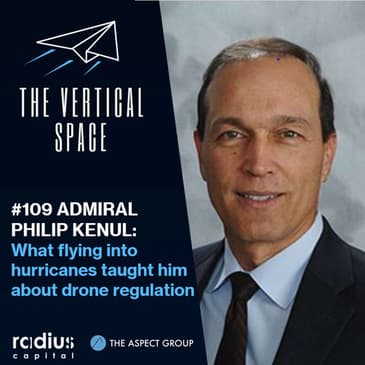
Admiral Phil Kenul spent decades flying NOAA aircraft into some of the most dangerous weather on earth, including multiple seasons as a P-3 Orion hurricane hunter, before transitioning into the world of UAS standards, where he now serves as Vice Chair of ASTM Committee F38. That path gives him a perspective on unmanned aviation that most people in the industry don't have. He's been the guy in the cockpit, the program manager trying to replace the cockpit with a Global Hawk, and now the person writing the standards that determine whether any of this scales commercially.
His take on the industry is refreshing. Technology, he argues, is no longer what's holding the drone industry back. Operations, regulatory approvals, and integration with legacy airspace systems are. He sees Part 108 as a genuine inflection point, one that will finally let operators fly by regulations and industry consensus standards rather than one-off waivers. But he's equally clear that getting there will take longer and cost more than most people expect, and that when the dust settles, success will go to the best operators, not the best aircraft.
03:38 Part 108 Standards Unlock BVLOS
04:22 When Will Part 108 Drop
07:12 NOAA Roots And Standards Mindset
08:48 Flying Into Hurricanes
10:05 Why Hurricane Recon Matters
11:37 The SHOUT Program
15:56 Future Hurricane Sensing Drones
18:55 Why NOAA Stayed Manned
25:35 Unmanned Weather Data Future
29:58 uAvionix sponsor segment
31:18 Inside ASTM F38 Committee
32:57 Global Standards Adoption
34:30 Europe vs US Momentum
35:28 Missing Compliance Pieces
36:41 Interop and Harmonization
41:08 Who Will Be Most Successful
All the technology is pretty impressive, but the tech is really not the bottleneck anymore. I think what's actually slowing things down is operations, regulatory approvals and integration to real world legacy systems, specifically airspace. Flying a demo is easy, but really running a reliable, repeatable, economically viable program is completely different.
JimHey everyone, welcome back to The Vertical Space and our conversation with Admiral Phil Kenul. Phil is a Senior Vice President TriVector Services and serves as Vice Chair ASTM Committee, F 38 on unmanned aircraft systems developing UAS standards. He discusses why the drone industry isn't fully ready to scale. Arguing technology is no longer the main bottleneck operations, regulatory approvals, and integration with legacy airspace systems are. He highlights the upcoming FAA part 1 0 8 rule as an inflection point, enabling actionable A STM standards and more predictable approvals versus waivers. Though timing is uncertain and final changes may involve electronic conspicuity and. Right of wat rules. As ASTM vice chair, he emphasizes interoperability and harmonization challenges. The need for faster standards and that success will depend on safe, reliable operators and revenue generating use cases, not hype. Just a bit more on Phil's background. Admiral Kennel served as NOAA Corps officer, focused on marine and aviation operations. Phil flew aircraft in support of aeronautical charting and trained with the Navy to become a WP 3D Orion aircraft pilot. He served as an aircraft commander with NOAA's Hurricane Hunters as director of NOAA Homeland Security Program office commanding Officer NOAA Aircraft Operation Center, and Director NOAA Marine and Aviation Operation Centers responsible for NOAA fleet of ships and aircraft. he has been directly involved with unmanned systems since the early start of these emerging technologies in noaa. Phil holds a bachelor's degree in biology from the State University of New York at Cortland and a master's degree in Environmental and Civil Engineering from the University of Texas at Austin. Admiral Phil Kennel, welcome to The Vertical Space. Great having you on.
Philip Kenulhey, thanks. I'm glad to be here.
JimFirst question, Admiral is there, and Phil, if I may call you Phil,
Philip KenulYeah, please.
Jimis there anything that very few in the industry agree with you on?
Philip KenulI, I think nobody generally agrees with me on anything in the industry, but, but one thing that I think there is that, a, a good point is that there's a tendency for the industry to think that we're ready to scale right now. And I, and I don't fully agree with that. I think we're getting there. We're, we're not quite there now. All the technology is pretty impressive, but the tech is really not the bottleneck anymore. I think what's actually slowing things down is operations, regulatory approvals and integration to real world legacy systems, specifically airspace. I think that's gonna be a big challenge. And just 10 or 15 years ago, everybody was talking about package delivery coming online by It's, it's right around the corner. Well, it's starting to get online, but we're not fully there everywhere all the time. I think back then, flying a demo is easy, but really running a reliable, repeatable, economically viable program is completely different. So, you know, all that being said, I think we're at an inflection point right now, and I think one of the biggest signals that things are moving forward is that the upcoming part 1 0 8, rule for BV loss operations. So in the past, I think I've been a little bit skeptical, but now I think the pieces are all starting to come together.
JimPhil, what would you say would be the least controversial part of, we're about to scale, What parts of the system would you say you're most optimistic about?
When Will Part 108 Drop
Philip KenulWhat I'm optimistic about is that we're gonna have a rule that we can start writing actionable standards against, and that's what we've been working on it at A STM is the standards to support the part 1 0 8 rule. And when it comes to drone operations, I think that's really critical. In the past, everybody's been flying by waivers and exemptions. They wanna fly by the regulations and by standards. And the part 1 0 8 rule is gonna set down industry consensus standards as one of the benchmarks to really open up the commercialization of these activities.
LukaDo you have any sense when we might see the final 1 0 8 rule?
Philip KenulGosh, you know, you know, there are people saying it was gonna come out last year and there were people saying it was gonna come out at the beginning of the year. Right now, from what I understand, and I talked to the FAA about this recently, is that it is out of the FAA, it's out of the Department of Transportation. It's outta OIR up. So the other agencies are looking at it. It all depends upon how quickly they're gonna get it back. you know, I'd like to say it's gonna come out within the next couple of months that would really help us in developing the standards. Right now we're working against the NPRM to develop our standards. But things can change when the final rule comes out. So, you know, the sooner, the better. But, that's, that's a tough one.
LukaDo you have any intel or insights into, How big of a change the final rule might reflect. Because one of the common things that, you know, we have observed and and when we're talking to others in the industry is that there has been a lot of times since the initial 1 0 8 draft and when it came out for comment, the industry has made a ton of progress that wasn't really captured in what appeared to be a snapshot, when the 1 0 8 was initially drafted. And so then how big that catch up in experience is actually, captured in what the final 1 0 8 will be.
Philip KenulOkay, let me start out. What I think is not gonna change, I think the airway innocent design requirements are pretty well set. We are working on those now at at A STM to get them down. And from the feedback I had from the people who might know. I think those are pretty solid. So I'm pretty, well confident that what we're working on now for design and air worthiness is gonna be what's gonna be in the final rule. What I'm not too sure about is where the conspicuity issues are gonna come up, electronic conspicuity and the right of way rules. I think those might change.
PeterOkay. And so the new draft is in the hands of these other agencies for their input at this point. And did those same agencies already weigh in on the first draft before it was released?
Philip KenulYou know, I'm pretty sure they, they had some feedback, there was some communication, but I don't know exactly to the extent that it was. All I've, I've heard is that, you know, most of the discussions over the past year have been on the right of way rules, and then recently they reopened up the comment period for electronic conspicuity. So I think there might be some additions, changes, gaps in it that we weren't. Quite frankly, expecting.
PeterAny feedback that you're anticipating from these other agencies when they. When they pass it back?
Philip KenulNo, I know. I, I think that's what everybody wants to know, and
PeterYeah.
NOAA Roots And Standards Mindset
Philip Kenuljust don't have that. Intel I have asked recently, and everybody's guess was it's, it's coming out real soon, so sooner rather than later.
LukaOne thing that stands out. In, your bio is when you compare to most people who are in the unmanned, systems industry, they tend to come, from, you know, software or the startup side, at least the ones that are building companies in this space and operating here. But you got into the industry through ships and photogram flights and flying p threes into hurricanes. does that path shape how you're thinking about the industry?
Flying Into Hurricanes
Philip KenulYeah, well, well, I started out in operations. I started out in ships at NOAA, and I went into aircraft. Did. Mapping for the FAA did the airport mapping and VFR mapping. I did a lot of photogrammetry. So I was involved in aviation for close to 20 years in noaa. And towards the end of that, started getting involved with, unmanned aircraft systems in the late 1990s. And, part of my job as, as the head of operations and, and, operations in the flight department at at NOAA was we, we worked a lot with standards. And after I retired, I kind of just transitioned into the world of standards by accident. And that's really what I've been doing for the last, gosh, 14, 15 years as working on aviation standards. But standards are real important, whether you're looking at any kind of operations, Marine or Aviation operations standards are very critical and they're even more critical today in these emerging technologies because there's not really a roadmap of how things are gonna go forward. You need, good solid regulations and you need standards to build against those regulations. And that's really what we're doing at A STM.
JimSo I'm just gonna do a quick aside, because that was really intriguing with You're flying into hurricane, so could you just give us a quick story of what that was like
Why Hurricane Recon Matters
Philip KenulOkay, sure, sure. Well, flying into hurricanes was probably about the most exciting thing I've ever done. there was an element of danger and risk involved, but we tried to manage that risk as well as possible. And, and we usually did that quite well. So flying into a hurricane is kind of like. E ticket ride at Disney. I mean, you're getting, you're in weather that most people don't go into. But we've got a, we had a really good airplane, a lock EP three. It'll get you home under the worst circumstances. And in several cases it did get crews home under the worst circumstances. But we also had a really well-trained crew. It wasn't just a, pilot, co-pilot flight engineer. There were meteorologists on board, there were avionics techs and they were all working together to get everybody home in one piece, so to speak. but I've, I've been in turbulence that would, we'd lose 2000 feet in a blink of an eye, and as soon as we got to the bottom of that elevator shaft, we get an updraft that shot us back up 2000 feet. So it was, as far as excitement goes, it was pretty exciting. But these days I just fly a desk.
JimPhil, what's the incremental value of the data that you're getting from within the aircraft that you would not otherwise get it from some other sensor that wasn't flying in the middle of a hurricane?
The SHOUT Program
Philip KenulWell, that's a great question. And you can have satellite imagery, but the data that you would collect on a P three or one of the other aircraft that we have flying around the storm, we have Doppler wet of the radar onboard the aircraft. We have C-band radar, we have X-band radar, and we drop drop wind saws that are little meteorological probes that collect temperature, dew point, wind speed, and direction once every two seconds and feed that back to the airplane, that information is fed back real time to the hurricane center. To ingest into meteorological models to support the development of those forecasts. So over the years, the research that we've done in that airplane and the reconnaissance have intended to improve the models for hurricane forecasts, both in intensity and in the track. Mostly the track forecasts have been much better than the intensity, but over the past few years, the intensity forecasts have been improving as well. And that's important to the people on shore where the hurricane's gonna hit. Also gonna tell you where the hurricane's not gonna hit, you know where to put the evacuation areas, where to put out the alerts and where not to. It costs money to start alerting people to leave their homes and to board up and evacuate. So, you know, on the whole, it's a program that's well worth the bank for the buck.
LukaAnd so you've flown p threes into hurricanes, and then later years later you're, you're managing a program that's trying to do the same with Global Hawks, and so you went from. Being the guy in the airplane to the guy that's responsible for demonstrating that the airplane doesn't need a guy. what was that transition like?
Philip KenulAll right, well, well, I'm not gonna go f as far as to say that the airplane didn't eat a guy, because there were a lot of caveats to that mission. the, the, the mission that we did was called Shout. It was sensing hazards with operational unmanned technology, and we flew three, six tropical storms and I think three wind storms. We even took it up to the Arctic to collect data, but the aircraft really performed pretty well, and it did have a positive effects on the forecast. It did improve the forecast by about 15% for the missions that we were able to accomplish, but the mission did require new systems and integration in an aircraft. That wasn't meant to be a flying weather station. The Global Hawk was meant for a different purpose. It wasn't purpose built for meteorological observations. There were also limits to the airspace clearances. When we were flying the P three, we can go just about anywhere. We routinely flew over Cuban airspace. Flying over a global hawk sends a different message and we really didn't get all the foreign clearances we needed. So that limited some of the data we could collect. But, but one of the bigger lessons that we did learn was that, you know, we built the mission around the aircraft instead of building the aircraft around the mission. So it wasn't purpose built. Another misconception that was that an unmanned aircraft can. Merely just simplify the operation.'cause it was unmanned, did not translate directly. We had the same manpower requirements and maybe more manpower power requirements at times. The Global Hawk flew for 24 hours, P three, maybe 10 hours. So we had multiple crews, multiple shifts, lot of people to support that aircraft. So the logistics footprint just didn't go away because it was quote unquote, an autonomous aircraft. So, long story short, the operational complexity just didn't disappear all of a sudden.'cause it was an ve autonomous vehicle.
Lukathe. Complex, the actually increase.
Philip KenulYou know, this was an experiment. So it was trying to prove a, a case. And what it did prove was that we could take people out of harm's way, take'em out of an aircraft, a dull, dare, dangerous, and dirty mission. Although they, the missions were really never dull, but that it did, we could collect information, could it do it efficiently and economically at the time. This was 10 years ago, we didn't prove that case.
Peterwhat was the, motivation for exploring this and what were the key questions?
Philip KenulYeah. Pretty, pretty much motivation. Can we take man outta harm's way and can we collect data efficiently, effectively, basically cost effectively?
LukaOkay, so, so cost aside, what other assumptions turn out to be wrong?
Philip Kenulyou know, you just can't transfer everything over to an unmanned mission. Because that's the new thing on the block. I think had we known what we know now, the end result might have been different, probably should have used a different aircraft. But there was really no other aircraft at the time that could do it, that that what the Global Hawk could do. And, and I just wanna point out, the Global Hawk didn't fly through the hurricane like a P three does. We flew it over the hurricane, 60,000 feet above and dropped sensors down. And we did have some radar on there that collected data as well. but, but there were a couple of things that did carry over. I mean, the safety culture carried over the procedures. crew, resource management. We had probably a dozen people in the command station down on the ground at Wallops Island. And they still had a practice crew resource management, but there were new risks that were involved. there was reliance on data links and when that plane flew up to the air arctic for some of the missions. The data links were not that great. At that point, there wasn't a lot of SATCOM communications. There were latency issues and sensor issues, but as I said, 10 years later, I think we have a better understanding what autonomy can do and a better understanding what we'd want to get out of an aircraft for a hurricane mission.
PeterSo if not the Global Hawk, then what is the future of flying either in or over hurricanes?
Philip KenulI'm glad you asked that question because right now Noah's still flying 50-year-old p threes. We have two of them. They're operational. The program that we didn't in shout, didn't convince the agency to change over to unmanned aircraft for their next generation research platform, but they're moving to a newer maned aircraft. It's probably a C one 30 variant that they're gonna be flying something like a J model, but that's gonna have to be instrumented for hurricane flights. but at the same time we were doing the Global Hawk mission, we started dropping small drones from the P three. There's an external belly shoot that you can load expendables into, and what they did is they put small foldable, Drones in there, and we started launching them out of the storm. So we started experimenting with smaller drones and just last year they started to become operational. This is 10 years later. And these drones act like persistent sensors that once they leave the P three, they can fly at the lower altitudes of the storm, collecting the same data that we would collect from a drop wind sign. But instead of a drop wind sign, getting a just a Vertical profile and splashing in the water, you get a small drone, it's called a black swift, and it'll fly inside the storm. And last year it flew for 119 minutes in the storm, collecting horizontal data at the lower altitudes of the storm. And that tends to be the most dangerous altitude for a manned aircraft to fly. We used to do that. We don't do it anymore. Too many close calls at 1500 feet to fly there anymore. So, so yeah. So we're transitioning. You can look at it as manned, unmanned teaming in a way. And I think, I think that's one of the good things that came out of the research programs that we were doing at NOA 10 years ago.
PeterIs the C one 30 going to be, as good of a fit as the P three for flying in these storms?
Philip KenulYeah. Yeah. the Air Force actually flies, the 53rd weather. Squadron flies P three J models now, we've flown p threes for years. As a matter of fact, about 10 years ago, we put new wings in a tail on'em because they're such a good platform. The thing that the P three gave us that the C one 30 is gonna be hard to engineer on, is it was ability to put a tail Doppler radar on the back of the P three and a C-band belly radar on the bottom. Now, the, the, the C one 30 has. The landing gear on the belly, not anywhere to put a radar, and it has a hatch in the back that fold down. So you can't put a tail doper radar, a little bit different configuration than the P three, but those are problems that they're gonna engineer into the new aircraft. They may be looking at phased ara radar or some other other technology that'll give'em the same information, but the drops on capability will still be there.
PeterInteresting.
Lukacan you expand a little bit more on why the agency was not convinced about the unmanned track? other than the cost part of it, which, you know, you can argue is really platform specific. So with a different platform it would would've been different and at the same time, technology has improved, over the years since then, to a point where the picture is much different now. what drove their decision to still hang on to the manned element of it?
Philip KenulYeah, I think, well, first of all, we took, advanced concept technical demonstrators for the, the Global Hawks. They were the first ones built, for the Department of Defense, and they were given in nasa and we teamed up with NASA and we flew'em in the heart can. So we were taking a, I don't wanna say an archaic platform, but they were the first generation global hawks, and we had to do a lot of reverse engineering on them. To get the systems on that we wanted, we had to build a new drops on dispenser. It was like a Coke machine. It would spit out these mini drops ons from the tail of the airplane. And we had a hard time getting that to work. So there were a lot of setbacks with even the dispensing drones in the storm. And the second thing, we had to add some additional, radar sensors on the aircraft. And that took time as well. So we were jury rigging an airplane to do our mission. I'm not saying the reliability wasn't always there, we still were able to collect data in most of the missions. But when we started to compare the readiness of that aircraft and the difficulty in the time in getting that aircraft to the storm, I think the, balance just wasn't there. We had to get airspace clearances to fly that from Edwards Air Force all the way to the Atlantic Ocean, to Wallops, and that was difficult. And then once we got to Wallops at that time, you still had to have a Chase aircraft to get it out of Wallops into international airspace up to 60,000 feet. So that was another cost. So when you added up all the costs involved, it just did not seem like it was that worthwhile to the agency. Instead, they're going to completely new aircraft.
LukaI see. if you were briefing a program manager who is about to run a similar program now, what would you tell them that's not in the official report? I.
Philip Kenulwhen I start, first started flying hurricanes back in like 1996. By 2026, nobody in that airplane thought we'd still be flying manned aircraft. When it came to around 2000, we were sure when they retired the p threes. There was gonna be an unmanned system or a better satellite system to collect the data. I still think you could do that if you build a purpose-built aircraft to do that mission and not try to jury rig something that we did 10 years ago.
JimA purpose. Unmanned aircraft.
Philip KenulYes, yes. And, and, and I don't know any aircraft right now, any unmanned aircraft, any large unmanned aircraft that, that people would take the chance of putting into the storm. I mean, back in the 1990s, we did put an AON into a hurricane several times, but that's a small, almost expendable aircraft. If you want to put something like a global hawk or a predator type aircraft carrying that, those same sensors, I don't think you want to take the risk of losing that at this time. Although I'd rather lose an unmanned aircraft than a manned aircraft.
JimHow many maned aircraft have ever been lost?
Philip Kenulonly one in the fifties that the Air Force flew. Noah has not lost an aircraft. we had one in Hurricane Hugo that lost an engine at 1500 feet. That's why we don't fly at 1500 air feet anymore. And they were able to pull it out at, at about 700 feet above the deck. So, and then we had another one doing North Atlantic Storm outta Newfoundland, and it lost three engines in the storm. They were at 3000 feet. It was salt water accretion on the turbines that flame three engines out, they were able to get another engine started up at about 700 feet as well. So that's one of the reasons why I think, you know, eventually you should go to manned aircraft for those kind of dull, dirty, dangerous missions.
Jimgiven the mission of NOAA and given the aviation assets, were 95% of them, within the middle of a storm, were there any other applications for aviation for noaa?
Philip KenulOh, yeah, yeah, yeah. We, we, we actually fly. We have to have a fleet of aircraft, down in Lakeland, Florida, we've got two p threes. We have a G four, we have four twin otters, and, a couple of turbo commanders. And we do have a fleet of drones that they fly for environmental observations as well. So they are transitioning to support some of the other programs at noaa. one program that they'd like to do is fisheries observations, Antarctic observations, and we were working on that 10 years ago as well. And they're still looking at ways to support. All the mis missions at NOAA with unmanned systems, but generally they're not looking at the hurricane mission any longer.
LukaWhat is the extent of unmanned operations, ed Noah, right now? You mentioned some, but what's the, what's the full. Operational scope right now. What's considered routine operations when it comes to unmanned flying?
Philip Kenulyou know, they were doing some coastal mapping with some small stuff and some coral reef mapping. But being, I've been, been out of that, that area for a while. I don't wanna really give you the wrong information. They haven't UN program there that's pretty active. You know, everything from trying to do marine mammal observations over the water. Some coastal mapping, coral reef mapping, things along that, those lines as well as Vertical profiles using, drones going up to collect Vertical profiles for meteorological data. But I, I don't wanna mislead your audience into areas that I, I, I just don't have the latest and greatest on. The, the biggest thing that they've been putting a lot of effort into is the P three launch drone into, into hurricanes.
JimFrom your experience, Phil, have been the lessons learned that were unique to Noah as it relates to unmanned aviation? were there any lessons learned that they could not have otherwise learned from some other source?
Philip Kenulwhen, when it come to the Global Hawk Project, they, you know, I think the lessons they learned to us, yes, it can be done. Is it cost effective or do they have enough confidence in the program to make a jump from man to unmanned aircraft? but I think that was a big question on their minds at the time.
Jimin a few minutes we're gonna talk a little bit more about A-S-T-M-F 38, and but before we do given your background with Noah, your experience with weather, what's your take today on unmanned weather capabilities? How much Has it progressed? And what's your impression of our current state?
Philip Kenulyou know, there, there are some companies that do in a lot of that, media. Max is one in Europe, and we've got, we've got some folks and at Noah, they're also doing it as well. I think there's a lot of potential for taking Vertical profiles with drones. You put'em in a, you know, have a, just put'em, automatically, have'em go up as often as, as you know, several times a day. Same location, collecting Vertical profiles. Now a lot of that is done with unmanned balloons. They just launched them, from 122 stations around the country, or they did before the budget cuts. 122 stations four times a day, they launch balloons to collect meteorological data. I think there's potential to do that with, with drones. you may not get as high with some of the drones now that, that they do with the balloons, but I think there's a lot of potential for that. And one of the other areas is with this low level economy that's coming around with, smaller drones flying at low altitudes, they're gonna need a lot of low level weather data, for that both for evals and for package delivery drones. And I think there is a potential for collecting data with thrones in those cases. Well, just short Vertical profiles up to 400 feet, a thousand feet, whatever it takes.
JimLuka and Peter, how is that being done today? Let's say with Amana, what's the of knowing the weather and then how is Bobby today with Manna, for example, getting weather data for his operation?
PeterI believe that they are sourcing the same weather data that the aviation community uses, and so they're just gonna be working off of those available sources. I believe they have a weather station at the base locations as well for, you know, the immediate, you know, launch and recovery area.
Philip Kenulthere a lot of the companies have their own weather units as well. true weather is also, Pitching a lot of their services as well. I think there's gonna be a demand. I think there's a demand signal for when there, when we get more congested airspace, more flights flying. I think there's gonna be a need for more low altitude weather for these kind of operations.
Petercertainly the drones themselves are able, able to infer, wind aloft based upon, their GPS track and their, you know, the power that they're exerting in order to fly. So I think that there's, some additional data that can be just brought back from the aircraft that are flying in the area too.
Philip Kenulabsolutely. Yep.
PeterYeah.
LukaI mean the, the industry has long been enamored by this idea of, of aircraft sharing actual weather conditions, and then consolidating all of that into some large pooled, resource that would inform, almost like a real time turbulence or weather radar type, asset. and, I wonder, well that obviously, for a variety of reasons that never materialized. But I wonder to what extent the industry can have a second shot at it with the, the low altitude
Philip KenulYeah,
Lukaand, and the drones.
Philip Kenulwell, the Weather Service did have a program where they had. At meteorological sensors on commercial airlines, that would be reported as well. And I think they're still doing that. And I think the same, same thing we're sharing, sharing weather, crowdsourcing the weather, to, to the service suppliers, I think, and the operators. I think that would be helpful and it could be done. there are supplemental data service providers that will be providing weather and if they crowdsource the weather from all the operators, it, it can't be a bad thing. It's gotta help.
LukaWhat part of the industry do you think would benefit the most from having this kind of data and, and what segment would be willing to pay for it?
uAvionix sponsor segment
Philip KenulThat's, that's a good question because, I think the paying part is the big part. I think a lot of the operators want to keep it in-house, potentially keep it in-house, and some of'em will outsource it. It depends upon how big they are, what type of operation they have. And, and what the cost structure is. you know, right now there's not too many people making money in this industry, so I think everybody's gonna be careful about what they're gonna be spending on. But coming from noaa, I think weather is a critical part of the solution to getting this economy off the ground.
Inside ASTM F38 Committee
LukaAnd now is a good time for a quick word from our sponsor. And I'll say upfront, this one's relevant to a lot of the conversations that we've had on the show. U Avionics, who many of you know from the A DSB hardware side, has a platform called flightline that is relevant in the UTM conversation. The core problem it solves is this, if you're operating BV loss or building UTM infrastructure, you need to know where crude aircraft are in real time with enough integrity to trust it for deconfliction. Flight line is how you get that. They are a surveillance data service provider pulling validated A DSB data from their ground sensor network and pushing it directly into UT M Platform's, VAPI. Airspace Link One, sky Drone Sense, and others are already integrated. What caught our attention is the FAA Surface Awareness Initiative piece. Flight line is already live at dozens of towers today, with 55 more airports coming online in the next six months. That's a significant footprint and it's operationally proven, not a demo. For operators. Building on this. The API doesn't just give you traffic data. It includes sensor health monitoring, so you always know whether your service volumes are actually healthy. And for mission critical ops, that's not a nice to have. That's a requirement, and activation is fast. Most feeds go live within 48 hours of finalizing your coverage area. Check it out@uofyannick.com.
JimPhil, tell us about your experiences at with A-S-T-M-F 38. you charity, you're the vice chair now. Give us a, walk through the history and what you've learned.
Philip KenulSure, sure. So, just a little bit about the history is, is the committee's been around since 2003. developing standards, ASTMs Worldwide organization, we pretty much have a low bar of entry. We've got about 600 members now. global members and working on standards. We've got 36 published standards. We're working on 25 standards in, in draft now, and one of the key areas that we're working on are, is the standards for, part 1 0 8, the Beyond Visual Line of Sight standards, so that, that standard we're, we're hoping to get that in sync and publish it around the time that the np that the final rule comes out. We're hoping for day one compliance. Through that, through the standards, we're developing a meta standard. A lot of the, the work is already done in other standards. We're gonna consolidate that in one standard to kick things off so that industry has a standard they could point to that'll comply with Part 1 0 8.
Jimwhat drove the need for the committee in the first place?
Global Standards Adoption
Philip KenulOh, well back in the early two thousands, I think everybody was looking at drones and UAS as the next best thing. And, I think, and they needed standards for that. So the FAA wanted a standards organization to develop standards for, for unmanned systems. A STM, which has standards in various industry categories, decided to pick up on that and through an agreement with the FAA, established a committee to develop standards for drones and UAS.
Lukahow much work is US centric and standards that the FAA will accept as. acceptable means of compliance and how much of that is applicable and pickable, in Europe.
Philip KenulOkay.
Lukathe reason I'm asking is there, there's a, there's a lot of, you know, we talk on this platform, many times with many guests about the, state of affairs in Europe and how, mature the regulatory landscape is over there for beyond visual line of sight However, where there still seems to be a gap is in some of the, the means of compliance on how you actually are, achieving compliance with these regulations. And that's part of the reason why, the ecosystem hasn't really flourished to the extent that you would expect from a more permissive and more defined, regulatory environment. And so do you look at it and how much applicability is your work or the committee's work in Europe?
Europe vs US Momentum
Philip KenulI, I think it's very applicable. as a matter of fact, in the past, IA has recognized more a STM standards than the FAA has. I think that's about to change. But you know, the regulators, they don't really care where the standards come from. They just care that the standards are good. So Euro K develops a lot of standards in Europe. A STM people think we're an American standard organization. People think your okay is a European standardization or European standardization organization. They're not. We're both global organizations. We have worldwide footprints and everybody can adopt our standards. I was just in Europe two weeks ago and, and as a matter of fact I was with Bobby Healy on a panel and one of the, the issues was is that Europe is, seems to be falling behind. Five years ago, I thought Europe was way ahead of the United States with implementation. they had regulations in place. You could build standards, you can start gearing your operations towards that. But things kind of got bogged down. And the United States. I think things are about to turn, with part 1 0 8 coming out, and also with the implementation that the FAA authorized in Dallas Fort Worth, the, north Texas airspace implementation where they've got several different companies operating in the same airspace at the same time. I think that's a big plus, and I think that's really pushing the industry forward. And a lot of people are looking at the, in Europe, are looking at the United States as the place to be right now. If you want to get your operations off the ground or your business off the ground,
LukaWhat are the most important MOOCs means of compliance that are still outstanding, that are preventing widespread BV loss operations? Either side of the Atlantic.
Philip Kenuleither side of the Atlantic, You know, in the US we have a really good idea what's gonna be in part 1 0 8. So that's what we're writing the means of compliance to. And a big part of that is the airworthiness and design standards for the aircraft. one of the challenges is gonna be that the BV loss standard is, goes from like, zero to 1,320 pounds. how do you write a standard near worthiness standard for a 15, 20, 55 pound drone at the same time, write a standard for a 600 kilogram or 1,320 pound drone. That's some of the things that we're looking at right now. the other issue is the operator requirements and the training requirements and the Declaration of Requirements. The declaration of Requirements, is the, is the requirements to declare compliance with the means of compliance as well.
LukaSix plus members, what are hearing from operator with respect? what they are frustrated about operations or where they are in their operations standards aside, but what are the, what are some of the key things that you're hearing from the operators?
Philip KenulYou know, I think one of the key things that I'm hearing from them is that interoperability is a problem. And it's not just the technical problem, but it's the problem across borders and it's lack of global harmonization. different regulators have different requirements and, and that that fragmentation tends to slow things down. a good example of that is the use based requirements in Europe and the UTM requirements here and the standards that are being developed. UK is now developing a use base standards. A STM has 35 48, which is being used in Dallas. the FAA is mandating the use of that in Dallas for the USS interoperability standard. And even though there are two UTM type standards, the European work and the US work won't necessarily be interoperable. And I think that
Lukadifference?
Philip Kenulthe difference, the, the data models are the same, but the data exchange models are different. And part of that issue is that in the US we're looking at generally a federated model for UTM, where different US SS will be talking to each other in Europe, it's not necessarily being pushed that way in the uricase standard. So the exchange mechanism won't be the same.
LukaInteresting. What else are the operators
Philip KenulYeah, well, they're asking, what's an issue is, I don't think it's, again, it's not technology that's the issue. They want repeatability, fewer one-off waivers, more predictable approvals. And that's really what I think they're waiting for in part 1 0 8. It's gonna be fly by the regulations and industry consensus standards. So I think that'll be, that'll be resolved pretty shortly as far as beyond visual line of sight goes.
Jimwhat operators are more apt to attend the A STM meetings?
Philip Kenulbasically everybody in the delivery business, Mona shows up Amazon Wing. and then we've got UTM providers and r flight tracks, you name it, they, they come to our meetings. So we we're,
Jimit's the people who either are gonna be responsible for the system, the UTM providers or the people who require an efficient system.
Philip Kenulyep.
JimLet's say they were on the call, let's say Adam Woodworth was on the call right now. What would he, would most Ask of you, or ask of, A-A-S-T-M to be able to accomplish, that's not being done today.
Philip Kenulthey want the standards faster. they want the standards for part 1 0 8. There are, there are probably half a dozen people from wing alone working on our committee work, working on the standards. So the standards can't come fast enough, standards work is very slow. It's like watching sausage get made. It, takes us, probably at least a year to get a standard out from start to finish, sometimes longer.
LukaWhat parts of the industry are you the most impressed with, whether these are, you know, operators or use cases or specific countries? when it comes to complex drone operations?
Philip Kenulthey've gotta work with airspace issues, they gotta work with the design of the aircraft, and then it's the operations. I mean, the operations are critical, getting the operations right. So it's a combination of just about everything that you need to get to get an aircraft in the air.
PeterAnd, and those types of complex problems attract, you know, a certain type of people. And it, it's really cool to see when people get together and, you know, have more than just the chance to talk about a solution. But if they can actually move on it and do it and make it fly, you know, that's, that's really special. And it's rare to find that.
Jimsay we're at a party and somebody walks up to you and says, I hear a lot about this industry, and, the drone, drone delivery, eVTOL, the services from eVTOL, which one is most interesting to you? Which one do you think is gonna be most successful? Now, I realize you're the vice chair of a rulemaking committee, and you have to be a little careful how you answer this, but where do you see the greatest success from these different constituents?
Philip KenulYou know? Right, right now, I, I see the potential for smaller drones taking off and, and being successful. I keep going back to the part 1 0 8 rule. I think that's gonna be a real inflection point.
Who Will Be Most Successful
JimAnd those companies, you feel it's the manna, Amazon, the, the wing are the gonna be the greatest beneficiaries.
Philip KenulI think they're doing the most work to lift everybody up right now. So the lessons learned from them are gonna be good lessons for everybody else. will they all be successful? I hope they do. I, I think they've put a lot of effort into it. and they're pretty smart in what they do, but when it comes down to it, the ones who are successful, it's not gonna be necessarily the best or the sexiest aircraft. It's gonna come down to who's the best operators, you know, who can do it safely, reliably, at scale in the real world. And I think the challenges of integrating into legacy air traffic management are gonna be one of the. big pluses in this industry, once they learn how to operate in traditional airspace, I think that's gonna be a big win.
LukaHow big is the gap between what people think the state of the industry is versus what you actually see it from your perspective?
Philip KenulSo I think people see extremes on the outside. Folks are saying this is never gonna work or be scale. They say it's impossible on the inside. People in then just say, we can do this now. But the regulators of the problem, and I think the reality is really somewhere in between. we're not to scale yet, but I think it's more real than people think. And getting to that tipping point is gonna move things forward. scaling's happening, but it's only in specific use cases right now, and it's gonna take time and investment on the whole. I, I'm optimistic. I think we'll get there. It's just not gonna happen overnight.
PeterYeah. Do you also spend time or get exposure to the rate of change happening, in drones, especially small drones being used in military missions? And, you know, it, it's, it's a whole taxonomy of different missions that they're flying and it's changing very quickly. But it's like one drone industry existing in two different worlds with totally different realities in terms of the velocity of change, the maturation of technology, you know, from our vantage point we find Fascinating. And we have one foot in both sides of it, you know, if you look across our portfolio. from your perspective, do you see how these, meet somewhere in the future? Or how the progress on the high volume defense side starts to percolate over into, the commercial side?
Philip KenulYeah, I was in Europe a couple of weeks ago at the, exponential Europe, few years ago last year, exponential Europe was. Very commercial this year. I'd say it was 80% military. And I saw what they had there. I was amazed. And the Ukrainians were there with some of their products. I was amazed how fast they could develop, new products to meet their needs. And there was a briefing by a gentleman there who was, from the, from Germany, who was supporting the Ukraines, and he said they're turning things around in less than six months. When Shahad kept coming, they, they figured out a way to knock'em out and, knock'em out. And in months start knocking'em out. They're getting a maybe an 80, 90% success rate. And then they, the, the Russians started flying'em at 15,000 feet instead of low, low at 5,000 feet. Took'em another few months, they figured out how to hit'em at 15,000 feet. Now the Russians are putting jet engines on the Shahad, so they're going faster and higher. And now the Ukrainians have to figure out how to do that, but they're turning'em around like that and becoming operational. that's something that you can't really do in the commercial airspace. it's again, innovation driven by war. It's been, it's been the story since, since time on end. So I was just thinking about this the other day. If, if they can move the industry as fast commercially as they do on a wartime footing, you know, where would we be now? But, it's just amazing what they're doing on the military side.
PeterYeah. And certainly the, the drones that are built for the last mile delivery mission or these other commercial missions designed with a very different set of priorities. They have no single points of failure. They have all of the levels of safety that are, know, framed by the regulations that we have. Yet the volume of production of those types of drones is three or four orders of magnitude lower than what's happening today on the military side. And with all of the iteration going on in the military side, the scale up of production to support that there, there's no way that you can. Look at that and say, oh, well there isn't an, a maturation in the technology. There isn't an improvement in the quality and reliability that's coming out of that. It's happening on the military side. There's, there's some incredible advances there that if you bring it across and you reconfigure it at the system level into things that are made to fly, you know, within the SOA framework and to be ultra reliable. I, I have to see the two meeting at some point in the future. They, they, they can't exist in these different worlds forever.
Philip KenulYeah. Yeah. It, you know, like, like everything else, you know, military applications can get commercialized later. you know, hopefully when, all these wars are over and we have a little, little breath or peace time, maybe some of that technology can shift over in a good way. I was just thinking about the rate of change is so quickly if we can match that on a commercial side, but then, I mean, the commercial side can only go as fast as the regulatory side goes, and there's a different level of risk that's gonna be accepted in a wartime scenario than in a civil scenario. And, and that's just a fact of life.
JimWho most impresses you in the industry today? Phil,
Philip KenulI think with an technologies is doing with, with UTM, I've been following them for years. I really like that. I think, and mono drones outta Ireland. very impressive, they've got a dynamic leader who's pushing things ahead. another company that, that I think really is helping everybody move forward is wing. you know, sometimes, you know, people look at wing as the 80 pound gorilla on the block, but you know, what they do now is gonna help everybody. The rising tide lifts all boats and, I've seen them as being very collaborative with the industry partners as well.
JimFive, 10 years from now, Phil, how is the world gonna be different than how most people are thinking today?
Philip KenulFive, 10 years from now. I've learned to be careful with predictions'cause I usually get them wrong, as most people do. So take everything I say with a grain of salt. But in five years, you know, I can see real scale and operations, not necessarily everywhere. I think it'll show up in specific use cases, infrastructure, inspection, cargo, and defined car. Medical logistics and definitely a, a growing package delivery service. And I think a lot of that, again, has to do with part 1 0 8. so I, I think I'll see real operations, but just in targeted areas and targeted industries,
JimSo
Philip KenulI,
JimPart 1 0 8 comes out, does the attendance at your meetings plummet?
Philip KenulI don't think so. There's gonna be a, i I don't think that once they, once they release part 1 0 8, I think there'll be a phase in period. And we've always had, there's always the next best thing in standards. So a few years ago it was remote id, then it was UTM, now it's part 1 0 8. There'll be something else that we're gonna be working on. I, I don't see the standards community drying up after part 1 0 8, you know, but 10 years out. I think it's gonna be more transformative by then, not universal. I think if it's not, then a lot of the people supplying venture capital, these companies, that capital might start drying up by then. But I think there's gonna be deeper integration in the airspace. I think airspace is always gonna be a big challenge. We'll have more autonomy. I think you'll have early operations for advanced air mobility, power lift, eVTOL on some structured routes. Things like, you know, get me to the airport use cases, maybe more cargo delivery first as opposed to people delivery. I think companies like, reliable Robotics who are just flying cargo, I think you'll see a lot of that in, in 10 years, but still might be a bit of a novelty rather than fully integrated into the transportation ecosystem. One thing I think is gonna be important is that, You know, public acceptance is gonna be a big factor on whether this industry is accepted in the future or not.
JimAt what point do standards. ever an enabler versus, a necessary impediment?
Philip Kenulit's definitely seen as an enabler, but we don't wanna write standards where standards aren't required for the regulation. So, as a means of compliance, definitely yes. And if it's a articulated in a requirement in a regulation, or if, an industry brings us a requirement for standard, we'll work on it. But we're not just gonna work on standards for standards sake.
Jimif you wanted to send message to the audience as a result of your preparation discussion here, what would it be?
Philip KenulI think people should ignore the hype of this industry. I think it's gonna be real in the future. technology's not gonna solve this problem by itself. I think, people need to look at real use cases that are gonna be revenue generating. And you have to be honest about the complexity of this problem. It's, not a normal startup industry. I think there's a lot that goes into it with certification, regulatory approvals, aerospace integration. And I think this is gonna take a lot longer than people thought and cost a lot more. It takes time and capital. So I think we're gonna get there. but, doing a one-off demonstration is easy, but building a business is pretty hard. And I think a lot of people in this industry have found that out,
JimYes, for sure.
Philip KenulBut there is good news, I think the last 10 years, I think there's been a lot of lessons learned. we've seen what works and what doesn't work. So I, I do see a path forward.
JimGreat, Phil. Thanks so much for joining us. Really appreciate it.