
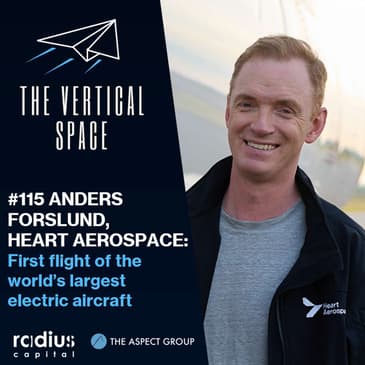
In this episode we speak with Anders Forslund, founder and CEO of Heart Aerospace, which is building the ES-30, a clean-sheet 30-seat hybrid-electric regional airliner. We recorded two days after Heart flew its X1 demonstrator at Plattsburgh, the largest battery-electric aircraft flown to date, and about a year after the company closed its Swedish operations and consolidated in Los Angeles. Most of the conversation was about whether electrification changes regional economics enough to bring back a market that has been shrinking for forty years. The first flight used 85 kWh, roughly $5 of electricity, and Anders walks through how that scales to a 125 mile leg, why battery amortization is the bigger line item than the energy itself, and why 40% cheaper than a comparable ATR is the threshold where a stagnant market starts growing again.
From there we cover what X1 retires and what waits for the pre-production aircraft in 2028, how sensitive the 40% is to jet fuel and cycle life, who funds megawatt charging at regional airports, and what moving from Gothenburg cost in schedule and continuity. Anders walks through the certification plan, the twenty or so requirements unique to this airframe out of roughly 3,000, the not-for-credit testing philosophy he took from SpaceX, and the billion dollars to certification. There is more to come on the independent hybrid, which he was visibly biting his tongue about. Anders also makes an interesting argument about the lost generation, engineers in their forties who have never worked a clean-sheet program, and why reps rather than incumbency are what preserve the ability to build airplanes.
02:35 First Flight!
04:22 Dawn Takeoff and Handling
05:43 Big Day For Aviation
06:28 $5: Revolutionary Economics
11:49 Hybrid Economics and Market Vision
15:58 Getting The Hybrid System Right
21:10 The guiding principles
23:01 Approach to Uncertainty
27:01 Unlocking the regional market
38:30 Airport Charging Reality
40:32 Hybrid Flexibility Edge
41:23 Electric Range And Reserves
43:15 Roadmap To Certification
47:13 Why Startups Win
52:37 Talent And SpaceX Playbook
54:37 Business Model And Revenue
56:09 Why Move To LA
01:01:16 Certification Timelines from Europe to US
01:04:16 Skunk Works Mindset
01:10:40 Capital Needed And Wrap
Anders 0:00
We believe that, this is a new era in aviation that we're opening up to. Whereas, you know, we came from the piston age, which introduced air travel to the world, and we came into the jet age, where we connected the world, and we, we flew faster and longer than we ever had before. and now I think the hybrid electric age is gonna be one of abundant air travel, where people can fly every day, where we can restore connectivity to a lot of airports around the world, including the five thousand airports in the US that many of them have lost service. and bring aviation to the eighty percent of the world's population that's never been on an aircraft I think electrification has that revolutionary economics, and it's only gonna get better
Jim 0:48
Hey everyone, welcome to The Vertical Space. We're joined today by Anders Forslund, founder and CEO of Heart Aerospace, just days after a major milestone, the first flight of Heart's full-scale electric aircraft demonstrator. Anders believes hybrid electric aviation could usher in a new era of dramatically lower cost regional air travel, reopening routes and reconnecting communities that aviation has left behind. We talk about the first flight, the economics behind the ES-30, how Heart has adapted its aircraft architecture, and what a startup can do that the aerospace giants can't. By way of background, Anders is an aerospace entrepreneur working to transform aviation through electrification. Under his leadership, Heart has set to fly the world's largest electric aircraft and has secured a nine point four billion order from leading global airlines, including United, Air Canada, and JSX. Before founding Heart with Klara Forslund in twenty eighteen, he launched ELISE, Sweden's national electric aviation initiative, and conducted award-winning aerospace research at MIT. His work on uncertainty and robustness in aircraft propulsion earned the twenty nineteen Charles M. Manly Medal. Dr. Forslund holds a PhD in aerospace product development and a bachelor's in science and engineering physics from Chalmers University of Technology, as well as a dual master's in astronautics and space engineering from Cranfield University and Luleå University. A Swedish citizen, he is a founding member of the Nordic Network for Electric Aviation and a member of the Prince Daniel Fellowship for Young Entrepreneurs. He lives in Santa Monica, California, with his wife and three children.
Luka 2:21
Anders, welcome to The Vertical Space. It's great to have you on the show
Anders 2:25
Excited to be here
Luka 2:26
Congratulations on the first flight. The X1 flight happened just a couple days from, our recording on the 12th of August. tell us what happened
First Flight!
Anders 2:35
Oh man, it was just, you know, it's some- an event that you go around, I've, I've had this company now for seven years, and you've just pictured it in your head, and it felt like a dream. So it started when I flew in from LA, and it was a big, big thunderstorm, and we've been chasing the perfect weather, and we had to divert over to, Albany and then drive up to Plattsburgh. But on the day it was just a beautiful starry night. You know, it was the same day as the big eclipse. It was a big meteor shower. I saw a shooting star right before the sun came up, and I don't tell people what I wished for, but it was quite amazing. but then at, 5:57, right around the time of the sun came up, that's when we took off. And, we got up, flew a little circuit, and, and landed the plane, right in the center of the runway. the feeling of seeing that aircraft in the air, so this is the world's largest electric airplane. It has 106-foot wingspan. It weighs over 25,000 pounds. and it felt not only like seeing the first electric aircraft, but it felt like seeing an aircraft fly for the first time. You know, you, you could do a lot of analysis, and you can, you know, taxi test and do all of these tests, but actually it's something about an aircraft until it flies, you can never really test for that. But it just flew perfectly. I think this is a tried and true platform. You know, it's a high wing, detail configuration, and it just's very, very stable. know, it was, say the, the most exciting part about it was kind of how undramatic it was. and yeah, it's a culmination of a lot of hard work that goes into, to z- looking at that and, and it looked very easy when it was in the air, but a time to get there.
Luka 4:21
Absolutely.
Dawn Takeoff and Handling
Luka 4:22
Congratulations. And the choice of, takeoff time, was that due to, a smoother atmosphere
Anders 4:26
Yeah, I it's, I think, yeah, it's, it's w- it was part of it. We were trying to find that time when, when there was no rain, and also winds are always, sometimes lower in, in the morning. and it's also very, it came out very beautiful. It's the golden hour of cinematography as well. So, you know, we caught some really beautiful footage. So I recommend those who haven't seen it to go on our, on YouTube and see, see the video that we just posted yesterday
Jim 4:53
what's the first words the pilot said when you talked to him? Or her.
Anders 4:56
he said it was better than the sim. It handled better than the sim. So he's been sitting a lot in our, in our simulator and, you know, we've been tweaking all parameters. This is a fly-by-wire aircraft it's a lot of tuning of that. then, and also he's been doing a lot of, you know, shutting off, sort of, contingency maneuvers if we lose engines, flight. he said this was e- much easier to fly than the sim, so, that was great. we're, we're I guess we're better at building aircraft than we are building simulators, so I'll take it
Luka 5:28
him or what surprised you in terms of, things that did not match the model or the sim?
Anders 5:34
I think it was, it was just that it... Yeah, I, I, I don't know exactly, but it was that it handled better. I think it was, like, the sensitivity was, was better or
Luka 5:42
Great.
Big Day For Aviation
Luka 5:43
What was the, abort criteria on that flight? how close did you get to them?
Anders 5:47
I was nev-never close to any o-any of those things. Yeah, we had no, no incidents, so we were tracking everything through telemetry. And we also, I think maybe the first, airliner flight test had Starliner-- sorry, a Starlink on it. we had a Starlink, we had eight actually iPhones that were sitting on the wing tips and everything, so we're feeding 4K video, down and also a lot of telemetry through several different channels and everything performed, uh, nominally. There was no issues which was extremely exciting. So we never got close to anything and we obviously have been practicing for a lot of contingencies.
Luka 6:26
big day for the company, big day for
$5: Revolutionary Economics
Luka 6:28
aviation. so for, for folks that have been following the roadmap, of your company, how does this X1, the pre-production aircraft, and the eventual conforming aircraft, how do they all relate to one another?
Anders 6:42
Yeah, so the X1 is our full-scale technology demonstrator. I think for us, it's really about a, a few things. first of all, it's, it's, it's about building a company that knows how to go do the entire loop from design, you know, build, test, and then y- a flight test campaign. So it's a tremendously good learning opportunity. as for the aircraft, we wanted to prove a few things. one thing that that electric aircraft is not just for small planes, that it's something that we can build on the airliner scale, and also we wanted to prove the revolutionary economics. So this flight cost about $5 worth of electricity, That's, that is the signal and the noise. That's the thing that's important. You know, we believe that, this is a new era in aviation that we're opening up to. Whereas, you know, we came from the piston age, which introduced air travel to the world, and we came into the jet age, where we connected the world, and we, we flew faster and longer than we ever had before. and now I think the hybrid electric age is gonna be one of abundant air travel, where people can fly every day, where we can restore connectivity to a lot of airports around the world, including the five thousand airports in the US that many of them have lost service. and bring aviation to the eighty percent of the world's population that's never been on an aircraft I think electrification has that revolutionary economics, and it's only gonna get better
Luka 8:06
okay, so this first flight was, 27 minutes. and, I read in the, in the press release, it had a, about a megawatt of delivered, power from the propulsion system. are those numbers correct?
Anders 8:18
Yeah, the mission was, was 27 minutes, and that includes the taxi actually and, and, and the takeoff. So the flight was about one-third of that. A- and mega, what was the max power at takeoff? And 85 kilowatt hours worth of electricity for this. So which is, you know, it's kind of a Tesla Model S battery pack that we, we used for this flight
Luka 8:38
Okay. And at
Anders 8:40
Yeah
Luka 8:40
the, commercial tariff in, in Plattsburgh, that turns out to be roughly $5.
Anders 8:45
$5, yeah. And that's a good electricity price. It's Hydro-Québec, so it's, it's gonna be more expensive in other places in the world, like California it might be four times more expensive. And obviously we're, if we fly longer, it's gonna be more, but this is a 36-seater aircraft, so even if you add a zero to that number or, or, you know, get it to what- whatever it is, you know, I... We- what we're calculating is, know, a, the 200-kilometer, 125-mile flight at a, at a more average electricity number would be something less than $200. for a 36, seat- seater aircraft, that's, you know, $5, $6 a seat, which is obviously revolutionary
Luka 9:26
And, and the X1 had an all-electric power plant. It didn't, it didn't feature the independent hybrid that
Anders 9:33
No. No. No. So, so the hybrid is about range extension and right now it's something we're testing on the ground. you know, the way we're sort of expanding the envelope, we didn't put the range extension on this. So this was four all-electric motors
Luka 9:48
does the X2 fit in this arc? I remember back, a couple years ago, X2 was supposed to test this, this hybrid architecture. the, the press release doesn't mention it, so is that still something that's on the roadmap
Anders 10:01
Yes, It's a pre-production prototype. We or the ES-30 we're, we're trying to figure out the right nomenclature, but it's part of a continuous actually to bring it through and then going through conformance and then, you know, building up the production facility where we could get, in our production system. So the, the idea of the pre-production prototype is just to be building something. I think the difference, you know... S- Very simplified, the difference between a pre-production and conforming aircraft is for the pre-production aircraft, you test every element on that artifact. So you do the wing bend test, you do everything on that, and then when you need to build something that is conforming, you need to build a, supply chain and a manufacturing facility that can test one and then produce many of them and make sure that they are all, similar enough to each other for the test that you did on one of them to be valid
Luka 10:51
Okay, so, what are some of the, big technical uncertainties that the X1, will retire or has started to retire? what remains other than the actual independent hybrid architecture, what are some of the other remaining, technical risks that, will be addressed by the X2?
Anders 11:08
I mean, there's a lot of things here. You know, we were testing the, the flight control system, the propulsion, all of these things, even, even structures. But it's noth- nothing of this, and that's pretty intentional that it's nothing of this that is some big unknown in technology. In try-- In fact, we're trying to be pretty deliberate about not betting on some new and unproven technology. When we make our battery, designs, when w- we're looking at cell selection, all of this stuff, we wanna make this as easy as possible for ourselves. So really how we're thinking about it is how do we minimize risk in the technology portfolio. I would say, yeah, what remains is, is the hybrid system which we're testing on the ground. That's the big big thing
Luka 11:48
Got it
Hybrid Economics and Market Vision
Peter 11:49
So as you, as, as you look ahead and, you know, you have that, the $5 figure from this most recent test flight for the electricity itself, I'm interested in how the sort of the variable mission cost, evolves as you look ahead. So if you, if you looked at this flight and took into account, you know, battery amortization cost over its, you know, s- whatever its cycle life is, and other similar costs that are, you know, I think really directly derived from the propulsion system and the, you know, the consumables that are effectively within that, what would that look like on this flight, and what, what is it gonna evolve to look like in X2 and beyond?
Anders 12:35
Yeah, I think that's a great question. So first of all, battery amortization becomes a, a big part of the cost, right? It's actually larger than the cost of electricity, and it's because the batteries have, you know, a f- few thousand cycles, on them and, and, and they're gonna be replacing maybe every two to three years or so but it's still less than what it cost-- what, what turbine m-maintenance costs. So that is s-still adding up there. I mean, not turbine maintenance the ex-- for, for our hybrid system, but turbine maintenance for, uh, turboprop. if we fl-- operating on all, all-electric missions, we're, we're gonna have very little, turbine m-maintenance. So that's really how we're trying to, to create this value proposition. So the mission of the company is to lower the cost of air travel, and that is this big trade-off that you're doing. What, battery c-chemistry are you selecting? How are you optimizing for energy density versus cycle life? How are you thinking about turbines? What's the best way to do the missions? should you run the turbine on idle a little bit and all this stuff. what electrification does, it's, it shows you kind of the first principle of that, like, this transformational econo-- uh, economics. But then the devil is really in the details of making how, how all these systems, work together to create that superior unit economics. So our calculations right now is we'll be about forty percent better, than a turboprop, and even more than that, say fifty, sixty compared to regional jets in terms of overall operating costs, which is not just the cost of fuel or propulsion, but cost of, maintenance and crew and all of these things.
Luka 14:15
this on a per seat basis or take a, 125-mile flight and then the total cost for that flight?
Anders 14:21
Yeah. this is, this is per aircraft. So, so a, a great example would be comparing it like a part tw- part 135 operations with an ATR with 30 passengers versus a 30-passenger, electric aircraft. So, so yeah, there's, It's, it's per aircraft, but even per seat it's, it's looking a lot better.
Luka 14:40
And when you draw that comparison, what is your assumed, cost per gallon jet fuel? in the press release there was a, a, a reference to a three, $3.50
Anders 14:52
Yeah
Luka 14:53
you know, which is, you know, significant, 60-plus percent year on year. is that the anchor point for the comparison? And when you look at when the ES30 will actually get into the service, what do you assume that the price per gallon might be at that point? What are you modeling?
Anders 15:10
Yeah. I mean, we're, we're continuously updating the model and, and that three point, five is, is the snapshot that we're on now, so that's what, what's in our press release. And obviously we, we see the price of jet fuel going up and down. There's a lot of volatility in it, which makes it very hard to plan for as well. and obviously right now, this year, we've seen a vast increase in the price of jet fuel. and there's oscillations here, but I think the trend line we're seeing, especially over a larger window, say a 30-year window, is this is not gonna get less expensive. And add to that, in many jurisdictions, Europe for instance, you have the carbon cost and all of these things. So I think it's the, the price, the uncertainty around the price, volatility that makes it very hard
Getting The Hybrid System Right
Anders 15:58
for a- to plan
Luka 15:58
see. Yeah. so all right, maybe this is a good time to clarify for the audience, but when you talk about hybrid, I think a lot of people still might picture the, the old, you know, turbo generator setup. but what you are executing on right now, it's an independent hybrid system where you have the inboard, engines or electric motors, driving the, the, the propellers, and then the outboard traditional, you know, PT6 equivalent, thermal engines. can you unpack this in a bit more detail what the architecture looks like?
Anders 16:30
this is actually something that we've been working a lot on, and we have made a lot of progress, in the last year. And, and the flight has informed it, but also a lot of the hybrid tests that we've been doing in Oxnard. So I can't go into too much detail right now, but I can say that the main criteria for this to be very successful is to use, an off-the-shelf, very common turbine architecture that does not need to be, updated, that does, does not need to be re-qualified. y- because you, you want that turbine to not be driving too much of the cost of the aircraft. So the independent hybrid system that has a one point four megawatt electric motor inboard and a turbine outboard that is just running and feathering
Luka 17:12
Can the turboprops top up the pack in flight at all, or are they strictly independent?
Anders 17:17
again, there's gonna be more news on this, which we're really excited about. Right?
Luka 17:20
looking forward to hearing so how, how
Anders 17:22
Yeah,
Luka 17:23
evolution, you know, in, in this design thinking evolve since you started the company? You've, you've taken a few turns at how you think about this architecture.
Anders 17:32
it is really a big challenge, I will say. it's getting the hybrid system right, getting the economics right, and just in terms of, you know, acquisition cost, what do you need to do in terms of certification? how does the system work? it's very, very hard, so it's not something you can just sort figure, figure your way out of, based on just physics and analysis. It's also something you have to take into account. You're very constrained by what's o-out there so yeah, that's been a, been a big thing, and, it's something that we will have more news on very shortly. So, I'm, I look forward to coming back and talking more about that when I can share more, but I'm trying to bite my tongue here.
Luka 18:08
let's talk a little bit about the past. And you started with an all-electric with
Anders 18:13
Yeah
Luka 18:14
and I think it was part 23. G-
Anders 18:17
Yes, that was right. Yeah
Luka 18:18
and then the s- the larger version, with a, you know, call it traditional series hybrid, and
Anders 18:25
No
Luka 18:25
current one with, this independent
Anders 18:28
Yeah
Luka 18:28
What was the, the big learning at each one of these stages for the company?
Anders 18:33
there's a Hangar Day video that we had when we had an event in 2022 when we announced our, our transition, where we really explained, what we were seeing. It was a few things. Like one of-- just the reserve r-rules, the IFR requirements. early off we were looking at limited operations, we were looking at, at exemptions, we were looking at, you know, battery trend lines that perhaps were optimistic. the big thing with Part 23 is that it's a 19, thousand pound weight limit, and it's very hard to meet with a 19-seater, so you have to ask for an for, for that or, or a deviation. On top of it, there's a lot of systems on board, like fly-by-wire systems that are not in the Part 23 category, so you have to use Part 25 anyway. And when we sort of stacked all of that up, we did a lot of analysis like, we just go to Part 25, we don't have the weight limit, we can build a hybrid system, we can build an aircraft that's larger, that more people can use. There was also, a part of it was we took a big order from United, and Part 23 aircraft, there's, some regulations, Part hundred, 121, that if it's been type certified after some day in 1995, you can't fly it in that kind of operation. I mean, obviously we wanna go bigger in the future. We wanna build technology scales up to the narrow body market, and this is a great entry point where I think it's great sort of intersection in the Venn diagram between what's technologically, feasible and what's commercially viable.
Luka 19:59
A- and what was the reason for going from a series hybrid to this independent hybrid?
Anders 20:04
Yeah, I was... Right at that point, we were looking at a series hybrid with kind of traditional APU, a dual APU in the rear of the aircraft, and we were struggling with availability of that kind of technology, fire zones, so yeah, this is when we're trying to figure out what is the, actual, simplest way of doing it. I will say in general, I am a person that is willing to change, right? the DNA of this company is that as we learn, we change. And I don't think we're, you know, we, we know everything yet. And I think actually I've seen it in it in startups that some people commit to architectures and, and then they double down on it even when, you know, they start seeing, that this is heading the wrong way. And, they just have the architecture be in the way of what, what's being accomplished. And, I'd rather people talk about us that we're, you know, changing our mind a lot than actually going in the wrong direction. So I really defend this, yeah
Jim 21:04
What you're saying is regardless of the architecture, we're committed to three things. What are the three things you're committed
The guiding principles
Jim 21:10
to?
Anders 21:10
Oh, I love this question. So let me tell you how I think about this. I ha- I have actually taken a page from Amazon here. You know, when, when they started selling, books, online, people were like, "Well, is the internet coming?" Or, "Why are people buying books? Is this gonna be like a market for books?" And they were, and they were kind of like saying, "Well, yeah, this is our starting point. It is what makes sense now, it might change in the future." And it has changed in the future, and now it's the everything store. But they said, basically, there's three principles that we believe in, it's people want, lower prices, they want a higher selection, they want faster deliveries. Right? And I think for us, we, we think very similar. Like, we think, "Hey, our, our mission is to lower the cost of air travel, so how do we-- how can build something that that has a lower operating cost, a lower, lower price tag for customers? How can we make the door-to-door times faster?" And I think that's a lot about like operating from, from s- from secondary airports, you know, where you can get rid of the TSA, Part 135, all of this stuff. And the third part of it is, how, how do you increase the selection? How do you open up more and more airports, so you can fly from where you are to where you're going instead of, you know, having lo-long drives, to and from the airport? I think as far as technology is concerned, I think that's that is, probabilistic. The future is not set in stone. The future is not deterministic. But I'm pretty sure that in 10, 20, or even 100 years, these principles will be true. People want cheaper tickets, they wanna be able to fly to more places, and they want faster door-to-door times. So what we're trying to do is to build a product that captures as much of that as, as possible.
Jim 22:47
So let's say the CEO of Embraer listened to your three principles. how would they say, "Well, we can do that too"? Why would they say that, and where would they say, "Yep, that's-- this is an area where Heart clearly
Approach to Uncertainty
Jim 23:01
has an edge"?
Anders 23:02
Yeah, What I think is, is really how I think the, approach to uncertainty. And what I think is, is, is different traditional aerospace, which has been a lot, and I'm not talking about Embraer or any specific, but I came from, from jet engines, and my, PhD actually called like, Uncertainty and Robustness in Aerospace Structures. So I really thinking a lot about uncertainty. and we've seen is decades of predictable incremental, improvements, where we're increasing the core temperature of engines, we're increasing the bypass ratio, we're making the aircraft a little bit lighter. And you could sort of retire risk early, and you can work with a mindset of like, "I'm gonna sign off on this project, and I'm pretty sure that it's gonna deliver what it takes." And that's worked up until about decade and a half ago. right now, when there's a paradigm shift where the technology you know, I think it's a very, very clear example of, like, the innovator's dilemma, and, and the sort of t- theory of paradigm shift, where we go like, "We're gonna rearchitecture the plane. we're gonna have-- It's gonna be transformation. It's not gonna be on a component-by-component l-level. We're gonna go to our suppliers and ask, 'Can you make a little bit better b- jet engine? Can you make a little bit lighter wing?'" But it's like, we gotta rearchitecture this thing. Um, then the risk becomes very, very hard to quantify for an incumbent, and becomes very like, what's the, spreadsheet you gotta sign off on, on this? Because it is, for, for them as well as us, it's about, okay, there's gonna be a lot of trade-off. the idea of, like, minimizing risks until you commit very, very hard. So you need to have a mindset of managing risk the program. Hence comes the idea of the iterative de-design, right? Like, you build something bec- And you start building before you actually like, all the paperwork, gone down. then you-- And then instead of saying, like, the way I view risk is, is a risk is, a product of two things. What's the likelihood of something no- you know, not happening the way you want it to, and what's the impact of it? And then you multiply that. That's a risk matrix. You do, like, one to five on likelihood, one to five on impact. traditional aerospace, impact of something not going your way is always catastrophic You lose hundreds of millions, if not billions of dollars. you, you lose years. So you spend all your time trying to m-minimize this likelihood column. and what, what I wanna do is I wanna be like, "I'm pretty sure that things are not gonna go as planned." So instead, I'm looking at, how do I minimize impact of something like this going wrong? So that is like, how do I build a wing in a way so that if it fails the static load test, I can rebuild really fast. How-- I could, you know, come up with a different, composite How, how do I, how do I think about software? If, if this doesn't work, where do I go? And you start thinking about like that as sort of a portfolio management ar-around it, and then you try to flight test very early. Like, the-- we're, we're flying ver- flight testing very early in our program. I think it's m-earlier than what the incumbents would be doing. and I, I, I don't really don't think this is, like, new. This is really how the space industry's been operating, where doing difference, you know, very different architecture. It's how the automotive industry has transformed. I think it's ba-basic Kelly Johnson stuff as well. So, so that's how, I think we're different. And when there is this paradigm shift, there's generally a market that's a little bit overlooked by the incumbents. you know, their customers are not asking them for, for 30-seaters. They're ask- they're saying like, "What's, what's with the narrow bodies?" Like, "What's with the... Wha-wha-" you know, like, "We have the, the, the long, backlogs for, for that." So it's-- it would be kind of a side quest for one of these if one of the incumbents would be saying, "Okay, we're gonna s- we see this new technology, we're gonna develop a 30-seater," to answer to their, their customers and stakeholders. And that's what gives the new entrants a chance, and that's, I think, the nature of innovator's dilemma and
Unlocking the regional market
Anders 27:01
paradigm shift.
Peter 27:01
Yeah, and that's, been borne out by recent history that, you know, these other aerospace companies are moving towards larger aircraft. They're not moving towards regional. I'm interested in, you know, you've been thinking about this for so long. I'm interested in beyond the high level sort of, metrics of cost, what is the full solution in terms of the aircraft that really enables it to succeed in this regional aviation market and, and essentially reinvigorate that market? Because it's, it's, it's not just cost. It's got to, you know, also touch dispatchability and noise and the passenger experience and ground operations and everything. And you've thought a lot about this. in today's age, because the last time we had this market, you know, really vibrant was over 40 years ago, wasn't it?
Anders 27:54
Yeah,
Peter 27:54
The market has changed
Anders 27:55
It's,
Peter 27:55
completely, right?
Anders 27:57
of the
Peter 27:57
Yeah.
Anders 27:59
but yeah, I think it's, it's not just unit economics, it's dispatch economics. it's use case, I think, making sure that everything works, obviously. charge times need to be good. Thinking about the infrastructure on the ground. I think what we have a great advantage from say hydrogen systems, is that we can essentially use truck chargers or a version of the megawatt charging standards for this stuff. noise I think is a great concern. like, like this aircraft is-- when you're watching it taxi, it's silent. At takeoff, it's 50% less noise. a lot more we, we're doing on that. You know, there's no local emissions. live right by Santa Monica Airport where, where we have turboprops, now, and it's really exciting that, to have turboprops this close, and it's expanding. But obviously as we go, into our aircraft, it would be an even better thing. I think neighbor noise complaints, worries about local pollution, et cetera, would go away. so yeah, I, I'm seeing these things as like All the kind of level, how would I say, values that we can create, and then it's just for us to find a product. I think it's one thing to see all those values, see the value of electrification, see the value of low noise, see the value of, of, zero emissions, meeting climate mandates, et cetera, and then it's, you gotta figure out how to, how to build a product that is sort of you're trading a bunch of things against each other, and that's that's the hard part
Peter 29:20
Do you feel like you have that crystallized at this point and, you know what you're bringing into the market and that it's, that it's going to meet, the reality of today's market?
Anders 29:29
I feel like we're ve- I'm very confident in our... What I feel that I have crystallized more than anything is our s- problem-solving and our to answer to changes of it. I feel very, very good about the next two years, and I'm very focused on building this pre-production prototype, I am, 100% sure that there's gonna be things that didn't turn out exactly the way I wanted it to, or that it's gonna be surprises along the way, unknown unknowns. b- because that's been the reality of the last, you know, the seven years that I ran this company, and certainly as we brought this aircraft, to first flight. But I'm most of all as confident in my team's continuing and improving capability of solving for these problems as they arise
Luka 30:18
When you look at the US regional market, how much of a constraint to that market the airplane itself, as opposed to all the other factors that, limited, you know, the growth of that particular segment, whether this was, the cost of the aircraft or, scope clauses or, airport infrastructure, route densities, all of these things that historically have worked against, growth of that particular segment of the market? What changed? And is a new aircraft will unlock this?
Anders 30:49
I think first of all, this is a very price elastic market, and there's nonlinear effects. So, and there is that much difference from when you were in the 1990s and you had hundreds of communities. You have, you had, you had a lot of 30-seaters crisscrossing the US. then you had, like all of these things came in the mid-1980s. You know, you had f- five different programs all coming from various small suppliers i- in various countries, like the Saab 340. You had the Fokker. You had the Embraer Brasilia. You had, Bombardier Dash series. You had ATR 42 and 72. And it, it thrived for a while, and then there was a few things that happened, right? Like it was it was a few, few crashes with turboprops that, that s- created a public opinion against it, especially in North America. there was the the introduction of the regional jet, which was coming, it was first of all, highly subsidized as, as a form of mar- market introduction. And, and it was also coming on the tail of that, that's what sort of the, the, the general sentiment turned against turboprops. and then as people started realizing the, the operating economics, and espec- especially the, the overhaul cost of these jet engines, that they don't really make sense for these short routes, they, they solved the problem by upgauging. And I think there's a way of looking at the world that it is right now, and, and that is some sort of convergent evolution. That, where we are in, in 2026 has been just the convergence, the natural convergence of everything into this sort of monoculture that is completely dominated by narrow bodies. But I think it's a, a combination of, variables and political decisions and all of these things. so the way I- I'm thinking about it is we do our best to create the absolutely best value proposition we try to lower the cost as much as possible. we look whatever complex system, and you wanna deal with it, you, you, you create redundancy and dissimilarity. So you, you try to identify as many different market segments as possible. So our market segment could be like, "Okay, let's go back to flying hub feeders for companies like United." That's one market segment. One market segment is, the JSX model of Part 135, you know, secondary airports creating a, a private jet experience for, for, for many people. One market segments is climate mandates, places like Norway where, where government says that they want all their, domestic short-haul flights to be 100% electric by 2040, or places like New Zealand then you build a portfolio of these things, and you monitor them, and you try to do the weighted average. You're not trying to be everything for everybody. So then you do your best. You can't really control, the environment around you, but you could just optimize for, for redundancy, a-adaptability. Listen, in this last seven years that I've ran this company, I've seen things that, you know, we had no idea. We've seen pandemics. We've seen the rise and fall of sort of a climate tech boom, that is, I think, coming, coming back now. Uh, we've seen wars. We've seen horror movie situations. We've seen a lot of unpredictable in the market, and I think that's the nature of our society as, as, as we're getting into it in the future, and I think that could be very, very paralyzing, if you're in aerospace and you're trying to plan with, you know, saying, "This is what we're gonna try to do in 30 years." what I th- what I'm thinking about is, like, we're in a vantage point right now with the product, with the team, with the technology stack. How do we build upon that so that in, in a year from now we're at a better vantage point a-and the next of it? I think it's just a very different way of looking at things. I'm very much like the Darwin quote of, "It's not the strongest that survive, nor it's the most intelligent. It's the ones that are most adaptable to change." And I think we've seen a lot of change in the last seven years, and we'll continue to see ever-increasing change.
Jim 34:48
Yeah,
Anders 34:49
And
Jim 34:49
PhD thesis as a competitive advantage for the company,
Anders 34:53
Yeah, yeah. Sure. Yeah. I, I'm looking at a lot of first principle. and, and maybe, yeah, this is-- I, I just view it sort of just how do you portfolio management all of these things, and do you make decisions? And, and, you know, kind of the nature even of these questions really kind of like, "Hey, what, what is, what is your-- what are you really sure about?" think in my head there's Gaussian distributions there's, error bars on everything. You can't, you can't really know everything. So I think there's a Musk quote that whatever you're thinking is wrong and your goal is to be less wrong.
Jim 35:28
Anders, one of the questions that Luka asked about was the secondary markets, and why would you open up the secondary markets where otherwise it couldn't be done today? And you also mentioned that, well, one of your goals, your principles, is to reduce the cost of flying.
Anders 35:42
Yeah
Jim 35:43
But what are the reasons you're gonna open up the secondary markets? I'm not sure if the price is gonna come down, because I think the price, be priced to value, not to cost. But at the end of the day, most of those routes are not profitable today with today's aircraft. gonna make that route profit- a profitable aircraft for United Airlines or for Air Canada
Anders 36:01
Yeah, yeah, This is a highly price elastic market, right? A very thin s- thin margin market, and it's, it's can be very competitive, right? if we create a product that substantially lower operating costs, airlines can look at that and just increase their margins and make a lot of money at the routes that are flying already now. But I think the, the way the market dynamics work and really, way, the f- yeah, capitalism free market works is then there's gonna be competition that, that wants to buy this aircraft and come in lower. So I, I, I mean, this is a typical price elastic product
Jim 36:33
short-haul flights today are unprofitable. you arguably will make them profitable, and this
Anders 36:38
yeah
Jim 36:39
core value proposition to open up the secondary markets
Anders 36:42
Yeah, yeah, for sure. Yeah. So, and, and, and there's a great-- Like, there's a NASA study on this where it says basically if you lower the operating cost 40%, you go from the period of, of stagnation that we've had today to a period of rapid, uh, uh, or an era of rapid expansion. I mean, 40% is transformational. Um
Luka 36:59
and there's 40% is as compared to a new turboprop at list price, or is that
Anders 37:05
Yes
Luka 37:05
ATR on a thin lease rate
Anders 37:08
Yeah, Yeah, I- it is, it is compared to a, to a similarly priced ATR, right? Yeah
Luka 37:15
when you mentioned that you're assuming you're always wrong, you just wanna be, less wrong or, or minimize how, how wrong you are, what's the most fragile assumption on that 40% cost advantage?
Anders 37:27
Yeah, that's a great question. I think, Yeah. W-what are the metrics that matter, right? Like, I would jet fuel price is one, energy price is one, cycle life is one. so yeah, all of these things, obviously we have an Excel model where we're running all these different and it's different in every jurisdiction. But what I will say is that I think there's oscillations on this thing, but I think the, the trend lines speak their own language. So for instance, battery cycle life, continuing to improve. Battery cost is continuing to go down. It's been quite dramatic. fuel is on its way up.
Luka 38:04
if jet fuel stays constant or decreases down to the levels that, you know, we've seen last year, and there's no additional improvements in cycle life on the batteries, does the 40% still hold?
Anders 38:18
No, I mean, the 40% is our baseline assumption, and obviously you can move, move all of those assumptions that we have in, in different directions, and it will be some variation. Yeah. Exactly.
Airport Charging Reality
Luka 38:30
what about, the infrastructure at regional airports? How much do you depend on those, and who funds those megawatt class projects? And what about interconnect timelines?
Anders 38:43
Yeah. So want-- one of the reasons we're at a 30-seater aircraft is, I like to compare it with a, with a, say, a Tesla semi-truck, right? The Tesla it's the truck version of a, you know, an electric car, basically. And we have same order of magnitude battery size, same system voltage, same order of magnitude power, et cetera, same charging standard as most electric trucks. But the trucks are two orders of magnitude cheaper so a Tesla, know, a Tesla truck is two, $300,000, and, and an aircraft is that. our thesis is that if you can take as much of that technology that is being developed, and bring it through, what we say, like the sausage machine of making the, this, this aerospace grade. if, if you do that and you just get a 10x increase in price, then you're still like then you have a 10x margin, right? So there, the sort of floor of what you can accomplish if you use automotive technology is really really good. we've seen a remarkable build-out of of chargers. yes, we shouldn't underestimate it. It is a megawatt charging standards. We're seeing airports are increasingly electrified on the land side because they wanna be able to provide electric chargers to their cars. ground service equipment is going electric as well. But again, this is the equivalent of building an electric bus stop at the gate. something that is operating i-in, in a market where the unit economics are operating at, at two orders of magnitude less. So I have every opportunity to take that, that technology and install it at airports. And when you're looking at what those systems cost, I think they're about one-twentieth of the cost of the aircraft
Luka 40:28
And, and the fact that, well, assuming, but maybe it's better to
Hybrid Flexibility Edge
Luka 40:32
ask as a question. Does, does your hybrid architecture, remove that need for a charger at an outstation? Is, is, is
Anders 40:41
There
Luka 40:42
I'm assuming that's a big strategic advantage
Anders 40:44
Yeah, there's an operating mode here where you could just run this on jet fuel and land with the batteries full. there's different types of charging. So if you don't have the megawatt charger, you could use sort of a standard car fast charger and charge overnight. So if you're, for instance, I, I would imagine if you're flying from two airports that have the standard, charging and you get diverted to another airport that doesn't have it, you don't want the aircraft to be stuck there. Or you could even plan to have like your either your destination or, say, say you're, you're departing from a one place and you arrive at the destination and that doesn't have the charging infrastructure, but you can still make the economics work and you can still operate, from jet fuel. yeah, we wanna maximize that kind of flexibility
Electric Range And Reserves
Luka 41:23
that makes sense. If, if you take a representative mission, including all the reserve requirements and, you know, the alternate requirement, what is a realistic all-electric leg on that mission?
Anders 41:34
the ES30 has an operational range of a hundred and twenty-five miles all electrically. If we're to fly like full electric range, we can do almost double that, but we're saving some-- we're not charging up the batteries fully, and we're change-- saving some batteries to maintain cycle life, to have reserves, et cetera. So it's a hundred and twenty-five miles. And yeah, when I'm thinking about right here sitting in LA, it's kind of like going to Palm Springs to LA, for instance. And, you know, feeding in a lot of people that are driving that distance, would, would instead jump on, on a plane, go through TSA at a much smaller airport, and they get in it. So that's kind of the hub feeder. And then if you expand it, it would be flying to places like, you know, LA to Santa Barbara, and go at Las Vegas and all of these things. So it's really that classic regional connectivity. I think at one point we were looking at this, and we got from one of our airline partners, pulled the data from the 30-seater operations that they had in the 1990s, and the average route length was a hundred and seventy-two miles, which means that half of them is much less than that. And there was hundred...
Luka 42:39
when you account for the reserves and an alternate,
Anders 42:42
That's, that's the IFR range. That's the IFR range. So we're carrying a hybrid system. So the first know, the f- first thing if, if we're flying 125-mile flight, we are-- we're keeping some battery reserve, but most importantly, we keep-- we can turn the hybrid on, and then we can 500-mile-plus reserves. I think if we're looking at the hybrid system without IFR reserves, it's... is it? It's something like 1,200 kilometers or something like that. But IFR reserves is a big th- big deal, and, and that's why you need a hybrid system. And I think that's one, one thing we were pretty early on, I th- I think the market is catching up with
Roadmap To Certification
Anders 43:15
us on that.
Jim 43:16
I would assume there were an awful lot of people who never thought you could pull off what you did this week. there's probably some people thinking y- right now you want the S-30, you're predicting that it's gonna be certified in 2031, is it,
Anders 43:29
Yeah, that's right
Jim 43:30
And a lot of people would say, "Listen, if you could do what you say you, you're gonna do, it's remarkable." and any doubters that you had before probably are a little less doubting of what you think you could pull off in 2031. play out the next five years. What has to happen when, and where are you super comfortable, and where are you thinking, where are you a little verklempt thinking, "This is gonna be a little bit tough to pull off"?
Anders 43:54
Oh, man.
Jim 43:55
it with our listeners.
Anders 43:56
Oh, yeah. I mean, this is really how we're thinking. You know, it's like, what's the game plan? What are the things that can go wrong? What's, what's the plan? I will say the feeling that I have in my uh, in my body having done this once, like, you know, you go from having n- not built an aircraft and seeing it fly to having built one, it's much easier to, to iterate on something you already know than to, than, than to sort of dive headfirst into the unknown. so, it, it, it's gone from being an unknown unknown to a known unknown. big focus obviously is, is the next two years in building this pre-production prototype. the first thing is the hybrid, test rig that we're, we're running and, and g- making that work then s- testing that enough so that we can put that on the next airframe, that we're flying. But it's a good feeling. It's like we know we have a baseline what we wanna do. We have a lot of aspirational goals for what we wanna achieve as well, but we know what it costs. We know, like, a sort of a, a supply chain, uh, a manufacturing technology that works, and we know where we wanna sort of improve on it. at the same time, we're, we're obviously... Right now we're, gonna be sending in our TC to the FAA within the next six to nine months. we've been working a lot at, at looking at the cert requirements, creating the, the strategy for it. I think there's about 3,000 requirements that goes into to an aircraft like we're trying to minimize the novelty in that. So we're looking at 95% of the requirements are standard, kind of similar to what they've been in the 1960s. Then there's 5% of them that are special conditions. but most of them are special conditions for things that are already flying, like composite airframes, special condition. and then there's about 20 of them that we think are unique to our airframe, and it's probably where we're gonna spend a lot of time, but that's like 0.7% of all requirements. And then we're thinking about that and how do we, how do we build an aircraft to minimize novelty, minimize sy- system complexity? an- another thing, a- another big lever that I'm thinking about is I think The largest kind of factor, if you're looking at something like what does a certification campaign cost, think the, the large leverage you have to pull is like what's your cost of testing? What's your lead time for testing? So I'm sitting here in our facility in Torrance where we got, know, 1.4 megawatts coming into this facility. We have shaker tables, we have a-at-atmospheric chambers for cells. We have a bunch of different things, and we can breadboard entire aircraft here. And one thing we've learned from SpaceX is the idea of doing not-for-credit testing before you do for-credit testing. done a lot of testing even for the X1 that is not at all required for flying an experimental aircraft. But you don't wanna be doing your sort of iterative part, part of your development where you feel that level of uncertainty on what you're doing or you wanna try and break things and see what works and doing that on your for-credit testing. So the more you can, test, the more you can build, the more you can validate before you start spending the money on, on the, the for-credit testing, the more you can retire
Why Startups Win
Anders 47:13
risk
Luka 47:13
If hybrid electric is the next stage in aviation, you explain the fact that no incumbent has taken this approach yet? At least not significant, step in that direction. You know, look, you look at ATR, Embraer, De Havilland, some of the others. they have the airframes, they have the customer relationships. they have, relationships with the regulators around the world, service networks. fact that they are inactive, what is that evidence of in your, in your mind?
Anders 47:37
No, I mean, I, I kind of beg to differ, right? I, well, in a way, I just came from Farnborough Airshow, and I think the big, big talking point was hybrid electric. You know, we saw what GE has been announcing the PFD program. Obviously, Pratt is working on their HERA program, which are both, like, about the hybridization of, of 30 seats as demonstrators. like I, I feel like this is where the industry... I mean, it is, you know, the RISE engine, all of this stuff. There's a lot of things. People are recognizing that it's not just about building high-temperature materials, inside of your core jet engines anymore. It's about creating these new architectures and, and co-optimizing the sort of cruise performance of jet engines and the range of jet engines with, with electric systems. Uh, so I think the industry's a lot waking up a bit. I just think it's hard. I think it's a risk profile that you're not ready for. You have a market. like it's, it's the nature of innovation. this is... If you, if you have something, you're protective of your market, you have a lot of, pressing challenges if you're an incumbent. You have a large backlog. You have, a lot of, you know, day-to-day problems that you're f-focusing on, and sometimes, know, making big bets, uncertain bets about the future. it becomes very, very hard when, like, when people create 30-year plans, I think even five-year plans sometimes are, are challenging, right? Like Soviets had five-year plans. so what, what, what, what a founder-led company can do, what a mission-driven company can do, what a, what a startup can do, it's, it's kind of exciting that it works, right? Like that it's worked in the, i-in the space industry, that it's worked in the car industry, new, new players can come and challenge incumbents. We, we come in with nothing to lose. We come in with a, with a focus on this new technology. we come in our, an availability to attach a different stakeholder set. We, we're not stuck to a sort of a, a number of shareholders. We can pick the shareholders that are as aligned with that, and we, we have, we kind of have a company to sell, right? Like, so we, we're... What I mean with, with, by that is when we're funding a development like this, we're, we're funding it through equity in our company. like we're not financing off, some other bottom line or, or something like that. So, I think it's just the focus and the mission.
Luka 49:53
I'd love you to perhaps elaborate on this when you say that there's a different risk profile in a company that's optimizing for hybrid as opposed to
Anders 50:02
Yeah
Luka 50:02
do, you mean by that?
Anders 50:04
Now, I mean, we're making a big bet a future that has, uh, uh, is a new paradigm, that has transformational ec- economics, that have, different use cases. with that, we're all in, right? we have nothing to lose and everything to win. if you're an incumbent and you want to develop a technology that is kind of competing with your own market, or like, i- it's just Yeah, I would really recommend the Christensen book on this, The Innovator's Dilemma, that explains this in great details. And it's, it really shows why, why startups work. But it's also, yeah, i- i- to me, important thing is that engineers, exceptional engineers, is the only thing that is not a commodity in this industry. a few extremely talented small group of individual that are highly motivated, that are exceptionally talented, can do exceptional things. So if you s- if you just turn on the bat signal in your company, you say, like, "Th- we're doing something exciting. we're, we're changing the world. We're ma- you know, making it better," then the best minds of, of that generation is gonna come to join that company, and that's the massive competitive advantage. And what you do is you give those people ownership in the company. get, they get, stock in the company. have, you know... So, so they're really working for something where there's skin in the game for them. and if you look at, you know, the last decades, you know, where has, where have the top people gone from, say, AeroAstro at MIT or Stanford? Like, they've been going to SpaceX. And w- and why shouldn't they? they've been, getting to fly, you know, rockets, building new technology, getting a large stake of ownership in what's right now by far the world's most valuable aerospace company. Whereas you would go to an incumbent, you'd, there's not even a plan for what you're gonna be building, right? Like What are, what are you attracting the best talent in the world to do, if you go to the incumbents? think t- traditionally what happens is, is if an industry is very focused on today, what the big levers are in the industry is how do you optimize my sales, right? Maybe production, but it's not engineering. It, it, it doesn't have the front row seat. and to me, that is the most overlooked p- problem in the industry. And where I wanna be in 2031 is I wanna have the best bench of engineers in the world, the most experienced and having built things and flown things, and, and I think we're gonna be unstoppable.
Talent And SpaceX Playbook
Jim 52:37
you talked about the bat signal. Your bat signal, which is attracting top talent, is reducing the cost of flying in order to improve the access of flight And let's say you, let's, um, down the last five years, the next five years, and the five years after that as it relates to the skill set and the talent within your company.
Anders 53:02
Yeah
Jim 53:03
What was the center point of the skill set for the last five years? What will it be for the next five years? And what will be the five years after certification? How will that transition
Anders 53:16
Well, I mean, I think that's a great question. where do I start? I think first of all, team is everything. What I found is always, like, if, if somebody comes in and is exceptionally talented, they can take on a, a wi-wide variety of problems. and, a-and I've obviously relocated the company to LA in a very deliberate way. I think that the most successful aerospace company in the world has been SpaceX. I think it's not the first time I mention it. Falcon rocket, just an incredible feat of engineering, and you have a lot of people that are, that are early in their career, that have still a lot of things they wanna prove, but nevertheless collected a lot of experience a-in, in this new paradigm of product and I, I think maybe something that you're alluding to, or there could be a perception that yes, that's the right, profile for early stage, but when you get to conforming and kind of the p-paperwork part of it, it, it's a different profile. I'm actually not too sure about that. I think that p-people i-in commercial aerospace underestimate, how much people in space, how much people that are working on auto, autonomous cars, how much of a regulated industry they've also been working on, how much they understand about f-functional safety, how much they... uh, the, the knowledge base that they have that can be applied to, to certification. I'm, betting on this team that it's gonna go with me for a lo- for a long time.
Business Model And Revenue
Jim 54:37
Let's say, uh, five years after you become certified, what's the revenue mix look like for the company? Where's the revenue coming from? I'm assuming, I right, no military?
Anders 54:46
so revenue is basically we're, we're selling the planes, we're leasing the, the batteries. And, th- so there's a revenue mix that comes from that. Batteries are not, you know, a huge part of the aircraft sales, but it is something that is every-- you know, it's, it's recurring. You're gonna have s- ten swaps of batteries during the lifetime of the aircraft. So it becomes quite substantial. and yeah, so, so I think that's the, the exciting part of hybrid electric i- is that it allows us to capture value. right now we have the airframer and we have the propulsion uh, supplier who's actually, you know, that's the most valuable companies in the industry right now. They're s- the ones that are making the most profit, the revenue. But right now we're kind of verticalizing those things with the hybrid system and just how integrated airframe and, and propulsion becomes. also, you know, it's the oil companies that are making the most money out of this. So as, as soon as you start creating batteries and that amor- am- amortization becomes part of your, your revenue mix, it becomes very very interesting. So I think we're gonna see the world first trillion-dollar company aerospace w- pretty soon, and I think we've made a pretty good case for ourselves this week
Jim 55:56
you're not kidding. and if you look at the airlines, I assume your primary customers, the, majors will be 80% of your revenue, in the first five years?
Anders 56:04
Yeah, yeah, yeah, for sure. Yeah. I mean, it's, it's our order book that we have
Why Move To LA
Anders 56:09
and
Luka 56:09
talking about the move to the US, how would you rank order the reasons for the move? How much was it due to, capital or availability of talent? perhaps because of the SpaceX talent cluster that you talk about. But was going on through your mind as you were deciding to, uproot the company?
Anders 56:29
Yeah. So, I mean, first of all, we started and, and we started in Sweden. we-- It was really driven by a lot of the mandates that came in the Nordics. So had, Norway announced they want all their domestic flights to be electric by twenty forty, Sweden had a mandate at the time that all domestic flights be fossil fuel-free by twenty thirty. and we got orders from, from, uh, or from airlines in the Nordics. as we progressed and we built this thing, we captured the ent- attention of the entire world. And I think the big thing was Airlines came in and, and, and, both invested and put a large order in, Air Canada. And when we looked at the North American market, it's the largest market in the world. At the same time, we got investors coming in mainly from the US. So the US has a very big advantage in this sort of startup ecosystem, this is where most of the capital are being deployed. We saw a trend line actually when we started that, you know, there were Volocopter-- or sorry, Volocopter is still there, but you know, Lilium and a lot of these companies, in the U- in Europe, but, and, and there was kind of fifty/fifty companies in the Eu- Europe and US, and, and it was the companies in the US that are, I think, the strongest ones right now. but most of, uh, most of, uh, we were going into flight test, and flight test is actually much easier to do here in the US. but mostly it was the draw of the talent and the kind of company that I wanted to build, on the SpaceX model, this sort of new paradigm of product development that I've been advocating. I think this is just remarkable. So we set up shop here. We started hiring our first members here two years ago. We were operating on two continents for a while, and then we cited-- to, to really put our focus, here and lean into what we, here.
Jim 58:10
All right, so for the people who all transferred to this continent, how do they like it and what's the biggest change for them, would they say?
Anders 58:18
Well me, well, the biggest change is that The mindset is already there, right? The mindset is already there. You don't have to tell people, like, "This is how we're doing." You don't have to say, "Okay, let's try iterative design. Let's try it the SpaceX way." by default the the alignment of that and, you know, this is people from all over the world that are working in our company. Actually, a lot of people from Europe. if you looked at our engineering leaders, many of them are, transplants from, from Europe. But they all c- all come from that sort of mindset and that mission, and I think we've diversity of talent, but also a great unity on this is the way we wanna build things, and I think that's made this company extremely resource efficient, extremely focused, and, um, exciting
Luka 59:03
What, percent of the company moved US
Anders 59:06
Yeah, it was, it was actually very few that, that moved over so it's mostly people that we've hired here.
Luka 59:11
really
Anders 59:12
but we're, we're not... Yeah. But obviously we, we still wanna keep a presence in Europe. and right now the focus has really been on engineering and focus on, on flight and those things. we're really excited about the European market and opportunities that could come there in the future to expand. but right now we're really consolidating and focusing on, on this ecosystem here in LA.
Luka 59:34
Yeah. What would you say to European leadership and things that, Europe needs to do, it needs to change in order to keep the next Heart locally
Anders 59:45
if I look at my engineering team, think, think of it this, that exceptional talents probably spawns equally across the world. Say, you if you look at my talent, like I have, Our head of systems and propulsion is from Belgium, our head structures is from Austria, our flight science, head of flight science is, is, from, from Germany, our, our CTO is half British. Like, like there's so many Europeans have relocated here because this, you know, this is where you get to do great stuff. This is where the money is. You're getting better paid. You're getting the opportunity to work, you know, on the most exciting programs. So how do you really compete with that if you're shaving off the very top, most most driven talent, and you're putting into this ecosystem? you don't need to just to play catch up. you need to reverse that dynamic, Your risk appetite shouldn't be less, it should be more. You know, the capital that, that you're-- should be able to attain should not be less. It should be more. So you're not actually trying to just get up to equalize those things, but you need to put your f- foot on the pedal to get even more competitive. I think a lot of that stuff is happening right now in Europe, and I actually think it's a great advantage that so many people are here. they're working in this ec-ecosystem, and they have ties to Europe, and a lot of the great European founders, and also in the future, is gonna come take their lessons learned and, and bring back
Certification Timelines from Europe to US
Anders 1:01:16
to Europe
Luka 1:01:17
What did the move cost you in terms of certification timelines? You, you had a type cert application with EASA initially. did you have to reset here with the FAA? how many months did that cost
Anders 1:01:30
Yeah, I mean, I, I think it's, it's pretty clear that we had a, had a goal of 28, and now we're 31. yeah, again, I think the risk minimizations, what we've had here, what we've built here, the sort of, base, the technology base, all of these things Is, is very different. So I think the error bars on that number look very, very different. point here is, I think the hard part about building an aerospace program is that it's kind of a step function, At, at least if you're trying to build it in a traditional way where you're not really generating revenue or any sales before you're, before you have the product. and if you're building an aircraft that's not vertically integrated, that is not building the building blocks for that technology, you're not act- actually capturing value along the way. the big difference between what we did then and what we're doing now is that we're building bottoms up. We're, we're building the technology stack, that has inherent value. and, and I think we're leaning in a little bit more to future technologies than we were in the past,
Luka 1:02:38
having, worked with both EASA and FAA, what's the biggest difference that you've picked up in terms of, appetite or process for certifying electric propulsion? What's the long pole as you look at your certification plan right now?
Anders 1:02:52
Yeah, I don't know. I, I think that the sort of... people think that there's some sort of arbitrage that you could do between, between FAA and, and EASA that these difference, like I think there's some differences, right? Like for instance, I think test is easier in the US. Experimental type, certificate like that is, is easier both in terms of just getting the process, but also the of, the ecosystem that is around it to support it. I'm really excited about what the FAA has done with the EIPP program, which is, you know, this Electric Aircraft Introduction Program. and I, I would urge EASA and I hope that they are working on something similar. Yeah. Ultimately, I don't think you get too much from, from sort of triangulating the differences there. I think a lot of it lot, and a lot of it is these first principles. Like, I'm not really thinking about how to, match for a certain geography certification basis as my main levers. I'm thinking my main levers are, or our main levers are how do we build an architecture that is as simple as possible components that are as proven as possible? how do we minimize the cost of test? How do we fail fast? How do we get our lessons learned early? How do we build a great engineering? So it was more of an engineering-driven, decision than it was sort of a certification decision. And I'm sure we're gonna be working with the FAA
Skunk Works Mindset
Anders 1:04:16
again in the future
Jim 1:04:17
Mike Whitaker has a newsletter called The Whitaker Report. It's a weekly newsletter. And about a month ago, right before the Fourth of July, he said, "Oh, you gotta read this book called The Spirit of St. Louis
Anders 1:04:27
Oh, really?
Jim 1:04:28
by Charles Lindbergh."
Anders 1:04:29
Okay
Jim 1:04:30
So if you, if people have not read that book, I just finished it, It's unbelievable. you have certain Charles Lindbergh qualities. and what's
Anders 1:04:39
I'll take it. Yeah.
Jim 1:04:41
listen to this though. He-- You may already know that, he built that essentially from scratch. But there's a certain, forgive the word, spirit about you. and there's a lot of things that you've done that, many people said Lindbergh couldn't pull it off. There's a lot of parallels. about the per- even the personal, but there's a parallels between what you're doing with the aircraft and what Lindbergh did and, and obviously he was hugely successful
Luka 1:05:05
Jim, I, I see your quote being, prominently displayed on the HART, webpage
Anders 1:05:10
I'll take it. Swedish punched above their weight. So my, my big hero obviously is Kelly Johnson. and, you know, I think actually a lot of people, when we talk about the SpaceX model and, like, all of that, I'm, I think Musk was an avid student, of Kelly Johnson, and a lot of the principles that I talk about today is his 14 principles. And also the book that's right behind me here, Skunk Works by Ben Rich. Last chapter, these more rules that Kelly didn't have. You know, Kelly had his 14 rules, then there's 20 more that he put in there that was like, "This is actually his rules." And I think are spot on. Like, the dynamics that in, in the industry right now is, you know, you could... The similar things b- to back then. So, and obviously there's this glorious history, right? Like, there's... I love it, you know, like SR-71 and all that, and how people build aircraft in two years, and how they did this without, you know, with slide rules manual, you know, CNC m- I mean, I think there's, th- th- we have this glorious past that sort of showed us, shows us the art of the possible.
Peter 1:06:19
Kelly had so much hands-on training he saw so many things that he could intuit a lot of the solutions to the, to the problems on the aircraft that he built later in his career. And it, it was, it was that approach to engineering across the board that, you know, was part of what m- enabled them to move so quickly because of the way that they trained
Anders 1:06:40
mean, read, read, read his aircraft back catalog, right? And, and see how he's, he's kind of like this kind of, you know, what, what do I say? Like Indiana Jones type figure or something that is like at every, at every point in, in aviation development, he's there, and he has a hand in it. Everything from, you know, the U-2 and, and the, the Lockheed Constellation, the U-2
Peter 1:07:01
Wasn't he, the T-38, early in his career? Yeah
Anders 1:07:05
yeah, for sure. A- and so, yeah, and that's the thing. He got the chance when he was 22 or something like that. He came in, and he got a leadership role very early on. Compare that to myself, you know, I sometimes s- or people my generation, I will say, I sometimes think of us as the lost generation. I'm not that, that young, right? Like, I'm in my, my early 40s, I, I sort of graduated in a time where if I'd stayed at a sort of traditional aerospace company, I wouldn't have worked on any clean sheet aircraft program. There's people that are in their 40s that are never, never built a clean sheet aircraft program, and I think is really the signal in the noise here. That is the important thing that we should thinking about. So it's this industry is built by people. Aircraft are built by people. There's not a Boeing aircraft or an Airbus aircraft. It is, you know, something can be a C Series, and then it's an A220, and it changes the name of it. But it's really about the people that build it and their experience, and experience is not about having, know, level of best practices and documentation somewhere in a, you know, in a cellar in some binders. It is, this is a job that requires hands-on problem-solving. a- and that is something that there's this sort of intrinsic, or, or how would I describe it? it is something that's being learned. through a culture, and, and a sort of an immersion in it that is transferred from one generation to another. So y- a- and I think if we break that chain, if we go from having, like there's no generation that has passed the torch to another one, we just are a bunch of people that don't even, like, know anybody that's built an aircraft, and then we're gonna build it, right? And at the same time, the pressure is on more and more because it gets harder and harder, for instance, to build an aircraft that has, you know, es- especially if you stay with traditional technologies, that has improvements in, in, in performance. So I think this is a extreme challenge, and I think as the West, we should be concerned about this. It's 17 years ago since the Dreamliner came here in the US. I mean, the Chinese have built fewer air- aircraft in that period. They've taken the shift to EVs to dominate that industry and I think our hands-on ability to, to build and r- and renew ourselves and be ready for the, for the next technologies, I think it's, it is, yeah, I think
Peter 1:09:40
So do think that part of the answer is engineering teams getting more repetitions, more things, whether they're aircraft or, or derivatives of aircraft or, you know, something like that, but getting more reps to go through that cycle and to not do it over a decade, but to do it over a couple of years, where the learning can happen faster. It's, I mean, it's like training a muscle, right?
Anders 1:10:05
It, it's, it's
Peter 1:10:06
bunch of neural networks. Yeah. training you're training a
Anders 1:10:08
school. Like, if you don't practice it, you're not
Peter 1:10:10
Yeah
Anders 1:10:11
it. Like, like going to the gym. And I mean, nobody said to Kelly Johnson, like in the 1940s, like, "Oh, by the way, you know, you're, you're gonna build the SR-71 in a few decades," or whatever Or, or, or the stealth or whatever it is. Like, new technologies are gonna come, gonna be the people that have worked their muscles that are gonna be ready to capture the upside of that technology. Now, this is not radical. Like, this is exactly what's happened in the automotive industry. It's exactly what's happened in the space industry, I think it's due to happen
Capital Needed And Wrap
Anders 1:10:40
in commercial well.
Jim 1:10:41
Anders, what's the range of capital you need to be certified by 2031
Anders 1:10:46
It's about, I mean, this is about a billion dollar program
Jim 1:10:50
very impressive. has been a great talk. Spirit of St. Louis.
Anders 1:10:54
Thank you. Yeah.
Jim 1:10:55
I'm gonna catch it from Luka and Peter for weeks to come now for this for that
Anders 1:10:59
yeah
Jim 1:11:00
read the book. You're gonna see a lot of parallels
Luka 1:11:03
Five years, Jim? We haven't heard those kinds of compliments
Anders 1:11:07
Oh, yeah. Oh, man
Jim 1:11:08
I don't know. I was inspired by the book and I'm inspired by the talk
Anders 1:11:12
All right. I
Luka 1:11:13
you. Thank you very much for your time and for going deep in, in some of our probing questions. Really appreciate it
Anders 1:11:18
the pleasure's been all mine, I'd love to come back at a later stage when we can tell you more about everything we're doing