
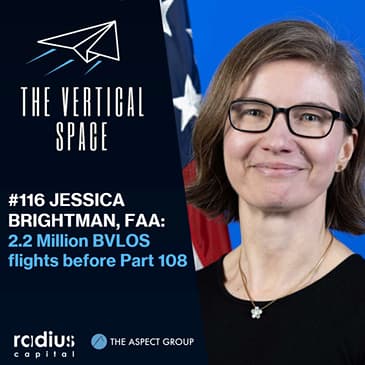
In this episode we speak with Jessica Brightman, Policy & Standards Branch Manager in the UAS & Advanced Technologies Division of the FAA’s Office of Advanced Aviation Technologies, recorded while the final Part 108 BVLOS rule sits in White House review. Most of the conversation was about how the US built a live UTM system without a final rule. Eleven FAA-accepted services now operate across roughly ten states, and from January through September 2026 they deconflicted more than 2.2 million BVLOS flights. Jessica argues the model scales because it requires only the services an operation’s risk calls for.
From there we cover her view that every aircraft should be electronically conspicuous, and how that shapes Part 108’s right-of-way construct, one of the proposal’s most debated parts. We also get into the new priority scheme for lifesaving missions, what Part 108 permits mean for small operators, and why tying UTM, air taxi services and ATC together is still an open standards problem. Jessica also makes an interesting argument about operational intents and why some operators have reserved far more airspace than they need.
06:53 ADS-B and Privacy
07:56 Privacy Identity and Right of Way
10:15 Two sides of the conspicuity argument in Part 108
16:35 UTM Breakthroughs Since 2023
25:03 Adding tactical deconfliction
26:09 US vs Europe and Part 108 Scale
34:45 The Economics between the US and Europe
38:31 What will Change with Part 108
41:30 Scaling Beyond Waivers
44:37 Everyday I'm Given a Puzzle
46:05 Surprising Use Cases
48:57 Community acceptance
54:14 Foreign-made drones
56:27 UTM Standards And Harmonization
01:05:15 Standards Development is a Team Sport
Jessica 0:00
Every day I'm given a puzzle. It's probably a 100-piece puzzle. It's got about maybe 80 pieces in the box, so I'm missing 20. And of the 80 pieces in the box, probably another 20 don't fit. So my job is to figure out what pieces we need, which pieces don't work and need to be changed, and how we can fit those all together.
Jim 0:31
Hey everyone, welcome back to "The Vertical Space" as we welcome Jessica Brightman, manager of Policy and Standards branch in the FAA's Advanced Aviation Technologies Integration Office. Her team leads policy development and implementation of UAS technologies. The drone industry is reaching an important turning point. In just three years, we've gone from testing UAS traffic management concepts to safely coordinating more than two point two million BVLOS flights in the United States in the first nine months of twenty twenty-six alone. But that's just the beginning. The challenge now is moving from individual approvals and limited operations to a system that can safely accommodate millions of flights, different missions, and an increasingly complex aerospace. We'll explore what's been learned, how the proposed part one oh eight framework could fundamentally change the industry, and what it will take to build a safe, scalable, and globally interoperable aerospace system. By way of background, Jessica joined the FAA's UAS Integration Office in twenty eighteen and transitioned to her current role in twenty twenty-three. Previously, she worked at the US Environmental Protection Agency, Internal Revenue Service, and in private industry. Jessica is a former US Air Force officer and pilot, where she flew C-five Galaxy aircraft. In addition, she is a FAA certified airline transport pilot and flight engineer, and flew for American Airlines throughout North America, the Caribbean, Central America, and Europe. Jessica earned her BS in mathematics from Fitchburg State College and an MBA from the University of San Francisco Jessica Brightman, welcome to The Vertical Space. It's great having you with us
Jessica 2:05
Thank you. It's great to be here. I really appreciate you inviting me to join you
Jim 2:09
We appreciate that you joined us. First question, Jessica, is there anything that very few in the industry agree with you on?
Jessica 2:16
That's a great question, and I'm gonna take it back a few years. think that the one thing that folks didn't agree with me on a couple years ago, I'm getting a lot more interest and a lot more understanding now, and that is around the need for universal electronic conspicuity and how that's going to help bring all aircraft together and within the airspace. You know, in the United States we have a very large, diverse airspace with a large portion of it, uncontrolled or Class G or Class E, and there's a lot of areas that are highly unpopulated, and we as a result have a lot of freedom in how we can utilize aircraft across our country. And over the years we have seen an increase in the diversity, variation, density, complexity of operations, not just in our urban areas, but across our country. And as this continues to evolve, I think we're going to get to a tipping point where it's really important that every aircraft, whether it is flown by a human, remotely controlled by a human, or potentially in the future autonomously controlled by a system, I think it is important that we have a level of electronic conspicuity and electronic signal so that all those aircraft can, you know, both see each other with eyes for the ones with pilots on them, but also see each other digitally and have that full picture, that national airspace that FAA envisioned several years ago and we're working towards
Jim 4:03
How has your position changed on this, Jessica? It sounds like you've changed your opinion on this in the last couple of years
Jessica 4:10
Well, I wouldn't say my position has changed. I would say a lot of others have. When we fir- when I first started, you know, doing this and I thought, you know, brought up that I think everyone should have some form of beacon, there's a lot of folks who really want to be out there and be anonymous and, and fly privately and, and have their, their space in the sky, and I think that's great. But I also think we are getting to a level of complexity and density of operations where we need a l- a safety level that requires, a way for us to digitally see each other, and we need to work through a variety of different issues and c- you know, concerns of stakeholders across our country. But over time, I think we need a way for everybody to be digitally visible to h- really have fully use and efficiently use our airspace
Luka 5:00
And Jessica, is this a conversation that has gotten increasing attention around Part 108, or are you thinking more broadly, as an alternative to ADS-B that offers more privacy or otherwise an improvement in bandwidth, et cetera?
Jessica 5:16
I think that there's been a lot of increase of discussion around it, definitely after the, notice of proposed rulemaking went out for the normalizing UAS BVLOS operations rulemaking, which includes Part one hundred and eight and one hundred and forty-six. also sadly, the crash that happened over the Potomac, increased the discussion around the need for conspicuity of aircraft. And I think that my opinion is that we need to utilize all types of conspicuity. There's not gonna be a one size fits all. So, you know, we have remote ID on small drones, we have ADS-B on aircraft, we have Mode S transponders, we have Mode C transponders. There's other tech-technologies out there such as FLARM that are being used in other parts of the world. And I think that, you know, we need to look at all the options and find ways to best suit the different use cases in our airspace so that everyone can be safe.
Jim 6:15
And who would find this most controversial at this point, Jessica?
Jessica 6:19
That's a great question. I think that a lot of the folks that are flying around, without electrical systems like the anonymity that that gives them. But there's also concern, within our and other sectors, across the industry around potentially that could be national security or other ways along those. And we need to find technologies to allow for those to be conspicuous, but also protect the mission and protect the security of the country. And I don't think this is an unsolvable problem.
ADS-B and Privacy
Peter 6:53
So Jessica, in the, in the early days of the ADS-B, design and, and the debate around that, just take us back. what were the points of discussion back then, and how did that get resolved?
Jessica 7:07
You know, I think that was a, a mandate that was required for certain airspace, so it's a little bit different of a qu- a little different question. I think that we, we resolved it in the way that we were able to meet the levels of equipage needed for ADS-B rule airspace. however, I don't th- because of the fact that there were still places that people could fly without it, there are... of the emotional issues around it were not addressed, and still need to be worked through. But on the other hand, we also allow for ADS-B out in certain s- circumstances in controlled airspace for national security. So we need to work around how to address that and how to, how to go forward with that in the future
Privacy Identity and Right of Way
Peter 7:56
What's the difference in your mind between, the concept of conspicuity and then attaching identity to that information? And You know, in order to achieve the mission, what do you feel is necessary?
Jessica Brightman, FAA (she/her) 8:12
I'm a safety person at heart. so from my perspective is location information and ability for aircraft to see each other and then utilize that information in potential systems such as UTM and other, ways to avoid collision is the most important thing. think that, you know, there are others that have other goals, but from an FAA perspective, from a safety perspective, the ability for aircraft to see where each other are digitally or otherwise, and for systems, you know, to do that it has to be digitally as we go towards auto- h- more highly automated systems. I think that the, the position and is the most important part
Peter 8:56
Yeah. That, that's, that's my opinion as well is that, you know, what really matters is that there's an object out there and, it's at a certain location and going in a certain direction, that's what I need in order to avoid it as a pilot.
Jessica Brightman, FAA (she/her) 9:10
Correct
Peter 9:12
knowing the identity of the owner, I mean, ultimately, you know, the tail number tying right back to that is not necessary for that, yet that's the way that the system works. And my understanding is that there, there is law, there about the, accepted uses of ADS-B data, for safety. but you know, we also see lots of instances of, abuse of that and, and using it for a bunch of other, commercial and economic purposes that is just working against us if, if the actual mission is, is what you're talking about, is safety.
Jessica Brightman, FAA (she/her) 9:47
Yeah, and I think, you know, there are some implications on that question that I can't fully answer because of the rulemaking. and the, You may have seen the use of non-installed ADS-B units implied within the rulemaking and the draft rule. so obviously there's some issues around that, that when it comes to the type of data included in those devices and what's needed, I can't really talk on that because we don't have a final rule
Two sides of the conspicuity argument in Part 108
Luka 10:15
in the context of 108? I understand that electronic conspicuity together with, right of way have been two of the most contentious issues for which a second round of comments has been, opened. as it relates to electronic conspicuity, what are the on both side of the industry, whether it's on the GA or traditional aviation or these new entrants?
Jessica Brightman, FAA (she/her) 10:39
Well, you know, let me sort of step back for a minute first. know, at FAA we look at risk and mitigating risk. And as we worked through building the framework for the normalizing UAS Beyond Visual Line of Sight operations rulemaking, AKA one oh eight and one forty six, we looked at the different risks and how we felt that these operations that we had been working through on waivers and exemptions were well the op... you know, w-were well mitigating the risks and what the consistencies were and how we should create a framework to mitigate these different risks going forward. Two of the biggest risks that we look at are drone-to-traditional aircraft collision risk and drone-to-drone collision risk. and within the rule construct, we have different ways of addressing both. electronic conspicuity is one of the ways we have of addressing, drone-to-traditional aircraft collision risk, in that we created a construct where if an aircraft was conspicuous, i.e., if it had ADS-B or some other form of, know, portable ADS-B or something along those lines, a transponder, then the drone could give way to it. Because we know we have several drone, operations that have successfully tested dr- DAA equipment where ADS-B out, signals from the traditional aircraft are received by the drone, and they utilize that information to avoid that aircraft. So we're gonna... You know, we created a construct where we would have a s- have areas of our airspace where conspicuous aircraft would always be given way to by the drone. And then on the other side, the drone-to-drone collision risk, we look at addressing that through strategic deconfliction services for UTM as well as conformance monitoring for situational awareness services in certain areas, depending on the risk of the airspace. there are other risks out there too, but those are the, the two big ones and we real- that's sort of how we think about them and why we incorporated that into the rulemaking.
Luka 12:48
and those who push back against this right of way, implication that traditional manned aircraft need to be conspicuous, what is their argument
Jessica Brightman, FAA (she/her) 12:57
Yeah, that's a good question. I probably... I can guess about a couple of their arguments. Obviously, I, I have a very strong feeling that I think the rule was written in a really good way, and I think it creates a safety construct that will improve safety for everyone. I do think it falls back on the innate human sort of feeling of with change and comfort with the way we've done things for a long time, and desire to be able to get in your small airplane and fly around and not have anyone know where you are. I do think that when take a look at it, they'll under- they understand that this does improve safety. But again, change can be very difficult, and I think that we have come a long way in bringing this conversation more to the forefront in the last two years. You know, when we started talking about this in San Diego at, the conference out there, and I think it was twenty twenty-four or twenty twenty-five, twenty twenty-five, there was a lot of people that were... A lot of emotion came up. But the same conversation, I was at the, GUTMA conference in Japan la- a couple weeks ago, and that conversation was still very much in the sh- forefront. Obviously, that was mostly new en- entrants, and from the new entrants perspective, it is much easier to create a detect and avoid system to a cooperative aircraft than a non-cooperative aircraft. The technology is much more mature and much more successful at this point in time. So you know, the... But it also wasn't, like, a controversial topic to bring up, where two years ago it was pretty controversial. And I think now we've gotten it to the point where it's something that everyone expects to talk about, and I think over the next year or two we can hopefully get it to the point where everyone understands that not only is this change that needs to happen because of the changes in our airspace and the increase in density and complexity of aircraft out there, but also that while it makes way for drones to come into the airspace, and allow them to fly beyond visual line of sight safely, it also increases safety between traditional aircraft and allows for other aircraft that were no- previously unable to be conspicuous, such as balloons and gliders, have that safety equipment and that added layer. Aviation is all about safety layers, so any time we can add a safety layer, I think it's a good thing.
Luka 15:34
would your opinion on this right of way rule, change if there was an equivalent to ADS-B out that could be, installed in drones, without the spectrum fears and concerns that exist today, and without, overly economically burdening the drone operators with onboard, acoustic or radar DAA systems which, would make a good chunk of these operations, just prohibitively expensive in the first place?
Jessica Brightman, FAA (she/her) 16:03
You know, I think that what we need to do is try to find a way to make it simple. And, you know, if we start adding more complex technologies and trying to change the paradigm of our right of way a lot, we could end up in a situation where we have a very complex airspace in the future. I wanna make sure that the decisions we're making today don't create potential unintended consequences in a more complicated right of way paradigm in the future
Jim 16:34
very
UTM Breakthroughs Since 2023
Jim 16:35
good. Hey, Jessica, UAS traffic management has advanced significantly since '23. What's changed the most in the last three years?
Jessica Brightman, FAA (she/her) 16:43
It's a great question, and we've come a really long way, and this is something I'm super excited about. approximately three years ago in September of 2023, my team and I sat down with folks from industry and NASA about up the first strategic deconfliction or strategic conflict detection, services in the United States for operational use. to that, we had had UTM pilot programs, we'd had a UTM field test, but it had all been times where we went out on a given day, set up the services at a certain time, had basically a s- a, series of scripted operations I knew where the planned conflicts were gonna be. The systems found the planned conflicts. Everybody, you know, clapped at the end of the day, turned the systems off, we go home. we felt we had gotten to a point where we needed to test them in a more organic dynamic way, so we wanted to turn them on for real in the airspace supporting live operations unplanned. from that point, we went through a variety of different, meetings and technical interchanges, the industry side and the governance agreement through the what is now called the, Shared Airspace UTM Consortium. and we officially... FAA gave FAA acceptance to the first two strategic deconfliction services in July of twenty twenty-four. Fast-forward from then, we now have eleven services that ha- have FAA acceptance or, you know, approval for use in the airspace to support live operations. and from January 1st through September 30th of twenty twenty-six, we safely and effectively deconflicted two million two hundred and forty-five thousand plus flights in the United States. that's just in the twenty twenty-six calendar year through the end of September. you know, back to twenty twenty-three where we had zero operational flights, that's huge. and I think thing that has really made this possible is it was of the most successful public-private partnerships I've ever had the opportunity to participate in. it was extremely collaborative, both between FAA and our partners at NASA who've supported us and others, the industry, but also within the industry. the folks really came together from the different companies that on a, outward facing way and with their customers, they're competing. But when it came to safety and working about standing up this ecosystem as the first live operational UTM ecosystem in the world, they worked together really hard, and they shared cross-organization extremely collaboratively. And I was really very happy and really impressed to see with how it all came out.
Luka 19:50
When you look at this, huge body of operational data, what taught you that surprised you?
Jessica Brightman, FAA (she/her) 19:55
A lot of things. I'm gathering lessons learned and, you know, I'm excited because now some other countries are starting to stand up similar, scenarios such as the UK up in Turley. and I hope that they learn different lessons and can share those with us. but you know, we, we definitely learned a lot along the way. and I didn't mention before too, is we started, you know, in the North Texas area, and now we have it across multiple states. I think it's t- 10 or 11 states right now, and more in the queue every few weeks. so couple things. You know, we are starting small, and initially we started with a single priority level and everybody was first come, first serve. Now we, as of April 2026, we now have a two-level priority schema within the ecosystem where if an operator is flying a life-saving mission, whether that operator is a public operator such as a police department or whether they're a drone delivery company, you know, flying a hospital sample, as long as they are approved ahead of time to do so, they may request high priority and they therefore get priority over the other non-launched flights. so we've cut-- we've learned how to build up to that. I'm sure that there'll be, you know, other things we wanna work on in the future. we've also learned that some of our assumptions were not correct. we're learning now there's, some task forces that are going on about how to really efficiently use the airspace. We've had a couple situations where operators stood up operations very close and ended up having some restrictions that they didn't anticipate. So we're working through now how to best and most efficiently create operational intents within the sy- ecosystem that both are safe and allow for as needed. You know, can the aircraft's performance truly stay within that boundary? but also
Luka 22:10
you give us an example, Jessica? Sorry, for these, what, what you're mentioning
Jessica Brightman, FAA (she/her) 22:13
So, you know, right now when we first set everything up, we just said to all the operators and service providers, "You set up the operational intents for your aircraft and your flights and your customers." So the operational intents are the four div- dimensional volumes through time and space and altitude that are deconflicted through the strategic, you know, conflict detection systems and services. We did not define how people should build those because every aircraft has a different performance and different navigation accuracy. and we assumed that everyone would do their best to have efficient use of the airspace. maybe, you know, I, I always try to assume p- a positive intent, and maybe that was probably a little naive in my perspective. but we're learning that some people were very, very meticulous about this. Some people had automated systems that gave huge volumes of airspace that they'd never get out of, there's everything in between, including folks that probably padded the time on their, volumes to make sure that they would be able to do the mission they needed to do if they weren't quite sure when they were gonna leave. So, you know, now we're stepping back in and say, talking with industry and saying, "Okay, what are the best practices? How can we, how can we do this where we're both still maintaining our level of safety, but also efficiently sharing the airspace so that we can have services to deliver via drone to as many people in our communities as possible?"
Luka 23:51
And Jessica, remind me please, the strategic deconfliction, coordinates plans and intentions, right before an actual flight happens. But what happens when a drone flying on this, intended path, something happens and it goes off nominal? How does that real-time update propagate through the system?
Jessica Brightman, FAA (she/her) 24:08
That's a good question. That's something we're working on. you know, in the notice of proposed rulemaking, we required both strategic deconfliction and what's called conformance monitoring for situational awareness, and that's the service that follows along, that's one that is on the roadmap. It is not completely developed right now, but it's on our roadmap, and we're working through that. The industry consortium, decided, and we talked through having them stand up network remote ID as an optional service first, to allow for some concerns in some communities around security. So we, we worked with them to get that set up, and then we'll be working on conformance monitoring for situational awareness but it is something we're, we're working through. Right now I think that the density of operations is such that We're definitely safe with what we have, but in the next few years we'll need both services, and we're working on that
Adding tactical deconfliction
Luka 25:03
Do you think there's a point, again, based on the data that you're seeing in the field, is there a point at which coordination between the operators, stops being enough and the FAA has to step in in one way or another?
Jessica Brightman, FAA (she/her) 25:16
It's a good question. I don't think we're gonna need to do that. we may need to in the distant future at a level of tactical deconfliction. you know, similar to we- what we have in traditional aviation today. We have flight plans for strategic deconfliction of aircraft and like see and avoid and TCAS and ADS-B for tactical deconfliction. I think eventually in drones we may need that, but I think it's a far ways off. I mean, you know, we did have over 2.2 million flights that were BVLOS UTM for deconfliction this year. However, that's still, you know, when you spread that across 50 states, over nine months, we'd still have a lot of free airspace that we can efficiently add more capacity to.
US vs Europe and Part 108 Scale
Luka 26:09
it's such an interesting contrast between the path that the FAA has taken and the one that EASA has taken, right? On the, one hand, the FAA, went to industry for the technical architecture for how, operators' flights are discovered, between, each other. it's all open source essentially that they're all sharing. there's no designated drone airspace, like it exists in Europe. you know, participation in the services and the requirements are all driven by, the different risk dials when it comes to airspace risk and, and population density, et cetera, as opposed to a relatively heavy top-down, regulatory framework that, we have seen in Europe. and yet, you know, volume is happening in the US, even though there's no final rule yet. contrasting that to Europe where there is a final framework yet, you know, nearly four years later there's very little traffic
Jessica Brightman, FAA (she/her) 27:08
Yeah, it is, it's definitely a different approach, you know? And, I would say two, three years ago sitting at conferences, I was in a very different space, and I was receiving very different questions from the audience and very different comments, and it was not necessarily comfortable. I will say that, you know, I truly, feel for the folks who are in my shoes in Europe who are working hard and, and doing their best to implement U-space and a, a UTM ecosystem up and running. It's challenging. and you know, I think we're also a far ways from the finish line. We're, we've made fabulous, progress, and it's super exciting, and I'm really proud of how far we've come in the United States. But, you know, we're still working on small drones below 400 feet, and we still have a long ways to go. I mean, I still can't get drone delivery where I live in Virginia, as well as many people across this country, and I think it's gonna be quite a while before continues to scale or it becomes ubiquitous across our country. so which approach is gonna work long term, I have my opinions, but we're, we'll have to let history see that, and I think that... However, I think that what, what we've seen so far has shown that collaboration and flexibility and allowing for innovation in this space can be rewarded. but I do think that there's a no one size fits all is good for every airspace and every regulator. You know, I do truly understand the difference that I have here in the United States and the types of airspace that I'm overseeing versus, you know, I was on stage at GUTMA with, Manu from FOCA. And you know, they have a very, very small... Switzerland's a very small country. They're getting ready to stand up some UTM services. they're, quite ways along as far as U-space, and progress there. But they've got a lot more challenges, than we do in certain circumstances and certain aspects. So you know, you can't take what, what was successful in one part of the world and assume it's g- you know, replacing it in another is gonna be great. But I do think there are some lessons learned, and I think that the way that we approached it by allowing for us as FAA to come and just sit and listen and learn and understand the possibilities and also understand the limitations know where we could take baby steps with industry sort of hand in hand collaboratively I think that really helped us get to the successful point we are today
Luka 29:56
Yeah, it seems like the FAA went to the industry and said, "Get together, come back with some, reasonable technical solutions for the problem. we're not going to do it ourselves, but we will obviously regulate it. We will approve, data service providers, and then we'll, learn from trials before we finalize the rules." that seems to be the FAA's, approach as opposed to some other places around the world. But, how much of when you're thinking about, Part 108 and everything around it, Part 146, how much thought are you giving to economic because, and I don't know if this is a coincidence, but it seems like the approach that the FAA is taking, is a lot more feasible economically than the approach that EASA has taken, which by the way, is one of the reasons why flights are not really happening at volume, in Europe because of the critique on how expensive, it is. Anyway, what are your thoughts on that?
Jessica Brightman, FAA (she/her) 30:50
I'm gonna answer that in two different ways. The first way is, you know, we in these, in this country have the Administrative Procedures Act, and, you know, we're required to take public comment when it comes to setting policy and, implementing and promulgating regulations. we received a lot of comments when we put this rule out, and several of them were around economics, and concern around economics certain aspects of how we drafted the rule. And we take, we take all the comments seriously. We, you know, look at them and we see what we can do to address them. Obviously, of the comments contradicted each other, so it's our job to sort of sit there in the middle and figure out what is gonna make the safest, best, most efficient airspace for the American people overall, and what is gonna bring the best benefit to everyone, not to one comment or another, but to everyone. That's one thing. The other side of the coin is, you know, we at FAA and across just like any other organization, have resource challenges. And when I looked at how we're gonna address this, one of the things we had to consider here within the FAA was what do we have and what resources do we have, and how can we utilize those best to collaborate with industry? how can we best build this ecosystem, help train folks, help folks learn about UTM so that we're ready to oversee a rule when we get to a final rule? when I started working on this with my team several years ago- We didn't really have anyone with this experience. We all had to learn. I mean, folks in industry had to learn. Even today when someone asks me, "Well, what are you looking for in skill sets of UTM to have someone on your team?" And my answer's always the ability to learn this is a new growing space, and we need to utilize the resources we have and help them gain the knowledge to be ready and, and willing and able to fulfill the oversight goals. And I think of the reasons we are in the position we are today was that I was able to have my team there step by step with everybody learning together. You know, if we were here in FAA in a closed room writing policy by ourselves, we wouldn't be learning the same lessons industry's learning and vice versa. it's required us as government regulators to be a little more open, and be a little more willing to change our minds and understand and, and learn, and I think that's good. you know, and it's not the easy button by any stretch of the imagination. my team participates and listens in on all the committee and working group meetings that the UTM Consortium has. that's a lot of time commitment, but it's also our ability to learn and grow and our ability to help guide, is the term I'd use, the direction industry is going on some of their development. Even the stuff that we don't oversee, we can share our thoughts on it, and we do so actively on a weekly basis. but also it helps us understand where they're going ahead of time. We get a, we get a s- a sneak peek rather than just waiting for them to submit a, you know, 60-page application for approval. We are there along the way, and I tell our, you know, applicants for UTM services, "I don't expect you to hand me a completely done everything, with a bow on it. You can give it to us one bit at a time. We're, we're here to learn together."
Jim 34:35
to Luka's question. Give our audience a, a snapshot of the economics between the US and Europe. Give our audience a better idea of the differences, if you could
The Economics between the US and Europe
Jessica Brightman, FAA (she/her) 34:45
Yeah, sure. You know, I think the biggest thing is that for U-space, Europe requires that a service provider set up four services, and they're very prescriptive about how they do it, and they must have all of them approved ahead of time before operators can start utilizing them. Where here in the United States we look at it from a risk-based perspective, and we only require the services you need where in s- in the locations you need them to be deployed. So if, you know, if you read the notice of proposed rulemaking, it basically says if you're over unpopulated areas, really not a whole lot of risk mitigations you need. because concern is about harming on the ground or other pe- other aircraft in the air. And if you're out in the middle of nowhere where there are no people on the ground and no one else flying, it is your responsibility and your aircraft and your just concern for that aircraft that is your driving safety need. now if you're flying over a suburban area with a bunch of houses and population and parks and schools on the ground, I'm worried, so I require more services and more safety mitigations, whether that be strategic deconfliction conformance monitoring for situational awareness, detect-and-avoid services, other types of things along those lines. So I think the thing is, is in Europe it's all or nothing when it comes to UTM and services, and everything must be deployed, and it must be gone through this full very rigorous overview process that is pretty intense. Where here in the United States we look at you only need the services you need based on your risk, we also do a lot more declarative, review from o- from the FAA perspective. We do require, you know, like for example we ask that they declare their cybersecurity. Now I may come back and audit it and ask for the full documentation, which it- will do in the future and have done, but all I'm asking you when you put your application is to declare through the mean, what means of compliance you're using
Jim 36:58
Luka, as, Jessica described your differences, is there anything else that you would mention that you think is different between the US and Europe on the economics?
Luka 37:06
yeah, correct me if I'm wrong, Jessica, but, but also my understanding is that in, in Europe, the U-space provider, actually issues the flight authorization. whereas in the US, the FAA just keeps that authority through the certificates, or, or permits, and the providers just coordinate among each other. and so in Europe, if you have an entity that actually issues the flight authorization, that implies a certain layer of additional certification and safety and quality management systems and, you know, all of these different layers that ultimately someone needs to pay for.
Jessica Brightman, FAA (she/her) 37:42
Correct
Luka 37:43
so yeah, that's the only additional part, Jim, that I would add. But, but also, Jessica, how fair is the pushback from a European regulator saying, that the U-space airspace is supposed to be set up only in places where, the risk is, you know, higher and where an equivalent, geography in the US would require equal levels of, you know, scrutiny and oversight and requirements?
Jessica Brightman, FAA (she/her) 38:12
I don't wanna question my, my fellow regulators. and, I would also say that, you know, I have not the risk levels, in that much detail side by side. So I, I would not to, make a comment there
What will Change with Part 108
Jim 38:31
Jessica, you mentioned ubiquitous drone operations across the US. How's 108 gonna help that? what's the biggest change that's gonna occur because of Part 108 in order to bring about this vision for ubiquitous drone services?
Jessica Brightman, FAA (she/her) 38:45
right now, whether it's UTM or BVLOS, approvals, we are at FAA are doing it as one-offs, utilizing waivers, exemptions, and letters of acceptance, to approve the operations and the services that support them. The, operations are either under 107 waivers or Part 135 exemptions. And burden on the operator to put together that application, their safety case, and, and go through that whole process to get the approval is a lot. and that's for the operational side. And then the service side, they have to go through the, what we call the U- UTM near-term approval process and get their letter of acceptance based off of the waiver and exemption granted. And it is not a small mountain to climb. So when we get to the normalizing UAS beyond visual line of sight operations final rule and Part 108 becomes effective, there is a framework within that that has a variety of permits and certificates based on the operational risk, that allow for different levels of applications and different rigor, when they apply for operations. As well as within the s- service side, we have different levels of services based on what types of operations they'll be supporting, 108, 108 with waivers, and or beyond 108. And all of these frameworks are set up so that the lower risk applications require less rigor and less oversight, both from the operator or service provider side, but also from FAA side. So it allows us to take the limited resources we have and focus them on the oversight of the higher risk operations. So it, it is really a, a two-sided coin here, where we are looking to reduce the regulatory burden on the lower risk operations, so it's less expensive for smaller operators to become, in this ecosystem. But also allowing us to understand and, and parse the operations that we need to be more actively involved in overseeing because they're higher risk, there's greater operations, versus those that we can, you know, provide more spaced out routine audits. under Part 108, there'll be the opera- option for a one person, two person, or very small operator to apply for an operating permit that is not a whole lot more than an online application with a few documents that they need to upload and declare to.
Scaling Beyond Waivers
Jessica Brightman, FAA (she/her) 41:30
Where now the for a 135 operator certificate with the exemptions required for remote operations is a, is a huge mountain to climb, and most smaller operators just could not afford that, nor take the time to have the time to do it. So I think that the ability to scale is really gonna come from the fact that, you know, the operators we see that are wor- working hard and making a great amount of progress in the airspace today are the big operators that have the financial resources to file for the exemptions and waivers and support those operations on a, great scale, where once we have a regulation allows for more simple applications for simpler, less risky operations, we'll see of variety coming into the ecosystem.
Peter 42:21
So is the framework that Part 108 lays out something that we all expect is gonna carry us far into the future, with this? Or is it a stepping stone to, another framework that is somewhere off in, in the future with scale?
Jessica Brightman, FAA (she/her) 42:39
I don't think it would be possible to build a rule that could predict the future. There is no, you know, one rule to rule them all, so to speak. that, that's just We learned that in 107. You know, the day that became effective or a few days later, we had a bunch of waiver requests. so by no means is this the final rule. I don't think we'll ever have a final rule, and, and, that's evident today, and you see the other rulemakings going on within FAA to continually update and approve our entire regulatory structure within 14 CFR. but I do think it's gonna make a big step, and definitely below 400 feet, allowing more operations along the aspects of... under 108, we have categories of operational permits and certificates, including demonstrations, civic interest, agriculture, package delivery, and testing, as well as, as others. so I think right now today, when we look out in our airspace, we see a lot of package delivery. We see some infrastructure inspection and some, and some agriculture. We're also seeing some, public safety operations, but again, they tend to be in the, the more funded areas. So I think once we have the permits for civic interest and the permits for agriculture, we'll have, small agricultural operations being able to, put in a permit for one to two drones or a or certificate, and it's much easier than going through a full 137 exemption process. I do see... expect that to scale as well as, smaller, surveying type operations will be able to, to scale as well. But I do think it is the end all be all, and I think, we have a bunch of other stuff going on within the FAA and DOT and across industry such as the, EIPP, where we're learning more about eVTOLs and higher altitude operations.
Everyday I'm Given a Puzzle
Jessica Brightman, FAA (she/her) 44:37
And we've got a lot more to learn about that before we understand fits into our current regulatory structure and what needs to change, and that's a puzzle. And that's one of the ways I've always described why I like my job, that is that drone integration, and it... the same will be true for eVTOL and some of the other things coming down the road such as, you know, supersonic, is
Jessica 45:03
every day I'm given a puzzle. It's probably a 100-piece puzzle. It's got about maybe 80 pieces in the box, so I'm missing 20. And of the 80 pieces in the box, probably another 20 don't fit. So my job is to figure out which, what pieces we need, which pieces don't work and need to be changed, and how we can fit those all together.
Jessica Brightman, FAA (she/her) 45:26
we do have several, you know, regulatory pieces out there that eVTOLs will be able to fly under Very well, such as ni- you know, under 91. But what in 91 needs to change and adapt? What needs to evolve? What needs to be adjusted? And I think the operations under the EIPP and other types of testing will help, help us get there, as well as what we learn when we actually implement and have a final rule under 108 and 146, and then we start seeing what kind of the... Hopefully not the next day, but you know, what kind of waivers and exemptions people want from that, and we can learn from that. It's a continuous cycle
Surprising Use Cases
Jim 46:05
you brought up different use cases for, drones. What surprised you a little bit about the use cases over the last three to four years?
Jessica Brightman, FAA (she/her) 46:13
One of the things that I, I had not anticipated was the rapid increase in drone light shows, which I think is really an awesome, awesome use of the technology. both from a environmental perspective, but also from like a smoke and, you know, other just airspace visibility perspective and the s- the view of the show. I think drone light shows are, are really amazing and it's gonna be interesting to see how those scale. I had been very focused personally just on the, package delivery, medical delivery side, public safety side, and watching the use of them scale and the different ways they've been worked into other artistic performances and entertainment has been really cool. and I think, obviously we have a lot of work to do to con- see where that can go, but I, I think it's a really cool, cool thing
Jim 47:10
And is drone package, delivery in more urban environments, is that more likely to occur in a couple years or less likely? How has your impression changed at all in the last couple of years?
Jessica Brightman, FAA (she/her) 47:22
You know, I think a lot of it's gonna come down to what types of delivery systems become most prominent and most successful. Because right now, you know, most of the deliveries are suburban environments where you've got a big backyard or front yard that you can drop the package into. however, there's also some use cases around apartment complexes in the Dallas-Fort Worth area where they have like, communal drop spots. so depending on how that all evolves, accuracy of putting the package and the ability to have a c- a communal area to get packages and how that all works into both how the industry evolves their aircraft and their delivery means, but also how local communities choose to set up land use and how these, you know, systems can launch and drop packages is gonna be something that is, outside of my purview, but will be interesting to see what communities want
Peter 48:26
I wanted to ask what your thoughts are on where does the FAA play... Let's, let's take Part 108 and, and drone package delivery, or really any type of drone operations. Where does the FAA play with respect to public acceptance concerns as opposed to safety concerns? And when hears community feedback around these types of operations, how does FAA react to it? how do you handle it? H- how do you contrast it with the other responsibilities that you have?
Community acceptance
Jessica Brightman, FAA (she/her) 48:57
It's a really good question. and I think it's important for FAA to be involved, but it's also important for everyone to be involved. Community acceptance is, a team sport. Everybody in the industry really is... needs to be responsible and needs to be participants. And I think we've seen that over the years with traditional aviation. You know, we have always dealt with noise issues as community issues. FAA has been there on the ground, operators are there on the ground. We all need to address the concerns together, and I think it is no different when it comes to, you know, new entrants and non-traditional aviation. I do think that it is much more-- more poignant and important that we do it in an, an active rather than a reactive way. FAA included aspects of community engagement and community outreach in our initial integration pilot program for drones, several years ago and also rolled that over into our Beyond program. and I think that that has been very successful. Several of the participants in both of those programs had some really great active, community outreach programs and worked to create best practices that they've shared with the industry as a whole, and I think we'll continue to iterate on. FAA has done everything, you know, we can with our limited resources to help and participate, and I intend to, you know, keep that up. I think it's really important for folks to understand that what the things flying in the airspace above their heads are safe and, there for good, and that drones are there to help bring interesting and, positive services to communities. But we do need to be active getting out there and sharing that message so people understand them. Because, you know, back to our earlier discussion on electronic conspicuity, change is hard for everybody. Even when it's going to something good and exciting, it's, it's new and different, and we need to help people understand what it is so that they can be comfortable with it.
Peter 51:09
Right. it touches on, being active in terms of communicating is, is one aspect of it, but you also, have at your disposal to be active in terms of regulating, around community acceptance concerns. And certainly in the past, the FAA has done that. If we think about supersonic flight over the continental US, I think I could argue that that was a community acceptance concern that led to regulation. Wasn't necessarily about safety. and then also with, planning of terminal procedures and the increasing precision of those procedures, and then the impact that that has had on communities that are getting, certain streets, certain neighborhoods are getting much more of a noise dose, than they were in the past. And so you've had to navigate that. some of those community acceptance issues you could say are constant over time because, jet technology is, is relatively static and, and the noise has been there and, you know, yes, there's been noise reduction. But then with something like, drone operations, it's so very new. it bears a lot of the similar community acceptance patterns that automobiles did, you know, a hundred and twenty years ago, a hundred and ten years ago. And so you have a moving target in terms of what the community is going to think about it. And then also you have a rapidly moving target in terms of the, acoustic impact of the drones themselves because the-- that, that technology is only going to improve from, from where it is today. So do you distinguish between the level of action that you take here in twenty twenty-six, twenty twenty-seven for something like this versus things that you've dealt with in the past?
Jessica Brightman, FAA (she/her) 52:48
Well, and you... I would also add that each of the different package delivery companies and each of the different drone manufacturers across the country have taken different approaches on how they build drones, how they address concerns. You know, we have package delivery drones that are, know, 12, 15, 20 pounds and very quiet. and then we have heavier drones that are 80-plus pounds and not as quiet. and then when it comes to some of the agriculture drones, we have, again, super quiet ones, electric ones, and then we have some that are fuel powered that are, you know, definitely not a whole lot quieter than some of the small traditional aircraft. So it is a broad range. I think the important thing is to be open to listening and, and hearing those concerns helping people understand what is going on allowing them to their feedback on that. And then FAA needs to adjust, you know, obviously we accepted public comment on the current draft rule for BVLOS, we will do so on other rules. We accept public comment on our environmental assessments and put that out there for the public to be able to share their concerns, and we take those comments and adjust and adjudicate appropriately, and we'll continue to
Foreign-made drones
Jessica Brightman, FAA (she/her) 54:14
do so
Luka 54:15
I think another interesting question, might be around, this, foreign drone restriction. The industry is hearing about this from, from a few different directions all at once. we have the FCC, decision from, I think, last December. there's some proposed Part 108 limits on this, but can you un- untangle all of that for us? And, and what does that mean for an operator who already owns, controls, flies drones? how does the FAA think about this as, as it builds a path to, you know, routine BVLOS?
Jessica Brightman, FAA (she/her) 54:47
I can't really speak to the, requirements set by other agencies such as FCC or, you know, some of the information that was put out in executive orders that were not directed at FAA. One thing I can say is, you know, within the regulation we have ways, to address drones manufactured in other countries through bilateral agreements the same way we do with traditional aircraft certification. and we, you know, included that similar framework into this rule set. obviously that was in the draft rule. I can't speak to any adjustments that were made or are being made. but I would say that, the important thing is we are doing everything we can to assure that the regulations we are promulgating, that the policies we're putting out are leading to the safest airspace that we can, provide
Luka 55:43
Got it. And maybe one, one last one-way question, at least from my side. Right now the final, draft is at the White House, as I understand, and the target is to release that by the end of the year. Is that still the timeline?
Jessica Brightman, FAA (she/her) 55:55
I can't speak to the timeline because it is at the White House, They can control my timeline, but I can- but the reverse is not true. We- That said, I can say that we are working very hard to collaborate with the Office of Management Budget, and specifically the Office of Information Affair and Regulatory Affairs to address interagency review and finalize this rule and get it out as soon as we can
Luka 56:17
It'll be on my dear Santa letter
Jessica Brightman, FAA (she/her) 56:20
Me too. If not bef- if it's not out before, it will be definitely on that
Jim 56:24
Jessica, how
UTM Standards And Harmonization
Jim 56:27
operators, o-other space users in the existing aviation system ultimately work together?
Jessica Brightman, FAA (she/her) 56:34
It's a great question. let me start with the UTM ecosystem. currently the servi- most of the services that we have deployed in the United States are interoperable services. They're based off of an ASTM standard called the UTM USS Interoperability Standard. And, we utilize software testing to assure that they are interoperable and that they can share information and that they can de-conflict the, the constructs. and right now That's sort of where we're at. One of the things that I think we need to work on in the future is how these ser- systems will interoperate and share information. You know, we have... We are working with industry on how they can share some of that information with FAA as needed in the future. stan- international standards bodies, including ASTM, are working on, you know, standards for UTM, also for what we call providers of service for UAM or PSUs because, you know, the, the UTM for eVTOLs someone decided an- another acronym was necessary in the world. and as well as s- services to support vertiports. and one of the things that I have talked to s- folks at ASTM F38 about is fact that I think it's gonna be really important that as we finalize and mature all of these standards, that we find a way, a protocol, a framework for exchanging information between them, as well as the traditional, ATM systems. And this is really important because, you know, we can build systems to receive information from data services in the United States, as can other countries. But what we really need is standards so that they can be harmonized across the globe and allow the industry to deploy the same technologies that they deploy in the United States, in Canada, in Europe, in Australia, in other areas. Because if we don't have standards and we go with boutique or, you know, regional solutions, go back to that economic topic. if you have an not uniform, non-standardized way of addressing these situations across the globe, it's just very expensive to deploy
Luka 58:58
And you mentioned EIPP earlier, the eVTOL Integration Pilot Program. Those aircraft that are flying right now, or I think they're flying still, but they're even if they're uncrewed, they're integrating through ATC, not UTM.
Jessica Brightman, FAA (she/her) 59:13
Correct
Luka 59:14
How d- do those two systems between ATC and, and UTM, how does that ultimately meet
Jessica Brightman, FAA (she/her) 59:20
Well, right now ASTM is building a standard for PSUs. I believe it's in a, a round of balloting. It's not been published yet. that standard is published, we will be looking to work with service providers, and actually there's several... a few of them that have already come to us and are s- beginning to talk to us about how they can work towards Part 14- 46 certification and authorization of services once the rule is final, for their PSUs based on those standards, and, and how those will interoperate with UTM and with, ATM. Obviously, since the standards are still being written, we, we're, we're gonna have to see how that all evolves. but I think that we're going to need to be very vigilant on how we work together and make sure that both the UTM interoperability standard, the PSU standard, the vertiport s- services standard that's being worked, all of those are in ASTM, how they're being worked, how they're being matured, as well as how we are working through the updates to the, air traffic system here at FAA. We're gonna have to work together and collaborate and, and keep track of all of them so that we do reach a point where they can all talk to each other and exchange information as necessary. And the thing that's... I say- would say is most challenging is none of them are a stationary object. even the UTM standard that's published, it published has been, had a couple drafts, but they're still working to mature it and improve it and make it more robust and continuing to, to add to it. So since they're all evolving, we need to really be very coordinated across industry and government and FAA and other, even other, authorities and other CAAs around the world working together to assure that we're, we're all moving forward in a way that will w- will be interoperable and collaborative. It's a house of cards, really
Jim 1:01:29
Jessica, when our guests see that, oh, Jessica Brightman is, is about to be released the podcast, and they'll say that, "Oh, this is gonna be great," what topics do you think they're gonna expect for you to talk about that we have yet to talk about?
Jessica Brightman, FAA (she/her) 1:01:45
I think global harmonization we just started to talk that's really, really important to me, because of the fact that a lot of these systems are all highly automated. And we need to have things that are deployable anywhere in the world with minimal regional, accommodations. I have a background in traditional aviation, so... and a lot of international flight time. And one of the hardest things was in areas of the world that had different types of regulations. When I flew in the late '90s, early 2000s, things were pretty homogenous, pretty similar. Like, you could take off outside the United States, fly through Canada, fly across the Atlantic, fly into Europe, and from a perspective of me strapped in my seat, the, the difference for the controllers was only the accent. procedures, the, the types of phraseology, everything was very, very similar. Now, not all areas of the world were that way, and when you went to some of the areas of the world that used different types of altimeter settings or different types of altitudes that required conversions, it became very challenging as an operator and as a pilot. you'd go somewhere where, say, you know, QN- QFE or QNH, altimeter settings were used versus, you'd have to off at one place using one type and land somewhere else using a different type with all sorts of math required at the end of a long flight. That's not a whole lot of fun. and I think about that, and as I think about drones and highly automated systems, need to make sure that things are as homogeneous and as harmonized as possible because these systems really need to be able to cross those borders seam- seamlessly. They need to be able to take off in the United States, you know, out of, say, know, Buffalo and deliver medical supplies to Toronto without having to worry about whole different protocols across that small spans of air, which has no boundary that the drone can see in any way. And I think that's really important, and I think that we need to collaborate across industry, across, you know, civil aviation authorities, across air navigation service providers to assure that we are creating a ecosystem that works in a standardized way, and create standards that can be utilized to support the needs of very different locations across the globe
Jim 1:04:21
And what person or organization can best bring that about based on your vision?
Jessica Brightman, FAA (she/her) 1:04:26
That's a good question. I don't think there's one organization. I think it needs to be a collaboration of a lot. I think ICAO has a very strong role to play, but I also think, you know, the individual, civil aviation authorities such as FAA need to be actively at the table and engaging. we can't wait for things to be developed and then say, "Oh," raise my hand and say, "I'm sorry, that doesn't work in my country."
Jim 1:04:50
the FAA engaging?
Jessica Brightman, FAA (she/her) 1:04:52
We are. We are, we are engaging at ICAO. We're engaging at the standards bodies such as ASTM and RTCA. I think standards bodies have a great, responsibility and a great role to play. And it comes down to that whole thing of safety's a team sport. I was at a ASTM meeting a couple weeks ago.
Standards Development is a Team Sport
Jessica Brightman, FAA (she/her) 1:05:15
My team is going to another one in a couple more weeks. we need industry there too, and one of the things that I think is really challenging, and I know the folks at ASTM am always happy when I remind everyone in the audiences that I talk to is standards development is a team sport. We a- we need you all there. And even from the perspective of, like, when we're working on standards for airworthiness, of course it's helpful to have the aircraft manufacturers in those meetings, but it's also helpful to have different operators in those meetings and understand the different needs of what types of drones they're gonna need, what ki- kind of systems are gonna best support their missions. If you're not at the table when the standards are being developed and there's a need you have, it may not be addressed because you're not there to
Jim 1:06:07
who's not at the table, Jessica? You don't have to name names, but you can name Well, you can name names. what, what kind of stakeholders are not at the meetings that you think should be?
Jessica Brightman, FAA (she/her) 1:06:17
Well, I think that, you know, it's, it's, it's one of those things where it comes in ebbs and flows. We see a lot of the big players at the meetings. I think it's one of those things where a lot of the smaller organizations have a harder time coming to the meetings. They have less resources. I personally encourage them to call in when they can. You don't have to be there every time, but call in, participate, read the documents, vote on the ballots, become members of the standards organizations. we see a lot of large package delivery companies at these standards bodies. see a lot of those. And, you know, that's great, and I'm so glad that they are dedicating those resources to build this ecosystem and to build this community and to build the standards we need, but I'm not seeing everybody else there. So if you're not a package delivery company and you're not showing up for standards meetings, you know, contact me. I'll help you get in touch with the right people and help you get in those meetings, because it's really important
Jim 1:07:16
as you prepared for today, what else were you hoping that we would ask that we haven't asked? Or what's a message you'd like to send that, you don't think you've sent yet?
Jessica Brightman, FAA (she/her) 1:07:26
That's a good question. about a lot and I'm trying to go back through my brain and, and wrap, you know, figure out where, what we've touched and what we haven't
Jim 1:07:35
who most influences you in this industry? Who do you, who do you spend the most time listening to and you think, "Yep, that's a person I want, I want to hear their perspective," and you think they have a, a clear message as you do?
Jessica Brightman, FAA (she/her) 1:07:50
There's a lot of them. I think that when it comes to UTM, Negron from Wing has a really, really interesting perspective. I also think that, also on the industry side, Tyler Dix from Airspace Link is a really smart individual, and I really appreciate work that he does. from the operator and airworthiness side, Mark Blanks is always a really great guy in terms of... And again, he's gonna be one of the ones that's gonna, bang on that standards drum as, one of the folks who leads the F-38 working group. also, from the regulator side, we've got some folks, across... we have Sophie, on her last name right now, from the UK. we have, Sam Chapman and Will, from CASA down in, in, Australia that are, are working really hard on this. and I'm sure I'm forgetting some other folks, you know, the, the folks up in Air Transport Canada as well as, know... I, I know I haven't mentioned EASA, but, I'm gonna leave them off the list.
Jim 1:08:58
you have an audience of entrepreneurs in the line as well who are listening. What innovations do you think are needed right now that you don't believe are being addressed?
Jessica Brightman, FAA (she/her) 1:09:09
That's a great question. I think of the things that are really gonna help long term is, we brought up before that we're utilizing strategic deconfliction now and, conformance monitoring. And I think that that has a... a lot of runway, to use a, a term, an aviation term, before we're gonna get to the density of operations where we'd need tactical. But I think working on smaller sensors and, things that can help drones, when it comes to tactical deconfliction over time are gonna be important. figuring out ways to better utilize the spectrum that we have in a way that is equitable able to be used by not just the big players but the smaller ones, done in a way that's secure. You know, a lot of the stuff that we did with line of sight drones wasn't necessarily aviation spectrum or secure aviation spectrum. You know, we did a lot w- lot of this line of sight drones are still being flown with, you know, Wi-Fi and Bluetooth signals. And how do we evolve and utilize secure spectrum in a way that can, benefit the whole industry? think those are some things as well as, you know, and the last thing is obviously gonna help not just drones but battery technology. how do we deal with battery technology that reduces weight, increases flight time and, is recyclable enough so that it... we can utilize them and reuse them and, and, and have the industry have that can fly for longer and, and be in a, a way that are easy to charge, easy to use, and then easy to swap out batteries and recycle the batteries
Luka 1:11:06
Jessica. This was a fantastic conversation
Jessica Brightman, FAA (she/her) 1:11:10
Thank you. And I think, you know, one of the things I think that is, I th- I know I've talked about it a lot, but I believe that when it comes to global harmonization, standards development, community acceptance, all of these things need everybody from the aviation community, the regulators, the operators, manufacturers, all of us need to work together. A lot of these organizations, a lot of us regulators, you know, we're, we're all in this, don't wanna say competition, but yes, there's a lot of competition, but when it comes to safety, we can't compete, and we need to work together, and we'll get the most progress if we all collaborate
Jim 1:11:54
Jessica, you're the kind of person that as a citizen people would hope that is working within the FAA. you're very impressive. This was an impressive discussion
Jessica Brightman, FAA (she/her) 1:12:03
Thank you. I appreciate it. I appreciate the opportunity
Peter 1:12:06
Yeah, I enjoyed covering all of these things, so this was great
Luka 1:12:10
Thank you very much