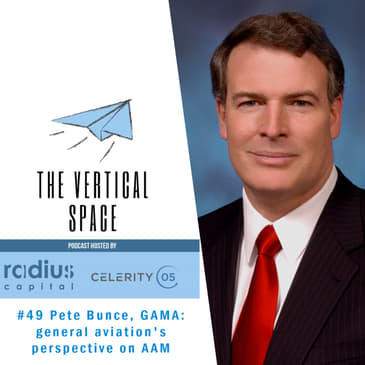
Blunt converation with Pete Bunce, President & CEO of the General Aviation Manufacturers Association (GAMA).
Pete combines a deep understanding of established aviation as well as advanced air mobility. He introduces competence, regulatory understanding, industry knowledge, and knowing how to get things done. Listen to Pete's vision of aviation and AAM - there's nothing superficial here.
As you will see time and again, Pete calls it as he sees it.
Pete is a great industry leader. Thanks Pete for joining us on The Vertical Space.
[00:00:00] Hello everyone and welcome to The Vertical Space, a podcast at the intersection of technology and flight. We are your hosts Jim Barry, Peter Shannon and Luka Tomljenovic and here we look at the most important forces shaping the market of advanced air mobility with a particular
[00:00:18] focus on why and how they matter to those building a business in this very exciting and growing industry. The whole nature by which we in aviation adopt new technology because we are so much programmed
[00:00:35] toward zero tolerance for error and that's not to say that we need to accept more risk on the commercial side. I mean it is a pretty good feeling that when you step onto an aircraft
[00:00:48] in the US or in Europe, you have the best probability of getting to where you're going safely than any other form of transportation that humankind has ever come up with. I mean that's a good feeling, we wouldn't want anything to disturb that but anytime that you introduce
[00:01:05] something new that has any type of risk, that risk has to be looked at and mitigated to the greatest extent possible and we're in just a new world and so the regulators don't move quickly in that environment not nearly as fast as the Congress or the industry
[00:01:23] would like them to. Hey everybody, welcome back to The Vertical Space and thanks again for all of your support. We hope you enjoyed our last podcast on the talk we gave at Honeywell's Advanced Air
[00:01:38] Mobility Summit in DC in July. So we heard today's guest Pete Bunce speak at that Honeywell Summit and as he always is, he was a standout and it's for those same reasons that we were delighted that Pete joined us on The Vertical Space. As most of you know,
[00:01:52] Pete is the president and CEO of Gamma, the General Aviation Manufacturers Association. So there's a number of reasons why you may find this podcast special. What stood out for me is that Pete is the perfect blend of a deep understanding of both established aviation
[00:02:06] with advanced durability, with a special combination of raw competence, regulatory understanding, industry knowledge, and knowing how to get things done. Listen to Pete's vision for the challenges, opportunities, practical realities of how advanced durability will be integrated into our traditional transportation infrastructure and the value we may realize
[00:02:25] after that integration. Listen, Pete is a national treasure and a great industry leader. Pete, thanks for joining us on the podcast and to our guests, enjoy our talk with Pete Bunce as you innovate in The Vertical Space. This episode of The Vertical Space podcast
[00:02:42] is brought to you by Uavionics. Uavionics is the leader in low size, weight, and power certified avionics for manned, unmanned, and advanced air mobility aircraft. Let Uavionics help you achieve your goals, whether that be type certification, airspace access, or beyond
[00:02:58] visual line of sight operations. Uavionics has certified and certifiable communications, navigation, and surveillance avionics for your aircraft. So head over to uavionics.com or Google it to see how you can start flying safer and move your platform forward into shared
[00:03:14] airspace. Pete Bunce is the president and CEO of the General Aviation Manufacturers Association. Pete joined Gamma in 2005. Gamma promotes general aviation and advances the interest of its global membership of more than 140 airframe, avionics, engine, and component manufacturers as well as the world's leading business aviation maintenance,
[00:03:40] repair, and overall companies. Pete served in the United States Air Force for 26 years and his last assignment prior to his retirement was as the director of the Air Force Congressional Budget Appropriations Liaison. Pete is an active pilot with more than 7,500
[00:03:55] hours in military fighter and trainer aircraft, as well as civil piston, turboprop, and business jet aircraft. He holds the FAA Air and Line Transport Certificate and Seaplane Rating. Pete is a member of the FAA's 13th member of Management Advisory Council.
[00:04:08] Additionally, Pete serves as both the FAA's Next-Gen Advisory Committee, MITRE Corporation Aviation Advisory Committee, and the NASA Advisory Council Aeronautics Committee. The living legends of aviation named Pete, the 2007 Aviation Industry Leader of the Year. In 2009,
[00:04:23] he was awarded the ICAST Sword of Excellence. In 2010, he was inducted into the 70 Living Legends of Aviation. In 2022, he was inducted into the Wisconsin Aviation Hall of Fame, and the National Aeronautical Association presented him with the McDonald Distinguished
[00:04:37] Statesmen of Aviation Award. Pete Bunce, it's a great honor to have you on the Vertical Space. Welcome. Well, thank you, Jim. I'm very glad to be here. So Pete, we asked the first question of all of our guests. Is there anything that very few in
[00:04:50] the industry agree with you on? I think it would be how you define very few. I think if you looked at general aviation and business aviation, we're pretty much in lockstep with all of our other sister associations and everything. Where I think we would get some
[00:05:08] great disagreement is all of my friends in the airline community about the role of technology in moving forward. It's been very disheartening to me that there is so much resistance to common sense use of technology as we move forward, automation,
[00:05:26] and you can't stop the march of technology. And there is a union position that is being taken that very much wants to disavow where technology can take us and what it can do for us. And if you
[00:05:45] look at current errors in the system, accidents, whether they're accidents, incidents, mishaps, a lot of the close calls that we're seeing that the FAA is focusing on right now, they're based on human error. And as much as I don't ever want to be replaced by a computer or
[00:06:05] robot flying an aircraft, the march of technology is what it is. And a lot of the arguments that you're hearing out of the airline community are just the same arguments they use when we went to
[00:06:15] four to three and three to two in the cockpit. And it just doesn't make sense, especially some of the negative comments that we saw in the advanced air mobility responses to the FAA's and PRM process from the airline unions that are just archaic in their thinking. And also,
[00:06:34] we're talking about trying to do a set of rulemaking that applies to aircraft that are four passenger to six passenger, everything. And for someone to think that those aircraft with being so highly automated require more than one pilot or require dual controls in the training
[00:06:56] is just an archaic way of doing things. And that's not where we've gone in the military. And it is, it's very frustrating. Pete, can you give us a few other examples of this archaic thinking about the potential of technology to improve aviation? Well, it's just like if we
[00:07:13] think about an ocean crossing, we've been working with the OS and a lot of our companies to be able to, instead of having to have an augmented crew up there when you're at crews and you can
[00:07:24] have a virtual co-pilot or you can have automation be able to help you out versus the very expensive cost without in my mind any safety benefit that you have to having to carry extra crews,
[00:07:39] especially when you're just droning along and talking on the radio, why we can't move in that direction is extremely frustrating. If we take the lesson from the past, you mentioned this initial resistance in decreasing the crew in the cockpit. How did industry ultimately win
[00:07:57] this argument? And how was able to change the minds of all of the skeptics around? And does that inform us about this new chapter in aviation? I think you just argue it on a safety
[00:08:11] case. And when you have an organization that is out there always claiming that they're the largest safety organization in the world, but then they don't at all acknowledge the safety that's brought by advanced technology, eventually that argument is just going to wear out. And people with
[00:08:31] common sense are going to look at it and say, no, that's not true. We can be safer if we employ more technology in the cockpit to be able to take care of a lot of the human error
[00:08:43] issues that come to rise out there. And I'm not saying that we're going to see large commercial aircraft probably in my professional career ever go to one pilot with a virtual co-pilot at the side, but there are definitely applications with smaller aircraft where we
[00:09:04] do a risk-based proportional approach to the rulemaking that would allow for at the appropriate point in time one pilot up front. Give us a little bit of your perspective on advanced term mobility. Well, we saw advanced term mobility coming when we actually worked the
[00:09:25] Small Aircraft Revitalization Act and we built into both part 23 and CS23 where there was tremendous cooperation between the FAA and ESA and several other authorities around the planet to be able to look at how we do small aircraft with the whole thought in mind that
[00:09:45] we would be able to capitalize on what we saw coming in this revolution and evolution in aviation with electric and hybrid propulsion. And so we built that in there and simultaneously we created at GAMA an associate membership category because up till that point the only
[00:10:08] way that you could be a member of GAMA is actually to have a certified product. And we thought that it would make sense not only for these entrepreneurial companies but also for our traditional aviation manufacturers that would be a part of this growing new segment of aviation
[00:10:28] to get them all together and have them work together like our traditional GAMA companies do. I've always been so impressed about when they get in a room all these competitors that compete very fiercely out in the marketplace all work to make to advance the industry and all
[00:10:47] boats rise at high tide and they really take that attitude and competitors are friends when they're in a GAMA meeting and we wanted to try to build that same ethos of camaraderie and cooperation with these new AM companies. So we created our what we call the Electric Propulsion
[00:11:05] Innovation Committee and I think we start off with about 16 members and now it's our largest committee and we have over 110 members of the committee and we allow the associate members you know they're required once they do get certified then to become a regular member
[00:11:24] but by getting them all to work together toward common purpose has been in my mind tremendous to be able to help this community along and to be able to speak with one voice as we go and
[00:11:38] work with the regulators which as you know are taking a different approach in Europe versus in the US and even within those regulatory schemes they've thrown us some curveballs in the last few years and we've had to deal with it as an industry as a whole but it's
[00:11:57] exciting for me to be able to see this evolution in aviation and as I always speak to what's happening right now this has to be what it was like during the dawn of the jet age when things were happening so quickly so many different designs coming out
[00:12:14] and you know just looking at technology and the potential for it is so exciting. So back at the let's say the dawn of the jet age do you think there was a general impression
[00:12:24] that people understood what the value of the jet would be we were even talking at a recent podcast when in fact we released today where the comments three of us made at the Honeywell Summit
[00:12:34] about a month ago and we mentioned that even when the airplane came about with the Wright brothers there was a question as to what do you do with this thing you know what's going
[00:12:41] to be the value of this thing they call an airplane is it your general impression there's a pretty solid understanding as to what the value of these that these 100 plus companies that you're part of your committee the value advanced term mobility is going to give to industry what's
[00:12:55] your general take on that. No I think that we're scratching the surface of people that actually know about it have actually looked into the potential and depending on who you talk to you know everybody's got a little bit of a different angle look about where this is
[00:13:13] is going to be a value proposition how the business case is going to close for a lot of these companies because you can take we originally called it urban air mobility and very quickly
[00:13:26] with some good advice from legislators up on Capitol Hill they said well what about rural America how do these aircraft support rural America and if you think about it you know with the cutback
[00:13:36] of essential air service to a lot of communities that have been affected very severely by the cutback in their services to be able to get to a hub to fly somewhere along range as we
[00:13:48] increase the range of these advanced air mobility vehicles you can think of scenarios where it really does help rural communities and then you think about eventually where we have vehicles sitting in the local firehouse whether it's a volunteer firehouse or a paid one that are pre-programmed
[00:14:06] to go to a trauma center or a burn center if somebody gets hurt with a nurse or a paramedic on board and they fly autonomously over to the burn center I mean this will change society if we
[00:14:18] as we proved in Iraq and Afghanistan if we get people in medical care within that golden hour after their injury we can save lives and so if we look at it from that perspective then
[00:14:31] then we go into the cities there's been a lot of conversation what happens when a local community starts to look at these vehicles for mass transit versus just people with means being able to pay
[00:14:44] whatever the the fee would be to avoid traffic jams and that that they're actually established routes that allow anybody to be able at a very affordable price to be able to travel
[00:14:57] with these like you would a bus or a metro line the potential is tremendous and then you go to the CETAL take short takeoff and landing type of vehicles and we're talking about doing some
[00:15:09] things with distributed propulsion that really make landing very very short distances so now our society has moved away from a lot of big malls some of the big malls are dying but there's a
[00:15:23] lot of asphalt and concrete there that could be used to have these very short takeoff and landing aircraft that can haul goods and services and that so again there's just so many tentacles and aspects of advanced air mobility that are exciting above and beyond just the urban air
[00:15:45] mobility piece and it's of course on the fixed wing side or I mean have a the traditional take the aviation type of platform there that looks like a business jet but she says two
[00:15:56] electric engines on the back of the aircraft you know you think about that in noise sensitive areas and or areas that really are are focusing heavily on sustainability footprints like up in the up in the Scandinavian countries for instance the potential is absolutely giant so I am extremely
[00:16:19] excited about all of these different aspects and trying to explain to people that is just not this one lone urban air mobility case that there's just so much more to it I think we're just
[00:16:34] scratching the surface of the public's understanding of it and the other part of it that people always ask is well will the public accept it and I think as these aircraft start to come
[00:16:46] into the airspace in the US and in Europe young people are flying these aircraft because they know that the regulatory bodies have a safety function out there and these these aircraft are safe and I
[00:16:58] think young people will adapt to it much more quickly than perhaps some older people but when we think about what we do every day when we go through any big airport right now we're jumping
[00:17:09] on trams that are totally autonomous and traveling at speeds that if it crashed people would get seriously hurt and we don't even think about it and and I think that's actually what will happen
[00:17:21] over time as we introduce these vehicles improve the safety case. Can we spend some time talking about general aviation broadly and if you don't mind taking us back to even the post world war
[00:17:33] two era and the rise in general aviation fleets and then the subsequent decline what were the underlying drivers of this evolution and how is it shifting today if at all? Well you know we come
[00:17:47] out of world war two and we've got you know this plethora of aviators that have very much saw the utility of flying and loved to be in the air but also you had all of this technology that was
[00:18:03] developed during world war two that was waiting to be unleashed in the civil sector so you saw a tremendous number of companies arise in the 50s and the 60s and then it was as we get into the
[00:18:19] 70s the amount of aircraft that were actually built and produced was just tremendous I mean I could only dream that our industry could produce that many aircraft now and maybe with these advanced air mobility machines we can get back to those types of production rates
[00:18:37] and that but you know what happened obviously as we got more into the 70s is the litigious society that we live in in the US and the US has always been since world war two the major market in
[00:18:51] the world because we have this incredible network of airfields across the entire nation that no country can even come close to replicating I mean we built these airfields every small community
[00:19:07] and we figured out that we could connect communities via air and we didn't you know we kind of sunset it in a lot of ways the railroad network obviously we still use it a lot for freight rail
[00:19:17] but a passenger rail network is just almost impossible to create cost effectively in this country now just because of land values and everything else you can't condemn property like they do in China and build high speed rail networks and so we have we have this great
[00:19:35] infrastructure out there but then all of a sudden in the in the litigiousness that we have in this country it really threatened this entire industry and that was how Gara came about the general aviation revitalization act and that was led by senator dole of no surprise from
[00:19:54] Kansas and being the home of the air capital of the world um Russ Meyer and senator dole worked very closely together to craft this legislation because Russ was very willing to get out of
[00:20:08] the light GA marketplace at that time because of the liability concerns that were out there Gara gamma working very closely with AOPA at that time was able to get Gara across the finish line
[00:20:20] and defeat the trial orders which was no small task whatsoever and and get it passed and that really did allow the the industry to continue albeit you know as we got into the late 70s
[00:20:34] and in the 80s with the great recession that we had at that time you know you think about the oil embargo years during the Carter administration and that the industry really took a big hit
[00:20:45] and then it's it's ebb and flowed and gradually recovered over over time but not to those levels that we had back in the 70s so um you know things have the marketplace goes up and down
[00:21:00] I think that we as an industry have done a much better job of taking a look at the ebb and flow of the economy and what it does to purchasing power for people to buy aircraft
[00:21:13] and right now we've done a better job than we have in my 18 and a half years at gamma being able not to build up so rapidly to meet demand that when there is a downturn we all of a sudden have
[00:21:26] massive layoffs and everything else has been a very logical way to build up the entire industry and at the same time we have some what I call governors on the industry which are
[00:21:37] supply chain and labor challenges that have also put a governor on keeping us from growing too rapidly and then obviously during a severe economic downturn we would have to go and lay off a lot
[00:21:51] of people so Pete in the US supply chain for aviation is as we look ahead to a a number of these vehicle platforms have the potential for scaling of production of the vehicles that is
[00:22:05] reminiscent of the type of scale that we saw in the middle of the 20th century but what are you hearing from manufacturers in terms of what we will need to build up what what parts of the
[00:22:16] US supply chain whether in propulsion or in aero structures or other areas that we will need to scale up in order to be able to to pull this off and have a really strong US industrial leadership
[00:22:31] in the space going forward it is a big challenge and especially if you look at you know we have a lot of the automotive industry that is being very supportive of this AM world that we're going
[00:22:45] to but we also our supply chain is somewhat different than the automotive supply chain now sure we use you know there's a lot of aluminum there's composites we use carbon fiber fabric
[00:22:57] things like that to be able to produce these aircraft most of them are going to be made of carbon fiber so there's going to be a big demand on that electrical engines are a new area that
[00:23:07] you know or electric motors really and a lot of our companies that are in the AM world are developing them themselves but also you have power generation that's happening from traditional manufacturers whether it's GU rolls Pratt, Huntingwell all of those companies are all very much into
[00:23:24] this space of being able to develop it will it put a great demand on the supply chain absolutely but with that are probably some very good things that hopefully the demand will be large enough
[00:23:37] to ease some of the ways that smaller suppliers can get into this especially if they can look at it and say okay I want to be an aerospace supplier I'm producing common parts for the AM vehicles
[00:23:52] but also if they are they're also providing common parts for business general aviation as long as commercial you know our ecosystem is relatively small obviously compared to automotive and that's the more that we can get small suppliers that are organic to the US our home
[00:24:12] grown suppliers into the whole marketplace and you know once they produce one widget for let's say the AM sector you know their capability especially when we look at robotics and some of the CNC machines
[00:24:28] that we have out there they can keep those machines running 24 hours a day providing parts for the rest of the industry so I see it as providing the demand out there that will allow
[00:24:40] people to invest in the supply side and that can only be a good thing well it will we strain the supply system initially probably but in the end I think we will be stronger for it because we
[00:24:53] just grow the pie and those that want to supply to the aerospace sector can get excited about the opportunity that they have out there to increase their their supply not only for the AM
[00:25:06] side but for business general aviation and car slave and military you know this dovetails with a lot of discussion in the country about bringing manufacturing back to the United States bringing that capacity and also capability do you see the hurdles as being cost and scale
[00:25:25] related or do you also see areas where the US has a deficiency in talent in the workforce working with new manufacturing technologies or where we need to catch up in terms of the technology
[00:25:41] itself and the capability to you know produce you know certain sub components at the same or superior level of quality versus what is available overseas today what are you seeing from your perspective from manufacturers in the supply chain around those hurdles well I think that quality
[00:26:00] is not an issue I mean when you look at what you get from a quality piece of equipment widget whatever you know if it's homegrown equality is generally good I think it's it's the size of labor force think about what happened during the pandemic you know we are
[00:26:17] as I said a very small ecosystem and in aviation and all of a sudden our commercial brethren were grounded they weren't flying at all well what does that do to a small company
[00:26:28] that's out there that had these very long term commitments with airbus or Boeing and all of a sudden the airlines just basically stopped buying things stopped doing repair work scheduled maintenance and things like that I mean everything ground on halt so a lot of these
[00:26:47] folks in the supply chain which are on the end of this gigantic whip just were were driven out of business and so now we've got to be able to reconstitute that with all of the
[00:26:58] demand that's out there and it is something that hopefully people can look at from an investment standpoint and say there is a pretty solid demand out there that I can feel comfortable to invest with now one of the other issues that obviously we're we're facing right now
[00:27:17] is the rising interest rates make money more expensive to procure for investment than it was you know three four years ago and so that does become a challenge but having that surety of demand out there I think can only be helpful to grow it so I think
[00:27:34] the cost of money is a challenge the labor force but when you look at the amount of automation that we're using in a lot of our manufacturing facilities right now and just what technology has been able to do to that sector you know if we can make the
[00:27:51] investments and we can find the labor that know how to work these machines it's a new ball game and that's why I'm very excited and we as GAM are very supportive of a lot of the programs in
[00:28:03] the trade sector where a lot of these community colleges are really being able to have some model programs that show young people how to be able to use these machines to be able to build
[00:28:16] the parts and pieces that we need in the industry and then there's apprentice programs out there that are pretty fascinating where our companies are paying them a good wage to be able to apprentice at the company but then also get their education on the sides in those trades
[00:28:33] and then later on as they become members of that company if they do desire to go get their college degrees companies are very willing to support that too because there's such an effort
[00:28:46] to be able to keep that labor that's homegrown so we see all of this coming together and then you add to it the educational programs that our sister association like AOPA is doing what
[00:28:58] we're trying to do with our design challenge and others to be able to bring to middle school junior high and high school and then tie it in with like what NASA does at the college level to be able
[00:29:10] to try to bring a workforce of the future into this industry to be able to provide all of that the goods and services that we will need. I recently came across an astonishing statistic
[00:29:22] that said that in OEMs liability insurance for each general aviation and aircraft manufacturing in the US rose from about $50 per airplane in the early 60s up to $100,000 per aircraft in the late 80s. This really had a chilling effect on the growth of the general aviation industry
[00:29:42] in the US. How do you see AAM potentially addressing this problem? Well we've had discussions with the insurance community first of all to let them understand this whole new sector and obviously we are having our challenges with just in business and general aviation now
[00:30:03] with insurance rates and and insurance rates have ebb and flow. The insurance industry will tell you that if you took normal inflationary factors into play were probably paying what we would
[00:30:16] have had increases happen at the rate of inflation from 20 years ago. With that said the rapid rise in insurance rates have really hurt the industry and we're obviously working with a lot of companies
[00:30:29] to be able to see what we can do about that having logical discounts for appropriate type of training in that. So the challenges in the AAM world is first to have the insurers understand what these aircraft are, who's operating them, the degree of automation,
[00:30:47] degree of redundancy and the degree of rigor that the FAA and other regulatory authorities are going to put on these aircraft just to be able to let them not only be certified but then
[00:31:01] operate and put that all into the cauldron to be able to work the issue. So I don't have any answers about right now of what we would see the rates are or they can answer with what we
[00:31:13] see on the business aviation front and that but I can just tell you that we're working with the insurance industries to try to understand the marketplace and understand these aircraft. Pete, talk a little bit about Gamma's comments to the FAA proposed as far.
[00:31:27] Well, as we all know when Administrator Dixon, while even I'll go back even further, when Administrator Huerta was at the head of the FAA and we passed the Smaller Car Revitalization Act, CERA, which passed unanimously in the House and Senate,
[00:31:43] which is one of the few things that's done that in my recent memory. There was great support by Administrator Huerta to be able to push this forward of looking at in the U.S. different
[00:31:55] ways to look at part 23 and then our plan was to certify all these vehicles that had any type of wing form on them and certify them with aircraft with special conditions that account for the fact that some of them would land and take off vertically.
[00:32:09] We went forward with that and Administrator Dixon kept that whole philosophy moving forward, but when he left, the FAA changed direction and decided to go with this powered lift category and what was striking to all of us is that there was rulemaking underway
[00:32:28] that actually had been given what's called a RIN number, a rulemaking indoctrination number I think is what it stands for. But anyway, that was all going in there to do away with powered lift because there was no category in the
[00:32:41] IKO about powered lift and it didn't make any sense. However, through the bureaucratic processes with the FAA, I think specialists that had certain rice bowls gotten ball and pushed for this powered lift category to not only stay put but then get expanded radically,
[00:33:01] which caused in my mind much more work for the FAA to be able to move forward because there are no operational rules available that are out there to allow powered lift aircraft into the airspace.
[00:33:14] So that really set the FAA on a path that they had to move rapidly to meet the commitments that the FAA also put forward, which was to have these aircraft introduced into the national airspace system at the beginning of 2025. Those that follow rulemaking know that the
[00:33:33] rulemaking system within FAA and Department of Transportation up to the White House is just broken because we placed a lot of attention to it as well as Congress has. There's been some good improvements that have happened recently and starting to look at rulemaking in a different way,
[00:33:51] but we all knew that it was a big task for the FAA to try to adopt this powered lift and be able to have the operational rules to get them into the airspace. So that's what this S-far is all about.
[00:34:04] And when it initially came out in its basic initial form that allowed us to comment on a few weeks ago, we had some great problems with it because we don't think it was well thought out.
[00:34:17] One of the big issues in that proposed S-far was the fact that to be able to qualify pilots, you'd have to have dual-controlled aircraft. And that's just, that's a stupid and archaic way
[00:34:31] of looking at it in this day and age without highly automated the arm. One of the things that we've been trying to do is get a lot of FAA people that are not pilots to be able to
[00:34:41] go and fly some of the simulators out there to figure out how or to be able to see and witness for stand how intuitive and simple they are to fly. They're just tremendously simple. And if we
[00:34:53] train people to be able to do many of the tasks that pilots do of talking on the radio, is being able to look for traffic, things like that, the actual flying part, stick and rudder skills as we would commonly refer to them as pilots. These aircraft,
[00:35:12] a lot of them don't have the same type of flight controls in the Ailerons elevator and rudder that we traditionally fly with. But to be able to require dual-controlled aircraft is just to me a ridiculous requirement that technologies move beyond that. And that's why an F-22 pilot
[00:35:31] or an F-35 pilot never see a dual-controlled aircraft. They do it in the sims and that's what we can do and these are far less complex than all the things that you have to do to fly a
[00:35:43] high-speed fighter like that. So that's one of them. Another big one is just how we certify simulators that we're going to use for this flight because if the certification requires rulemaking with as slow as rulemaking is there's just no way that we can achieve
[00:35:57] the objective of getting aircraft into the system in 2025. And the FAA recently doubled down on that commitment because the FAA came forward with their Innovate 2028 program and they publicized it and they talk about operations for the Olympics in 2028 at quote, at scale operations which means
[00:36:18] at scale means that we got these aircraft very prolific within the system into the National Airspace System which doubles down on the need to be able to get them into the airspace by 2025.
[00:36:32] So those are some big things. The other things are looking at energy reserves. We feel very strongly on the energy reserve topic that we've got a lot of ways to look at these aircraft a little bit differently on energy reserves than obviously we do with fixed-wing aircraft but
[00:36:49] also potentially with helicopters because of their ability to where they're going to fly and where they're able to put down if they do have a problem. So those areas are a lot of what we wanted to focus
[00:37:00] on some fire points on the operational rules also we wanted to touch on. So I'm encouraged, I'm very encouraged by the fact that David Bolter was named yesterday as the permanent head of safety of the FAA because I respect David a lot. I think that as an operator
[00:37:19] he's got the right way of looking at things. It's what worries me is just, you know, will the FAA have the resources to be able to adjudicate all the comments that went in and be able to go ahead
[00:37:32] and get the final rule out in time for us to be able to capitalize and get the aircraft in the system in 2025. So I'm looking forward to having dialogue within the rules that we
[00:37:43] have to when they get into rulemaking and exparte to be able to have at least have the FAA senior leadership listen to why we made the comments that we did so that hopefully when they get to the specialist level that the specialists can understand where this new
[00:38:00] technology is able to take us. Pete, can you unpack the energy reserves argument in a little bit more detail and also take both sides of this argument especially where your pilot had?
[00:38:10] Well, I think that when you look at energy reserves there's so many things that you can look at in electrical aviation. When you and I fly a regular aircraft let's just take a piston aircraft until the
[00:38:21] last gallon of gas until the last molecule of gas goes into the system we get the amount of power that we want out of it where with electrical aviation you're decreasing the level of energy
[00:38:34] throughout its course. But we will have guidelines of where you have to cut off and say that the aircraft is empty and you'll have fuel reserves on top of that. You know, think about aircraft especially in initial phases that are flying VFR to
[00:38:52] require them to have typical 30-minute reserve out there is just crazy and it's not needed. And we're hopeful that the FAA looks at this and looks at the capability of you know, you can put these aircrafts safely down in so many places even
[00:39:11] in an urban environment that you don't need those types of energy reserves especially on aircraft that are very sensitive to energy until we figure out you know the back to the future flux capacitor or whatever you know whatever comes on board we're hoping that battery technology and
[00:39:29] hybrid technology improves along but when you're doing this crawl walk run phase to initially be requiring aircraft to have these tremendous reserves is not the smart way to approach this. What is the right metric in your view that should define the reserve requirement if not the
[00:39:46] 30 minutes? Well it may not be a universal set standard it may be a vehicle by vehicle based on its technology and you know it's weight, its size those kind of things. So
[00:40:01] that's what we want to have a dialogue with the FAA about because it may not be one size fits all because these vehicles are so tremendously different and if it's an S-Tall or C-Tall
[00:40:13] versus a V-Tall aircraft there may be differences of what we want out there for electric and hybrid aviation. Also where we draw the line that the that the battery is at zero there is a capability
[00:40:27] that you can tap into a reserve within the battery that will harm the battery but if you had an emergency situation could you really access that energy in there knowing that you're going to
[00:40:40] have to replace all the batteries which obviously becomes a very costly endeavor those are things that we need to think about there as well but we just want to have flexibility with the regulators
[00:40:51] to be able to talk about energy reserves in a different way. How was the 30 minute for VFR flight reserve how was that born? I don't know I wish I knew but that one I don't know the
[00:41:03] answer to. Or what's the constituency that's pushing for the 30 minutes of reserve? Well I think it's what existed out there previously you know some people within the agency are picking fixed-wing rules some people are picking helicopter rules some people want to have a hybrid
[00:41:21] of both of them and some people want to look at them in a totally different way because we're not talking about fuel we're talking about electrical power or you know we're not talking about
[00:41:32] gas or jet fuel. Pete you made some really good comments stand out comments at the Honeywell second annual Advanced Air Mobility Conference could you just give us some of those highlights?
[00:41:43] Well yeah but I think you know getting back to the situation that the FAA has put us into as an industry it is incumbent upon the FAA to take care of what they the mess they created
[00:41:57] basically and if they do it smartly if they listen to industry if they understand the technology they can do it but if the forces of bureaucracy and this is the way we've always
[00:42:11] done it take root and take precedence then they're not going to be able to achieve their objective and they will have failed and so I think that's probably some of the strongest statements that
[00:42:24] that I made at the at the Honeywell forum is that they've got to be able to understand the technology and talk with industry because quite frankly you look at what's happened with the
[00:42:37] FAA right now they've had a tremendous brain drain over the last few years I can't understand when the president of the United States comes out and says these people need to come back to work
[00:42:47] and quit working from home and all of a sudden you have the unions balking at that that's just unconscionable to me these people need to be back in the office collaborating with one another understanding the technology to be able to move aviation forward. So Pete
[00:43:05] how would you describe the relationship between the general aviation and the drone communities and how has it evolved over the years? First of all we work very closely with the drone communities the GA groups I mean we've gone in several forms at the White House with the UAS
[00:43:24] community and you know the head of AUVSI Brian Wins a good friend of mine GA pilot very passionate Lisa Alman has had a small drone alliance and so we work together very often and
[00:43:36] speak on forums together. I think people make a big deal about the difference in how the BV lost the book beyond visual line of sight arc actually the report that was produced which was pretty much
[00:43:52] split between traditional man aviation and the UAS community and it was unfortunate at that time from my perspective that there just wasn't more time to arrive at consensus because what I feel is that the manned community especially general aviation and in particular the autograph community
[00:44:13] that use the airspace below 400 feet much more often than the then obviously the airlines do when they're landing or taking off that's the only time they're really spending much time down there but it's GA that that is affected with that airspace below 400 feet
[00:44:30] we very much support the drone industry being able to develop down there especially commercially what we would like because obviously we can't see the drones with a naked eye until they're right you're right upon them is an ability for the drones to be able to detect and avoid
[00:44:49] and that technology is moved rapidly as all technology does but in that sector there are some very cool solutions that are now being put on these machines and the technology is fascinating and the technology will benefit manned aviation so we're very supportive we work with the UAS
[00:45:12] community and what we want to see on the man side is we want to see integration into the airspace we don't want to see segregation and we don't want the onus being on the pilot that has to rely on
[00:45:27] visual contact to be the one that's responsible for keeping us safe down there and the technology is out there it is I'm understanding somewhat controversial within the federal government of whether the FA can share their surveillance data with UAS operators that are operating a
[00:45:47] UTM type of system and that's concerning to me and obviously we all know about the concern over drones as we watch the war with Ukraine and Russia unfold but at the same time to not share
[00:46:01] the surveillance data with these users down there I think is absolutely crazy that could really help inform them when they do have a manned aircraft that's descending to or from a small
[00:46:13] airport or a large airport and things like that that's one of the pieces that would help develop the UTM systems that are out there because there's also a misperception by some people even some of my friends in NACA that think that the controllers are going to be controlling
[00:46:30] the drones down the low altitude and that's just that's just not going to happen there's not enough controllers and there certainly is not enough capability in our system right now to deal with that many vehicles out there so we've got to rely on a UTM system that then
[00:46:47] interfaces with our normal air traffic management system and then by exception the normal system will inform the UTM operators of those systems when we have a manned aircraft down in that airspace that needs to be avoided do you think that the general aviation community should become
[00:47:09] electronically conspicuous to solve the drone industry's detecting avoid problem I think that there are low cost solutions to ADS-B that could be employed by GA but with that said down at
[00:47:26] low altitude is that going to be enough because of you know line of sight and everything else that you have and so I think that it's still with what we have seen out there in especially underneath
[00:47:42] the veil the ADS-B veil it's an easy problem to solve because we know by exception any aircraft that doesn't have ADS-B has to be authorized to fly in there by the FAA so that's a known
[00:47:54] player everybody else has ADS-B and it's relatively easy for the UAS to avoid that and that's really where a lot of the commercial activity is going to happen now more so in
[00:48:06] rural America and we care a lot about people that are doing crop dusting and the ag aviation community and things like that they're integrating with drone drones right now it's the ones that they aren't that particular contractor is not integrating with that can be the problem so are
[00:48:24] there onboard solutions that can accommodate both communities that's something we're all talking about right now low cost ones you know there's ADS-B available in a low cost version for sail planes and things like that is that enough to provide the detect and avoid capability for
[00:48:40] the drone to avoid the manned aircraft. Pete describe the the cool technologies that you're referring to with UTM yeah I mean NASA's done some great work on UTM they use it and really showing
[00:48:54] its capability in a lot of the TFRs that are out there the firefighting TFRs but onboard systems for the UAS is very sophisticated low cost LiDAR acoustical ways to avoid and then integration with a ground-based system that can be radar can be very sophisticated optical scanning
[00:49:19] type of systems but also then obviously ADS-B so there's a lot of solutions and it's not just one it's a combination that can be used for for these vehicles. But you're advocating some kind of a
[00:49:34] ground-based radar that would play a part wherever UTM is deployed. No no I would say that is one of the solutions but you know does ground-based radar cover cover you down really at low altitude again
[00:49:51] you have you have limitations down there at low altitude but you've got ADS-B in a lot of those cases where that the ADS-B may suffice enough for your detect and avoid but we would want where it's possible to have that surveillance picture shared with the UTM operators.
[00:50:12] Pete just play out a little bit for our guests we've had a couple people talk about UTM play off our guests how you see UTM being deployed and the interrelationship of the
[00:50:23] drones the GA and the it even get into ATM a little bit but how do you see five years from now for the interrelationship of the three? Well we will have systems that are developed now whether one
[00:50:36] system operating on a network of cell towers operates one proprietary system of drones or whether you have a contractor take for instance like like Embraer we all know that Embraer provides
[00:50:49] the entire ATM network for down there in Brazil if you had somebody like that that was making their services available to multiple companies that have you know are sharing the same type of platform
[00:51:04] to be able to communicate back and forth it may be one UTM provider in a certain amount of airspace that then has an interface with the traditional FAA air traffic control system
[00:51:17] there may be multiple players in the UTM space that communicate with one another so the number of different possibilities are quite varied but the important thing is that you know we're able to
[00:51:31] go ahead and make sure that we have separation that we use technology to be able to keep aircraft but we also have to always think in three dimensions it's too easy for people and I see this on the
[00:51:47] AAM side too they just think two dimensionally and then not thinking about the freedom that you have with that third dimension where you our problem is actually easier than it is for ground vehicles
[00:52:02] autonomous ground vehicles because you know we have that third dimension of a maneuver which opens up tremendous more possibilities to avoid any type of close calls what's a realistic path to integrating drones into the national airspace system and why is it that here we are in 2023
[00:52:22] and this problem still hasn't been solved I think it's probably the reluctance or the slow nature by which we in aviation adopt new technology because we are so much programmed toward zero tolerance for error and that's not to say that we need to
[00:52:46] accept more risk on the commercial side or anything I mean it is a pretty good feeling that when you step onto an aircraft in the US or in Europe you have the best probability of getting to
[00:52:59] where you're going safely than any other form of transportation the humankind has ever come up with I mean that's a good feeling we wouldn't want anything to disturb that but anytime that you
[00:53:11] introduce something new that has any type of risk that risk has to be looked at and mitigated to the greatest extent possible and we're in just a new world and so the regulators don't move
[00:53:25] quickly in that environment not nearly as fast as the congress or the industry would like them to and it's incumbent upon industry to bring the regulator along because we have you know we
[00:53:39] have the expertise so we've got to train this very new workforce that's at the FAA that is also working in a lot of extent in certain and flight sares working from home which makes it
[00:53:55] even more difficult to properly train them on this technology so I think those are probably the biggest delays or impediments that exist out there we recently had Dan Elwell on he talked about the FAA
[00:54:07] reauthorization what are your thoughts of course off if we if we take the house side right now the fact that both chairman graves and ranking member Larson are friends they came into congress
[00:54:20] together they serve on t and i but also on arm services together and from the get go said hey there's not going to be drama in this committee we're going to get our job done and we're going to do it on time
[00:54:33] that surprised everybody and surprised the administration the administration had talked to talked a big game about having a actually a reauth proposal which has been done for a long time well they didn't get it done and they didn't come forward with a reauth proposal but the house
[00:54:50] executed and executed very well to the to the extent that that vote when the committee marked up was unanimous I mean I had not seen that since actually since I came to game I I saw it um
[00:55:04] one center seen in center in way we're working together in appropriations back in my air force days but uh it is pretty remarkable what they did and when they got to the house for
[00:55:15] the vote was very strong I mean you had the fringes of either of both parties voting against it which probably means your legislation was pretty good and so that passed and it passed
[00:55:24] much faster than the senate or or the or the uh the administration ever expected so now the senate was all set to mark up their version and we were very happy with with what we knew
[00:55:39] of their version of the bill and what was to be marked up but in the end game we ended up having the controversy over the 15 hour hour rule and the slots at Reagan uh the 75 to or 65 to 67
[00:55:54] age discussions all come in there that and quite frankly I think now it's come down to a discussion between senator thune very senior on the commerce committee and senator schumer the majority
[00:56:07] leader in the senate over how that's to be resolved and it would be a shame in my mind for the country to not be able to get that resolved in a timely manner now I'm being realistic there's probably
[00:56:20] going to have to be an extension because obviously the authorization runs out the current authorization runs out at the end of fiscal year so 30 september next month so I would expect to
[00:56:30] see hopefully a short extension that culminates in in a senate bill that then can go to conference that we can get it get it over the goal line because there are some really strong things for the nation
[00:56:46] in the bills and there's at the same time you have real authorization you have the appropriations working so and what we're seeing on the appropriation side is strong support in both the house and the senate and their props markups toward aviation vis-a-vis some of the other modes
[00:57:03] of transportation and even with a very fiscally minded house right now real strong support and similarities between the bills on the appropriation side so but some of the things that we were
[00:57:15] pushing for at gamma at the macro sense in both bills is trying to fix the problem with rulemaking right now it's taken so long to get rules through the pipeline and I think I mentioned earlier that
[00:57:28] we are we have seen the f a make some changes in how they do rulemaking but we also want to strengthen just the overall management within the agency itself the fact that we have been without an
[00:57:43] f a administrator for a while we've had changes in the deputy administrator both political appointees we felt strongly and the house really pushed this forward in their bill to be able to
[00:57:54] establish a career individual as a deputy administrator for safety that is is there to provide that type of continuity they also chose to elevate the position of the head of rulemaking in the f a to an
[00:58:11] assistant administrator level which I think again is positive to raise the profile of rulemaking because it's not just rulemaking itself when we think of passing rules it's policy guidance those kind of things that go through a rulemaking process that that start to make it very difficult
[00:58:30] to get through and time consuming from a gamma perspective those areas become important as does aviation workforce within the f a to strengthen that to be able to give the f a as much personnel
[00:58:45] flexibility as they can to be able to hire especially engineering experts where their pay bans are competitive with other areas but then also to make federal programs for developing the workforce for aviation apply to manufacturers as well as maintenance organizations and pilots
[00:59:08] we think is a is a very strong strong message and of course in the house bill they reauthorize the NTSB and all of us in aviation are strong supporters of the great work that the NTSB does on the senate side
[00:59:22] if you look at their bill there is a lot of similarities with the house bill there they do have some variances on consumer protections for the airline experience and that which is somewhat controversial I understand with the with the commercial aviation side but
[00:59:42] I think their bill is very it's a symbiotic bill along with the house sign so we're very bullish on both of them we do have a GA title that Chairman Graves has pushed for on the house sign which obviously those of us in general business aviation are very
[01:00:02] supportive of what's really neat in this new area of aviation is the strong support that we have in both bills for technology for pushing advanced air mobility and for pushing the previous subject
[01:00:15] we were talking about UAS to be able to be entering the service so I'm very happy with those bills we just got to get over the goal line of what Senator Thun and Senator Schumer
[01:00:28] are talking about in regards to whether it's the 1500 hour rule which you know the political dynamics of that are very complicated because of the Colgan families that are supported by Alba being able to push for no changes whatsoever Senator Duckworth's firm position on on that
[01:00:46] issue as you saw on the house side some minor changes to the 1500 hour rule allowing more time for simulator training do not pass in the house as some of us would have hoped and I think
[01:01:01] it's just become a very emotional issue that people don't look at the common sense of logic being able to do simulator training where you're working hard those of us that have been through
[01:01:13] dial a disaster many times in the sim know that you can do things in the simulator that absolutely cannot do safely in the aircraft and that time in the simulator of working on emergencies and doing some very complex flying is better training than what you get
[01:01:34] drowning along on autopilot or what you would get in just burning holes in the sky as an young instructor pilot with no experience out there which I think is one of our one of
[01:01:46] the key issues we have to deal with as a nation when a young person goes and gets their ticket then they start to work on their commercial instrument and then they start to work on their
[01:01:55] instructor and there's and it's a very cook and cutter approach that some of our training academies rightfully so and they have no experience they're sitting in the right seat so it just feeds on itself of the lack of experience that the instructor is translating
[01:02:11] to the new student and we could be taking some of that time and using it more productively in working them hard on in the simulator to be able to get that experience. Dan Elwell advocated that all the 1500 hours could be done this simulator and come out
[01:02:27] to an advantaged outcome what would you change about the $1500 rule Pete if you could? Well I think just allowing more time to be logged in an appropriate level simulator than is currently out there would be would be a strong change and it could be incremental over time
[01:02:45] we would have to also look at what are you know a lot of people say well the airlines don't have more simulators available well we're not talking about the airlines we're talking about prior to
[01:02:55] getting to the airlines you know to building up to that 1500 hour rule and I think there are very sophisticated training capabilities that we have and we're only scratching the surface now because as we bring on virtual reality simulator training it starts to lower the cost of simulators
[01:03:13] and enhance the experience so there's some there's some really neat things that are happening with simulator technology now that all the big training providers are on board with and it'll only get better. We recently quizzed or set a survey out to our previous guests to give
[01:03:30] their opinion as to where we stand as a country as it relates to the regulatory and AAM versus the rest of the world what are your thoughts and how do you think we compare and where are we favorable
[01:03:42] and where could we catch up? Well back to my previous comments on rule making we are behind the Europeans right now in promulgating rules that deal with AAM and other areas like AI and
[01:03:58] things like that just because of the nature of how we interpret the administrative procedures act and how the FA moves forward and then obviously when Congress tells them to do something on rule making
[01:04:12] other things that they should have done then start to get pushed further down the chain so that puts us behind in the areas of AAM but now you take the other side of the coin
[01:04:25] of the approach if successful with what hopefully the FA does in the S-FAR to enable getting these vehicles into the airspace we have just such a tremendous advantage because we've got the
[01:04:40] largest most complex airspace on the planet and we know how to do this and you think an AAM aircraft if we use the crawl walk run analogy as we start to put them in into the airspace
[01:04:52] controllers are going to get comfortable with them we fly them in you know I describe it to people as a tube and the tubes flex you know if we're changing runways at a major airport
[01:05:03] tubes may turn around or go in a different direction so that we don't have any conflicts but once they get out of the inverted wedding cake out there and have freedom of movement
[01:05:15] within a class B or class C to be able to operate and go to let's say reliever airports our reliever airport infrastructure is so much more vast than any place else on the planet and
[01:05:27] that's where we it's easier to dig up soil and dig up asphalt to be able to install the electrical lines needed for recharge there than it is into a metropolitan area where you have to get on a much
[01:05:40] longer public utilities plan to be able to to lay down the lines that you would need so in my mind I think we're really going to see a greater utilization of a lot of our reliever airports and
[01:05:56] our public use airports that are out there in the near future and I'm very excited about that and you know take for instance Santa Monica you know it looked like you know we tried to make this
[01:06:06] argument when all the changes by the city council were being taken at Santa Monica and it looked like the airport was going to totally close and now I'm hearing positively that they're finally listening to the argument that hey with the advance of advanced air mobility
[01:06:24] Santa Monica may be a prime location where we can solve a lot of the the commuter issues that you find in the LA basin so I'm really encouraged by the way we we look at this incredible
[01:06:37] infrastructure that we have in the US and be able to think about how we can better utilize it for advanced air mobility. Pete what are you hearing from the general aviation manufacturers and community
[01:06:49] broadly that is top of mind for them whether they're most excited or concerned about? Well most excited about is continued growth of the industry we just released our Q2 numbers today and every segment is up which we're very excited about in a healthy manner concerns always
[01:07:09] exist with the economy will we ultimately are we going to be able to avoid recession workforce the availability of the workforce to be able to attract young people into our industry and you know we're working hard on obviously diversity in the workforce but also we one of
[01:07:31] the biggest things that has remained untapped is the number of females that we have in our workforce and it's just we've got to figure a way to appeal to young ladies early on in their
[01:07:45] educational profile to be able to say hey come to us be part of the solution the sustainability solutions that we're looking for and that so workforce is a big issue for us and then
[01:07:57] as we talked about earlier the ongoing supply chain issues that we have out there so those to me are the biggest challenges now in Europe our challenges accelerate when you look at just some
[01:08:09] of the craziness that you see there with trying to hurt business aviation and it's so short-sighted because business aviation well general and business aviation is the technology incubator for all of aviation we develop things in smaller aircraft that then proliferate up
[01:08:27] in the commercial aircraft one of our am companies the other day looked at how they're using wiring and have found a different way to use the wire strands to be able to move more electrons
[01:08:42] in a lighter weight capability and we all know weight is a big issue for all of aviation so things like that will proliferate across the industry and in Europe there's a tax going on daily toward business aviation and it's just going to hurt everybody sustainability journey
[01:09:02] if you disenfranchise business aviation so you know whether it's punitive taxes that they're they're putting on the industry bans at some airports like Skipple and others up in the Netherlands a lack of availability to get at sustainable aviation fuel or even to use
[01:09:20] book and claim the taxonomy issues over there in Europe that basically tells investment firms banks and that unless you have basically total electric aircraft you shouldn't invest in the industry those things are very very dangerous and so we're continuing to work with our colleagues and
[01:09:40] sister associations over in Europe to see what messages can appeal to the grass tops you're never going to change the mind of the crazies but to work with policymakers and that to be able to make them understand how important general business aviation is to sustainability
[01:09:58] solutions for all of aviation and try to drive home that point it's really our big challenge let's go to a kind of a bullet round if we could as we wrap it up next gen success
[01:10:09] yes or no what was its greatest accomplishment i think next gen if you look at it is there an end state to next gen for those of us that are working it for so long they never really
[01:10:21] was it was it was always evolutionary change of air traffic management system so if you look at adsb if you look at wake recategorization if you look at simultaneous approaches to runways the proliferation of gps-based approaches yes it's been a success has it been as fast
[01:10:44] as we all want to know are the procurement systems for the f a antiquated yes it's very difficult to acquire new systems i mean it just bothers me to know when that we aren't allowing adsb
[01:11:01] feed to some of our towers that don't have surveillance feed for some reason i don't understand there's pluses and minuses to this what i really think though that we have to do now
[01:11:15] is we have to think about what our air traffic control system is going to look like in the 2030s and the term that the f a is coin is the net centered nas and if we're going to a net centered
[01:11:28] nas when are we going to build our first center for the future it just drives me crazy that we have 20 plus centers around the country that we don't we don't need that many right now it's just
[01:11:43] intense infrastructure there that we have to devote facility and maintenance dollars to that we should be looking at what does what is the net centered center of the 2030s look like build one of them and maybe at one of the existing locations or a new location say
[01:12:03] that's a model okay how many do we really need out there and then what kind of redundancy do we have we're just scratching the surface on what we could do with the limited dollars that we have available
[01:12:16] what are the hurdles of scaling aam that most investors in public don't really realize that you behind the scenes better understand well the speed with which the regulatory bodies can
[01:12:31] be able to allow let's say our movement from day vfr tonight vfr than imc that could be an impediment depending upon how the regulators look at that and how we build up data to be able to provide
[01:12:47] the safety case i think how the business case closes for a lot of these companies will determine how quickly investors will want to jump in more you know how quickly these companies can start
[01:12:59] doing revenue flights because it's going to in a crawl walk run scenario it takes a while to be able to get the network developed with enough vehicles that you can start making money off of the proposal
[01:13:12] so there's there's a lot of variables that are unknown out there but i think there's such momentum built on this industry becoming a reality there and a lot of work now is going toward can we
[01:13:24] build batteries that have more power density that can service aviation that means that they're lightweight and you know some of the recent announcements toyota had one recently i'm curious to be able to
[01:13:39] learn more about what they're able to come up with but hopefully this momentum will build more producers of battery technology out there to want to get into the game you said revenue flights
[01:13:51] for the aam what about profitable flights there's a lot of people who say that they'll really only be profitable when we have full autonomy what are your thoughts on that and when do you think we'll
[01:14:00] have full autonomy i think autonomy will be incremental you know whisk maybe one of the first ones out there with the fully autonomous aircraft they're gonna they're gonna groundbreaking a lot of ways and depending on what type of flying that we're doing you know you look at
[01:14:17] reliable robotics right now working with a fully autonomous caravan type of flights in the cargo sector we most likely would probably see that first and may see it on traditional aircraft that are modified traditional aircraft that are modified with the capability to fly autonomously
[01:14:35] versus some of these new vehicles i don't know how that that's all going to develop but obviously the sooner that we can get to some of that autonomy the sooner the revenue case closes
[01:14:49] because we all know that pilots are not cheap right now and so this this industry will will develop first with the pilots and then we will be able to prove the technology and its capability and
[01:15:02] probably more in the cargo area first and then we'll gain the safety experience with that to be able to prove that we can do this with passengers on board p before we have a couple more closing
[01:15:15] questions who does peep bunts listen to in aviation and aerospace my board members and and i don't say that sucking up to them i say that because they are a tremendous amount just tremendous resource
[01:15:30] for me i mean these are the captains of the industry really smart people and then you know because i've got such great friends and the other g a associations and i would say overall all of all
[01:15:43] of the aviation industry i listen to the leaders in there we have just g a itself we're on a phone normally twice a week talking with each other we are all friends we socialize together but we
[01:15:56] learn from each other so those as long you've been a gamma who've been a couple callouts in the industry that you mentioned to our guest well my chairman have been mentors to me whether it's you know joe brown mark burns michael afetano
[01:16:14] Phil stroud i hate to not not bring any because there's been so many every one of my chairman i i've become personal friends with and learned so much from jack pelton one of him he was one
[01:16:28] of my first chairman when he was at sesna so each each one of those individuals because we work so closely and i rotate chairman every year i get the benefit of being able to see their leadership
[01:16:40] styles but also just tap into their intellect and it's been absolutely fantastic an entrepreneur walks up to you at a party and says i need to invent something in the advanced durability space
[01:16:53] where would you point them what advice would you give to him or her actually if if they have already formed a company i would say be an associate member of of gamma and not because i
[01:17:07] i need more members is because that's where they'll get exposure to the industry and how to learn what the latest you know thinking is of this this new exciting part of aviation is and what
[01:17:22] the needs are and that's really how we get you know other than the traditional or other traditional is not the right term but other than the oems the airframe manufacturers we have so many members
[01:17:34] that have had joined in the associate category whether they're on battery technology or parachutes or you know you name it new types of avionics and that they want to be part of it to learn
[01:17:48] what the requirements are out there so you know you take a forward thinker like mark van tine who ran jeppson for many years and you you look at you know he came to apple and said i think
[01:18:01] we can take all of these reams and reams of papers that we provide pilots on a routine basis that they have to plug and play into their charts and everything i think we can all do it on an
[01:18:11] ipad and look at how you revolutionized aviation and it's just phenomenal and i'm very lucky to call him my closest friend and to be able to to take people like that that have an idea or tyson
[01:18:25] wise or daniel baker you know whether it's for flight or it's flight aware and create what they did you know we have that type of talent out there and that's why i always get so jazzed about
[01:18:39] the job that i have that's great this has been terrific again it's an honor that you're on the podcast is there anything else you'd like to leave with our guests i think just spreading the word about
[01:18:49] the excitement that there is in their industry i end this industry and one of the reasons that we all love it so much is because we love the people and i can't think of a more rewarding industry
[01:19:00] that you could be a part of you know one not as a man if representing manufacturers we make things that's cool but all of us that can share in the freedom of flight and to enjoy this new
[01:19:12] era of technology that's that's coming on board this is exciting stuff and it's going to change the world and we want young people to be a part of it so if i could ask anybody do anything it's just
[01:19:24] encourage young people and parents to be able to say hey look at aerospace and encourage the younger generation to be a part of it you're an inspiring guy great leader in this industry
[01:19:36] and a great american thanks p i appreciate it and all you guys thanks for what you do and thanks for helping us get the word out to the wider community because we have a lot of
[01:19:48] education to do to the entire planet actually on on what can happen here in the next few years and now if you can help us share the excitement that is greatly appreciate great thank you thank you guys
[01:20:06] all right that's a wrap for today thank you for listening to the vertical space podcast reach out if there are topics that you would like us to discuss and goodbye until the next episode
[01:20:16] unless mentioned this podcast is in no way endorsing or promoting any person and or company mentioned in all opinions within the podcast are solely that of the presenters the vertical space makes no guarantees warranty or representation of any information given in this podcast any
[01:20:33] information given is for informational purposes and should be used at your own risk this podcast is for general educational and entertainment purposes only